
 This is the 13th article in a special series by Ally Adnan that brings to life memorable incidents from the rich and fascinating life of Hazrat Amir Khusrau, whose timeless legacy continues to inspire the world.
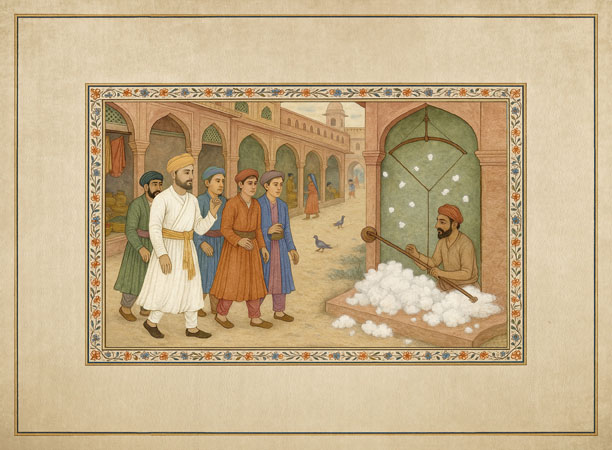
One day, Amir Khusrau and his disciples were walking through a market in Delhi when they heard a peculiar sound that was repeating in perfect rhythm.
They were fascinated by the sound and traced it to a small shop where a dhuniya (cotton carder) was carding cotton using a dhunki (a bow-like tool used to card cotton). Captivated by the repetitive, twanging sound, they stood outside the shop, enjoying its rhythm for a long time. One of the disciples asked Amir Khusrau, “Can music be made from this sound?” Khusrau smiled and replied, “Not only music, but poetry,” and right then and there, composed a rhythmic Persian verse that imitated the sound of the dhunki. Amir Khusrau set the poem as a paran (pakhavaj-style composition) in the 16-beat Farsi Teen Taal, fitting it perfectly into its four vibhaag (groupings of beats in a taal).
The poem echoed the twanging rhythm of the dhunki and expressed the profound Sufi themes of the annihilation of the self in love, the transient nature of worldly attachments and the inevitability of loss. Its cadence of repetition emphasised that both the self and all that is cherished must ultimately be surrendered on the path of true love. The poem demonstrated Khusrau’s poetic and musical genius and his rare gift for blending the ordinary with the mystical, showing that music, poetry and truth can be found everywhere, even in the work of a humble dhuniya.
The writer lives in Dallas, Texas and writes about culture, history and the arts. He tweets @allyadnanjanjua and can be reached at [email protected]