 There is a famous saying that we won half the battle in the 1965 war through the power of our national songs written by famous poets Rais Amrohvi, Kaleem Usmani , Saif fuddin saif and Jameel ud din Aali and sung by Malika Taranum Noor Jahan, Nasim Begum and Mehdi Hassan. Carried through the airwaves by radio, these stirring melodies resonated in the hearts of the people, igniting a sense of unity and patriotism. Decades later, the magic of those anthems still lingers, with their tunes continuing to inspire and move listeners.
Today, however, the greatest battle confronting humanity is against the looming threat of climate change. This fight cannot be won by scientists, researchers, and environmentalists alone — it demands the collective voice of artists, poets, writers, playwrights, and actors. Their creativity has the power to awaken public consciousness and drive action.
This is why, at literature festivals and book fairs, discussions about the environment, global warming, and climate change are no longer sidelined — they are taking center stage. The Gwadar Book Festival 2025 was a shining example, uniting climate narratives with cultural expression under the powerful theme of climate change.
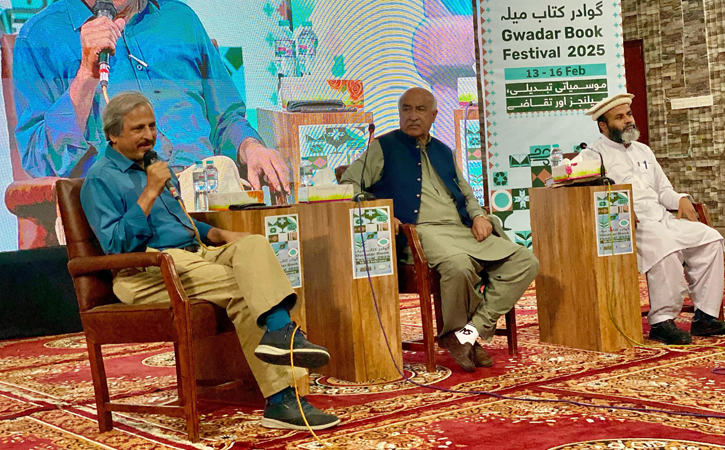
The Gwadar Book Festival (GBF) 2025, organized by the Rural Community Development Council (RCDC), marked a remarkable milestone as it celebrated its 10th edition with the theme of “Climate Change Impact, Planning, and Mitigation.” Held in the coastal city of Gwadar, this multisector event brought together intellectuals, experts, writers, poets, climate researchers, media, and resource persons from across Pakistan to engage in meaningful discussions on the urgent challenges posed by climate change, particularly in the context of Balochistan. This year’s festival not only highlighted environmental concerns but also offered a platform for cultural expression, reflecting the diversity of thought, creativity, and innovation present in Pakistan.
Nasir Rahim Sohrabi, president of RCDC said that “the 2025 edition of the Gwadar Book Festival was far more than just a literary gathering. It transformed into a vibrant cultural and intellectual celebration, with a series of engaging activities designed to both entertain and educate. The festival featured an array of debates, storytelling sessions, poetry recitals, stage dramas, and a series of short documentary competitions that captured the imagination of the audience while raising awareness about critical issues like climate change.”
An important highlight was the photography and painting exhibitions, which allowed visitors to engage with visual art that reflected the environment, the culture of Balochistan, and the ongoing struggles of local communities. These exhibitions gave artists a platform to showcase their interpretations of climate change, as well as the beauty and fragility of Balochistan’s ecosystems.
Manzoor Ahmad, vice chancellor of university of Gwadar talked about Gwadar Book Festival that ”one of the most significant achievements of the festival was the launch of over one million Balochi language books. This initiative not only aimed to preserve and promote the language but also emphasized the importance of cultural identity in the face of global challenges. The festival also witnessed record-breaking book sales, totaling an impressive 2.8 million Pakistani Rupees, reflecting the widespread demand for literature that informs and educates the public. These figures were particularly significant as they illustrated how deeply invested the local and national communities are in both the intellectual and cultural development of the region.”
The thematic focus of GBF 2025 centered on the alarming issue of climate change, particularly in the context of Balochistan, a region that is uniquely vulnerable to the environmental changes taking place across Pakistan. The discussions at the festival delved deeply into how climate change is impacting the region’s various ecosystems, including marine and coastal ecosystems, urban environments, wildlife, forests, and even underwater marine life. The speakers highlighted how Balochistan’s fragile ecosystems are bearing the brunt of rising sea levels, temperature fluctuations, and unpredictable weather patterns.
Climate change in Balochistan threatens not only the environment but also the socio-economic fabric of the province. The increased frequency of droughts, shifts in rainfall patterns, and the decline of natural resources directly affect local communities whose livelihoods depend on agriculture, fisheries, and pastoralism. The speakers underscored the urgency of addressing these issues through strategic planning and coordinated efforts from both governmental and non-governmental organizations.
One of the fascinating natural wonders that came to light during the festival was the distinctive geological features of Balochistan’s coastline, particularly the rough clay mountains and the stunning mountain formations found in coastal areas such as Hingol National Park, Gwadar, Gunz Jiwani, Pasni, and Ormara. These mountains, sculpted by the forces of weathering and rain, present striking, surreal structures, some of which are named the “Princes of Hope ” and other formations that evoke images of civilization’s ancient milestones.
The clay mountains in these coastal areas have been formed over centuries by the continuous erosion and weathering processes brought on by rain, wind, and the shifting of tectonic plates. Their unique, jagged shapes tell the story of millions of years of geological activity, making them not only a natural wonder but also a testament to the history of the region’s landscape.
However, these beautiful and historic clay mountains are now facing significant erosion due to the impacts of climate change. Rising temperatures, erratic rainfall patterns, and increased flooding are accelerating the breakdown of these clay formations, which are sensitive to moisture and extreme weather events. As the landscape continues to erode, the very essence of these striking mountain structures may be lost, representing a tragic loss not just for the natural environment but also for the cultural and geological heritage of the region.
The coastal areas of Balochistan, including Hingol National Park and Ormara, are known for their rich biodiversity and geological formations. These mountains have long been a source of pride for the local communities. These mountains have stood as silent witnesses to the passage of time, but now, their vulnerability to the changing climate is becoming more apparent, and it is crucial to act to prevent further damage.
Throughout the festival, experts shared their knowledge and insights on practical solutions to mitigate the effects of climate change, particularly in Balochistan. These experts emphasized the necessity of integrated climate change adaptation strategies, including sustainable agricultural practices, better water management systems, and restoration efforts for degraded lands. They also discussed the importance of developing climate-resilient urban infrastructure to protect communities from the adverse impacts of extreme weather events.
One major area of focus was the protection and restoration of natural ecosystems, particularly forests and marine life. The experts recommended a collaborative approach to reforestation, wetland conservation, and the sustainable management of marine resources. They also highlighted the need for a national framework that prioritizes climate resilience in all areas of development, from policy formulation to grassroots action.
The role of education and community engagement was a key topic during the discussions. It was emphasized that local communities, particularly in Balochistan, must be empowered to not only understand the impacts of climate change but also to become active participants in the planning and execution of adaptation and mitigation strategies. Ensuring that future generations are well-versed in environmental issues is essential to creating a more sustainable future.
The GBF 2025 was not just a celebration of literature and culture; it was an inclusive platform that provided a space for dialogue on some of the most pressing challenges facing Pakistan and the world. The festival allowed for the intersection of scientific research, artistic expression, and grassroots activism, which proved to be a powerful tool in raising awareness about climate change.
By bringing together intellectuals, activists, artists, and environmental experts, local indigenous people, the festival fostered a comprehensive dialogue about climate change and its many facets. From urban planning to conservation, the discussions explored a variety of angles to help identify solutions that could be implemented at local, regional, and national levels. The festival’s diverse programming ensured that participants from all walks of life were able to engage with these crucial issues, from students to seasoned professionals.
One of the most profound aspects of the Gwadar Book Festival 2025 was its ability to simultaneously address two vital concerns climate change and the preservation of cultural heritage. By highlighting the beauty and significance of Balochistan’s culture and language, while also addressing the pressing environmental challenges, the event captured the essence of what is at stake for the people and the planet.
The festival showcased the resilience of the people of Balochistan, their deep connection to the land, and their commitment to protecting it for future generations. It highlighted how cultural identity and environmental preservation go hand in hand, with each reinforcing the other. As the festival came to a close, the collective sense of purpose among the participants was palpable, and the discussions offered hope for a future in which cultural richness and environmental sustainability are mutually reinforcing.
In conclusion, the Gwadar Book Festival 2025 was an outstanding success. It not only provided a space for intellectual debate but also celebrated the cultural and artistic achievements of Pakistan. The event’s focus on climate change, particularly in Balochistan, underscored the urgency of taking collective action to address the environmental crisis. As the festival continues to grow, it stands as a beacon of hope, reminding us that the future of our planet and its cultural heritage depend on the choices we make today.