

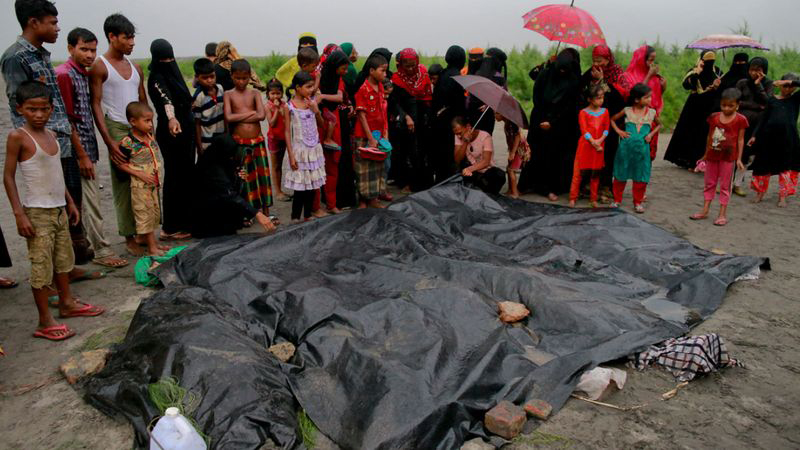
A crime against humanity is taking place. Rohingya, an ethnic Muslim minority, mostly habited for centuries in the Rakhine State of Myanmar (formerly Burma) faces systematic prosecution at the hands of the Myanmar army and Buddhist monks. In recent violence, over 2,600 houses of the poor Rohingya minority were set on fire, forcing them to leave the country with nowhere to go. In recent violence over 400 Rohingya’s were killed. According to the UN, at least 270,000 refugees took shelter in neighbouring Bangladesh and some flew to India but risk facing deportation.
Rakhine was an independent State but was captured by Burma in 1784. In 1824 the British annexed it and the State became a part of British India. When the British left in 1948 from Burma, Rakhine remained part of it. Today, the Rohingya constitute 1.1 million population in Myanmar but they are not recognised as a minority group and face systemic persecution in State legislatures. Around 2 million Rohingya fled other countries in the world since 1978. Rohingyas are the “single largest stateless community in the world”. The violence against the Rohingyas might radicalise them like the Mindonao minority Muslims group in Southern Philippines or the Kashmiris in Jammu Kashmir.
The Taliban-Daesh could capture this ‘opportunity’ and the situation from Rakhine to Kashmir could become perilous
Implications for India
Additionally, the Taliban-Daesh could capture this “opportunity” and the situation from Rakhine to Kashmir would become perilous. Prime Minister Narendra Modi should have thought of this before visiting Yangon after the BRICS Summit and giving advice to the Myanmar Government. His silence on the Rohingya community could backfire in the future, creating a much larger human crisis of Muslims from Rakhine State to the Indian Occupied State of Kashmir.
Modi looks happy that his Shiv Sinha’s Hindutva has come true to Myanmar in the form of military-junta and Buddhist monks with the same purpose of prosecuting the minority Muslims. This Hindu-Buddhist radicalism would invite radical Islam too, disturbing the harmony in South East Asia, which had largely been kept apart from radicalism
A new emerging islamic radical trend
The Indian and Bangladeshi anti-Rohingya move would internationalize the issue and invite Islamic militants to help their fellow Rohingyas. Some estimates show that there already exist Rohingya terrorist groups with links to other terrorists groups outside Myanmar.
This crisis is in the making. The Rakhine States might become a “Frontline” for Islamic militants from Pakistan, Afghanistan, Iraq, Syria, Egypt, and Turkey. Radical Islamic outfits such as Daesh, ISIL, Taliban, Al-Qaeda offshoots, IMU, ETIM could join hands with the Rohingya cause. And create an ugle scenario. Muslims from neighbouring Thailand, Malaysia, Indonesia, and Mindonao in the Philippines, besides several other outfits, might use Rakhine as a new frontier. This would become a new battle-ground for Islamic militants versus Buddhist radicals supported by Hindu fanatics.
Demonstrations all over Pakistan on September 8 demonstrated this new emerging trend where criticism was directed against the Myanmar Government and in support of the Rohingyas. If their prosecution goes on, this trend might emerge more rapidly. If Rohingyas can reach Pakistan, there might accrue a dramatic shift and many terrorist organisations may recruit them and use them against Myanmar, India, and Afghanistan. New Jihadi recruits are always needed by such organisations. A new wave of terrorism might seep the region.
The Nobel Laureate
The silent approach of Aung San Suu Kyi has been forcing many to revert the Nobel Peace Prize accorded to her as she failed to raise her voice for Rohingyas, probably fearing threats from the army and the Buddhist monks — a country ruled by them. Her role has been termed as ignoramus for not protecting the ethic minority.
Aung Suu has related the Rohingya situation with the Indian Muslim minority problem. She says: “because [there is] a larger Muslim community in India and in places like Kashmir, [India] had this trouble of sorting out the terrorists from the innocent citizens and all those who are not involved in the terrorist movement at all. We have the same problem.” Her message has sent a negative signal to Muslims all over the world and Islamists could take action. Malala Yousafzai, the youngest winner of the Nobel peace prize, has called on the fellow laureate to speak out against the persecution of Rohingyas.
The Rohingya issue is a left-over of World War II and an unfinished agenda since 1948 but it is a pure humanitarian issue and should be considered as such. Genocide by the Myanmar Government should be ended immediately and placed before the international community for resolution and justice. It must be decided if Rohingyas were given all legal rights in Myanmar and they form a separate State. Terrorist organisations should not be allowed to use the issue to enhance their terror motives. Moreover, The global community must prevent this on-going ethic genocide.
The writer is Director of the China-Pakistan Study Center at the Institute of Strategic Studies Islamabad. He writes on East Asian affairs