

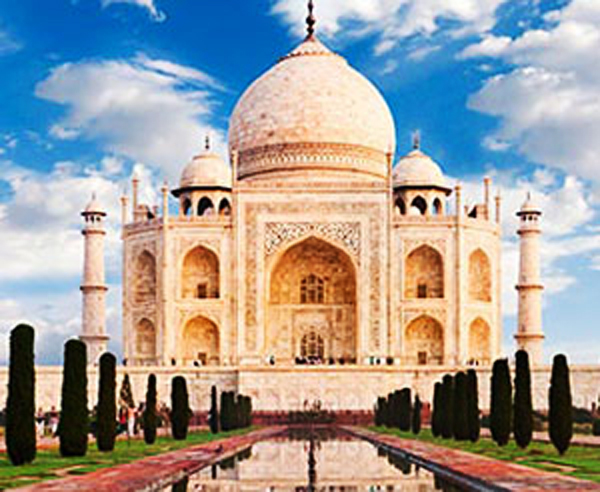
The recent tourism booklet published in India’s Uttar Pradesh province excludes the iconic Taj Mahal from its sites to visit in the province. Although on the surface, this omission seems innocuous or a simple mistake, it comes six months after the right wing Hindu nationalist Yogi Adityanath’s accession as UP’s Prime Minister — a man who claimed the Taj Mahal ‘did not reflect Indian culture’. This depicts something more sinister is at play.
Since Narendra Modi’s rise in 2014 to the pinnacle of political power in India, Indian society has increasingly become victim to a highly toxic strand of Hindu nationalism. This nationalist and xenophobic sentiment rests on championing India as a nation of Hindus, one which stands united in its worship of the cow and in pursuing a neoliberal agenda of economic reforms.
This myopic view of India’s religious, social and political diversity naturally excludes Muslims and other minorities such as the Dalits, and is best characterised by Yogi Adityanath’s selection as Chief Minister of India’s most populous state.
This exclusion also places a strong emphasis on India’s global image and historical past — which is where the UP CM’s exclusion of the Taj Mahal becomes instrumental in perpetuating the BJP’s nationalist Hindu dominated version of India.
By claiming that Taj Mahal does not ‘reflect Indian culture’, Yogi Adityanath is in fact claiming that the Mughal period in India’s history — and by extension the dominant role Muslims play in Indian society — does not exist
National icons and symbols such as the Taj Mahal form essential elements of a country’s identity and culture. By claiming the Taj Mahal does not ‘reflect Indian culture’, Yogi Adityanath is in fact claiming that the Mughal period in India’s history — and by extension the dominant role Muslims play in Indian society — does not exist.
This claim, in turn, stems from the narrative that Muslims were in fact always outsiders to the land of the Hindus, and only cemented their place in India through conquest. This narrative is not only false, but was also extensively used by both Muslims and Hindus in the partition struggle. This narrative also partly formed the basis of the Two Nation Theory.
Thus, by excluding the Taj Mahal from UP’s cultural heritage, Yogi Adityanath is in fact aiming to rewrite India’s history in a way that depicts India as a land belonging only to Hindus. Moreover, by shaping the country’s history, Modi and Co will then be able to mould Indian society according to their nationalist and anti-Muslim views, further flaming ethnic and religious tensions in the soon to be world’s most populous country.
The sharp contrast between a Hindu-led India and a Muslim led-India in fact, owes its existence to our colonial heritage and background. In his book, Colonialism and its Forms of Knowledge, Bernard Cohn argues that a codification of Indian history and knowledge was essential to the British establishing control over the sub-continent.
This codification placed a strong emphasis on dividing Indian history into segments — a segment of Muslim rule, and a segment of Hindu rule. This characterisation ignored the diverse basis of Indian politics, and instead painted the decentralised and multi-dimensional rule of the Mughals as simply a period of ‘Muslim domination’ — a characterisation many of us continue to adhere to today.
The British’s categorisation and polarisation of Indian society between Hindu and Muslim, in turn, came to dominate Indian politics and society under British rule, eventually culminating in the struggle for partition and independence. Throughout the partition struggle, both Muslims and Hindus resorted to this distinction between Hindus and Muslims.
The BJP’s emphasis on Hindu nationalism, therefore, is an extension of the differences colonialism percolated in India. The BJP places its agenda on the idea that India has always belonged to Hindus, who were and continue to remain a distinct community from Muslims in India.
The UP government’s campaign against the Taj Mahal highlights how ethnic groups aim to artificially create a sense of nationality. This artificial nationality, historian and political scientist Benedict Anderson argues, forms the basis of ‘imagined communities’ — or nation states.
This artificial sense of nationality relies on manipulating national culture, history and imagery — something the BJP is undertaking with its project of making India a land exclusively for the Hindus. The BJP’s emphasis on ignoring the Taj Mahal, and by extension the role of the Muslims in Indian history, is a prime example of Anderson’s theory of how communities construct nationalism artificially. In BJP’s case, this sense of nationalism relies on artificially excluding Muslims from India, and perpetuating an image of India represented by Hindu culture, Hindu history, and Hindu religion.
The UP government’s removal of the Taj Mahal from its tourism brochure should not, therefore, be seen simply as a mere omission. It is a calculated step aimed at removing Muslims from India’s history and culture, and at further polarising a nation that has become increasingly victim to religious divide.
Exclusion along religious and ethnic lines, however, is not solely limited to India. Most countries in the world exercise some form of exclusion — with Myanmar’s systematic cleansing of the Rohingya being an extreme and highly poignant example.
This exclusion is also evident in Pakistan, with our proclivity to shame the Pakhtun community and to castigate Afghan refugees for bringing the ‘gun and drugs’ culture to Pakistan — a claim that is simply not true — serving as cases in point.
Critiquing India’s increasingly Hindu nationalist ideology, must therefore, be followed by ensuring we do not perpetuate similar beliefs that rest on religious and ethnic exclusion.
The writer graduated from Aitchison College and Cornell University, USA. He also studied at Oxford University, and his interests include the politics of class, gender and race. He can be reached at [email protected]
Published in Daily Times, October 6th 2017.