Europeans are opening their energy bills with trepidation these days, bracing for hefty price hikes as utility companies pass on the surging cost of natural gas, oil and electricity tied to Russia’s war in Ukraine. Many are trying to conserve by turning down the heat and shutting off lights this winter.
Not so the people of Feldheim, population 130.
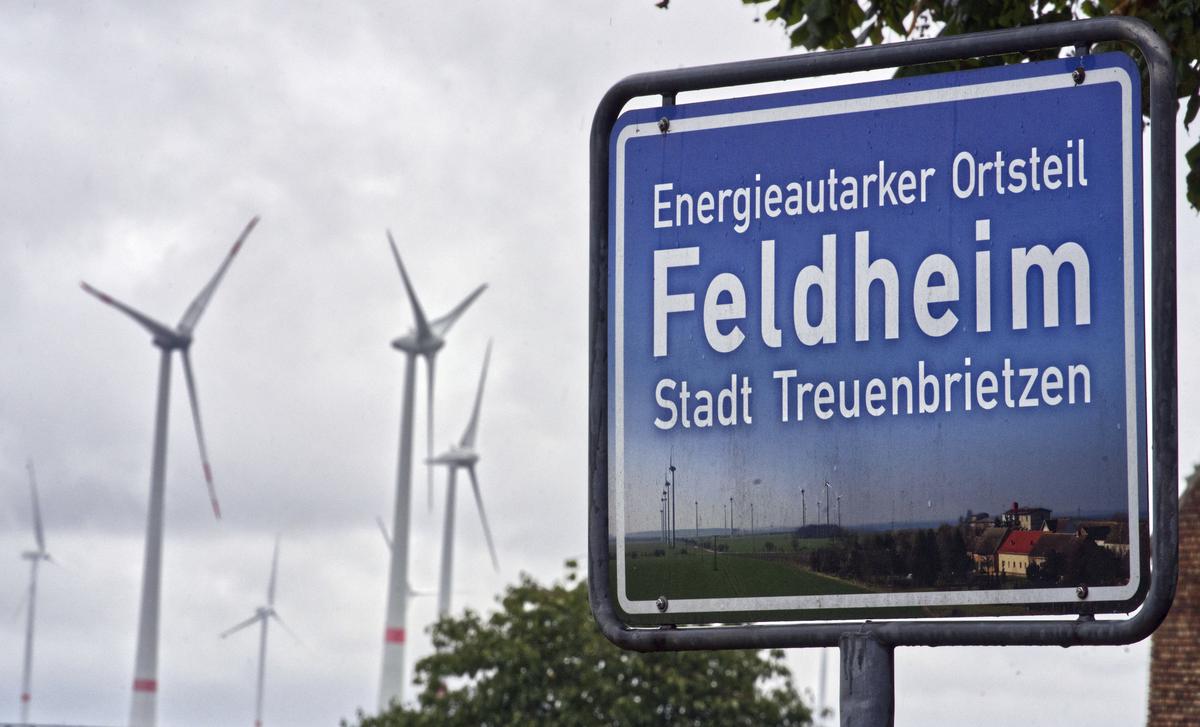
Located about an hour and a half south of Berlin, this modest but well-kept village has been energy self-sufficient for more than a decade.
A bold experiment launched in the mid-1990s saw Feldheim erect a handful of wind turbines to provide electricity to the village. Then it built a local grid, solar panels, battery storage and more turbines. A biogas plant put up to keep piglets warm was expanded, providing extra income to the farmers’ cooperative, which pumps hot water through a village-wide central heating system. A hydrogen production facility is also under construction.
Now, 55 wind turbines can be seen but not heard on the sloping farmlands around Feldheim and residents enjoy some of the cheapest electricity and natural gas rates in Germany.
“They can all sleep well at night,” says Kathleen Thompson, who works for a local educational organization, the New Energies Forum. “They’ve got no concerns because the prices are not going to change, not in the immediate future anyway.”
Feldheim’s hands-on approach to producing its own eco-friendly energy draws thousands of visitors from around the world each year and contrasts with the way Germany as a whole still relies on fossil fuel imports for much of its needs.
That became painfully apparent when Russia invaded Ukraine, upending the reliance Germany and other European countries had on Moscow’s coal, oil and natural gas.
Despite Germany pumping billions into the growth of renewable energy to reduce climate-changing emissions, fossil fuels and nuclear were responsible for more than half of the country’s gross power production in the first six months of the year.
A lack of sufficient transmission capacity means wind parks in the north regularly have to be shut down while fossil fuel plants are fired up to provide electricity to factories in the south.
Letting locals participate in — and benefit from — the project was key to Feldheim’s success, said Michael Knape, mayor of Treuenbrietzen, a municipality to which Feldheim belongs.
While wind parks elsewhere in Germany often face opposition, including some economically depressed neighboring villages, Feldheim’s close-knit community approved so many turbines that it actually exports about 250 times as much electricity as it consumes.
“Citizens need to feel that it’s their transition and not one imposed from above,” Knape said.
But he also credits authorities at the time with not interfering in what he describes as an “experiment” that could have failed. It fell into a legal gray area that officials elsewhere might have clamped down on.
“In Germany, you sometimes get the impression that if someone makes a mistake then it’s a huge problem,” Knape said. “But it’s only in that way that we make progress.”
Feldheim’s grassroots approach to generating clean energy contrasts starkly with the prevailing practice in Germany, where large energy companies tend to build and control vast power projects. Small-scale efforts, meanwhile, often face high regulatory hurdles.
Still, Knape is hopeful that Germany’s energy transition can catch up with Feldheim.
“I’m firmly convinced that given the current pressure in Europe … it’s become clear to everyone that we need to approach this differently than before,” he said.
While Feldheim’s approach can’t be copied everywhere, such projects can be a big part of the solution, Knape said. “Many little Feldheims could supply at least parts of Berlin.”
Siegfried Kappert, 83, is similarly optimistic. Born and bred in Feldheim, he enthusiastically paid the 3,000-euro (dollar) fee to connect his home to the electricity and heating grids when they were built.
That investment has paid off manifold since, with lower energy prices for him and the village, which has no unemployment and was recently able to afford new pavements, streetlights and a cultural venue in a converted barn topped with solar panels.
Kappert laments that longtime former Chancellor Angela Merkel allowed Germany to become dependent on Russian energy and feels her conservative Union bloc, now in opposition, should stop sniping at the new government.
“They should work together, that would be the right way,” he said.
Kappert, who as a child saw the Red Army roll in at the end of World War II, then grew up under communism in East Germany and saw his world turned upside down again with reunification, said Feldheim’s success is a source of satisfaction.
“We looked for a path and found one,” he said. “I can say, quite honestly, that we’re proud of this.”