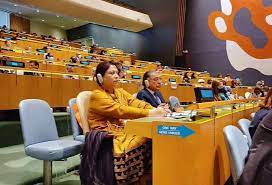
UN-Climate-Pak ”’
At UN, Pakistan stresses women’s inclusion in decision-making processes for effective climate action
UNITED NATIONS, Highlighting the world’s “monumental challenges” of ‘gender parity’ and ‘climate change’, Pakistan told the United Nations Monday that Islamabad’s climate policies recognize women’s disadvantages and how they have to be facilitated in their productive, reproductive and care giving roles.
“Climate change is one of the defining issues of our times,” Nilofar Bakhtiar, the Pakistani delegate to the 66th Session of Commission on Status of Women (CSW),
said, adding that the phenomenon affects all states, peoples and communities.
“Our climate policies are paying attention to the plight of women and gender differentials that emerge from climate change and the vastly different experiences men and women have as workers, breadwinners, caregivers, patients and parents through climate-induced stress, she added.
The Commission on the Status of Women is the principal global intergovernmental body exclusively dedicated to the promotion of gender equality and the empowerment of women. The priority theme for this year’s deliberations is, ‘Climate change, environmental and disaster risk reduction policies, and programmes: advancing gender equality through holistic and integrated actions from global to local”.
Ms. Bakhtiar, who is the chairperson of the National Commission on the Status of Women (NCSW), also said that Pakistani women were playing a role in all walks of life.
Pakistan, she said, has a “very strong and glorious” history of women rights’ movement. Right after 7 years of the country’s independence, in which they played a major role, Pakistan had first female Governor, Begum Rana Liaqat Ali Khan; In 1965, Mohtarma Fatima Jinnah contested the presidential elections, and in 1988, Benazir Bhutto became the world’s first female Muslim Prime Minister.
In 2002, the Pakistani delegate added, the government reserved 17% seats in the parliament and 33% at the grass-roots level. Pakistan had its first female State Bank Governor in 2005. Pakistan Army have had 5 major generals and today, there is also a three-star female General. Also, just recently, the first female judge was elevated to the Supreme Court of Pakistan.
“We see women CEOs, footballers, swimmers, climbers, fighter pilots – women are everywhere, and in every walk of life,” Ms. Bakhtoar said.
“Our set of pro-women legislation is something we can boast about,” she said, pointing out that implementation is still a challenge.
Elaborating on climate change, Ms. Bakhtiar said Pakistan has the lowest carbon emissions, contributing virtually nothing to climate change, yet the country is one of the most severely impacted by climate change, with devastating consequences for economy, lives, and people’s livelihoods.
In this regard, she said, “Prime Minister Imran Khan’s Ten Billion Tree Tsunami Programme is a testimony to the fact that the will of the government (to fight climate change) is not lacking.”
The National Commission on the Status of Women, Ms. Bakhtiar said, spent the last four months in consultations with women from various segments of the society in Pakistan’s four provinces plus Gilgit-Baltistan and Azad Jammu and Kashmir and formulated a comprehensive country report on ‘Gender Parity: Women as Agents of Change.’
“Our progress can be attested by the fact that we have achieved SDG (Sustainable Developments Goal) 13 a decade earlier than its timeline”, the Pakistani delegate added.
“We are fully integrating gender perspective in key sectors, primarily agriculture, economy, forest and bio diversity, coastal management, energy and transportation,”
she said, emphasizing that inclusion of women in decision-making processes is critical for effective climate action as they possess unique knowledge and experience, particularly at the local level.
Ms. Bakhtiar also said that developing countries need financial resources to mitigate the impact of climate change on their populations, in particular women. “The international community should evolve mechanisms to fund programmes and projects for safeguarding the rights of women from the devastating impact of climate change and natural disasters.”
Opening the session, UN Secretary-General Antonio Guterres said that “women and girls must be front and centre, leading the way” in forging a sustainable future for all.
He described the climate and environmental crises, coupled with the ongoing economic and social fallout of the COVID-19 pandemic, as “the defining issues of our time,” reminding that “our collective response will chart our course for decades to come”.
Noting that the “unprecedented emergencies of the climate crisis, pollution, desertification and biodiversity loss, coupled with the COVID-19 pandemic, and the impact of new and ongoing conflicts, have accelerated and intensified into widespread and interlinked crises that affect us all,” he told the Commission that the damage would not be meted out equally.
“Everywhere, women and girls face the greatest threats and the deepest harm”.
And while they are taking action to confront the climate and environmental crises, they continue to be largely excluded from the rooms where decisions are taken.
Women and girls living in small island nations, least developed countries, and places affected by conflict, are impacted most of all, the UN chief said.
UN Economic and Social Council (ECOSOC) President, Collen Vixen Kelapile, reminded that as a subsidiary body, CSW continues provide oversight and monitoring the implementation of the 2030 Agenda for Sustainable Development and the development goals, particularly SDG 5 on Gender Equality.
“In this connection, the Commission’s work will remain central to the ECOSOC system for guiding a people-centred and gender-sensitive recovery from the COVID-19 pandemic,” he said, reminding that the High-Level Political Forum in July will examine implementation progress on SDG 5, alongside other global goals.
CSW’s work remains “essential” in strengthening the global framework for gender equality, empowerment of women, and advising policy-makers on “how to advance these important goals in an integrated and cross-cutting manner.”
UN General Assembly President Abdulla Shahid pointed out that in the UN’s 76 years, just four women have been elected Assembly President and no woman has ever been chosen as Secretary-General.
“This needs to be corrected,” he asserted. “The UN cannot call for implementation of gold standards throughout the world as far as gender equality and women’s empowerment is concerned but not implement this standard at home”.
Shahid said that he would “personally” lead in calling for the next Secretary General to be a woman
“Join me in this clarion call,” he invited the participants.
The Executive Director of UN Women, Sima Bahous, opened her address by drawing attention to “all crises and conflicts,” reminding that they “exact their highest price from women and girls” – from Myanmar to Afghanistan, the Sahel to Haiti, and Syria to Somalia to Yemen and Ethiopia, with “the horrifying war in Ukraine,” the newest addition.
Echoing the Secretary-General, she said, “the invasion of Ukraine must end, war must end, peace must prevail.”
“We see with every passing day the damage done to the lives, hopes and futures of Ukrainian women and girls,” Ms. Bahous continued, reiterating solidarity with the women of Ukraine while paying tribute to “their courage and resilience”.
“And I pray that they – and all those who are experiencing conflict – will soon know peace”.
Executive Director of the UN Environment Programme (UNEP) Inger Andersen said the world had had “enough of male-dominated solutions”.
In reinvigorating environmental multilateralism, she said that it is “critical” that women be put “at the heart of decision-making.”