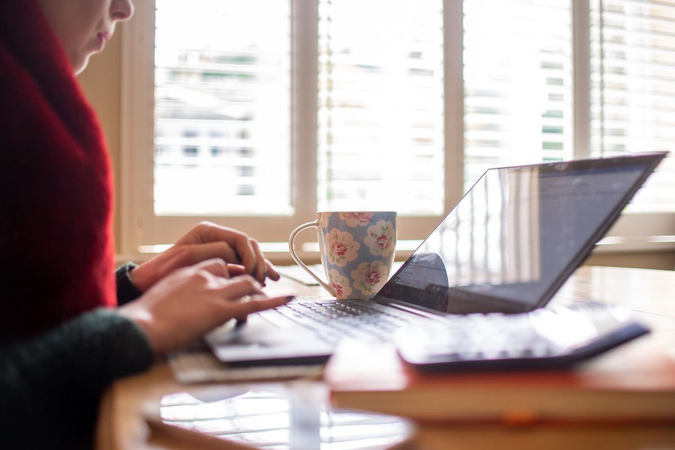
 Fairly soon after the government imposed a lockdown in late March, most companies opted for a work-from-home (WFH) policy.
Some went about it haphazardly, not giving clear guidance or directions to their employees, while others did some quick analysis and drew up a set of standard operating procedures (SOPs) for their employees to follow. Two months later, a number of companies are considering reopening offices, partially or fully, but the decision will depend on whether or not the government re-imposes the lockdown, in light of the huge surge in COVID-19 cases over the past three weeks especially, following the lockdown being considerably eased.
In many Western countries, WFH has been a normal practice for a long time; not for all employees and not continuously, but typically for one day in the week. But in our country, WFH is a new drill, brought into play suddenly in response to a crisis. A number of useful learnings have emerged from the WFH practice. First of all, everything did not go haywire just because people were not coming to the office daily, as some had thought. True, there were initial hiccups in some cases, but by and large work continued as before. Then, employees adapted to the WFH routine fairly well and fairly quickly, which was quite pleasantly surprising, given that it was a new norm. Third, in many cases company managements even discovered that individual productivity actually improved noticeably. One wonders if this was due to the fact that at home workers had fewer distractions, like no colleagues around to chit-chat with, ever so often!
First of all, everything did not go haywire just because people were not coming to the office daily, as some had thought. True, there were initial hiccups in some cases, but by and large work continued as before. Then, employees adapted to the WFH routine fairly well and fairly quickly, which was quite pleasantly surprising, given that it was a new norm. Third, in many cases company managements even discovered that individual productivity actually improved noticeably. One wonders if this was due to the fact that at home workers had fewer distractions, like no colleagues around to chit-chat with, ever so often!
WFH by default also increased decentralization of decision-making. Executives became more empowered to take a variety of everyday decisions themselves, without running to their line manager for a nod on everything. Resultantly, decision-making became faster, with less time-wasting for all. Decentralization has additionally promoted creativity in thought, proactivity and boldness, and also responsibility, as empowered executives also realized that they would be directly responsible for whatever actions they took and hence their decisions and actions need to be carefully thought-through.
For many companies, especially the small and medium sized ones, WFH has also meant a sudden and sharp upsurge in their use of technology. They have crossed the Rubicon in this respect and have realized that they must further up their game on technology in business or lose out, for technology is not only allowing everyone in the company to constantly stay in contact with each other, without being physically present in one premises, but it is also opening up new opportunities to market products and services, source raw materials from new sources, and not least, save on operating costs.
Having said all above, perhaps a stage is now being reached where the law of diminishing marginal returns is starting to apply to the WFH routine. People are getting increasingly bored, frustrated and even mentally disturbed as a result of the extremely prolonged lockdown. Humans by nature are gregarious creatures, and workplaces do provide us the opportunity to socialize and work together as a team for a common goal. Perhaps we even work harder overall in the workplace, as the work environment is much more in-the-face competitive. Further, WFH does have the drawback of not permitting on-job training or effective mentoring of junior and middle management level executives by their line managers or by higher management.
Thus there is a good case for reopening offices, if for the present only partially, in terms of a few days of the working week only, or rotational attendance or a combination of the two. Each organization needs to decide for itself, first of all whether it will be really beneficial to reopen, or the WFH routine is working just fine and can be further continued. Those who do go for reopening, must then decide if all staff really needs to come to the office, or some can still work from home, so that the number of people in the office can be reduced to avoid crowding and to ensure social distancing can be effectively maintained, with minimum of 6 feet in between people seated at their workstations. In this regard it is also recommended that all employees who use public transport to get to work, should not be part of the returning staff and should continue to work from home. It is also imperative for reopening that other SOPs are also strictly followed, like wearing of masks at work, sanitizing hands, immediately reporting if self or anyone at home develops any COVID-19 symptoms and immediately going into home isolation, and so forth. Reopening of the office cannot under any circumstance be at the risk of compromising safety, not only of the employees but also of the society at large.
The writer is a public relations and communications professional. He can be reached at [email protected]