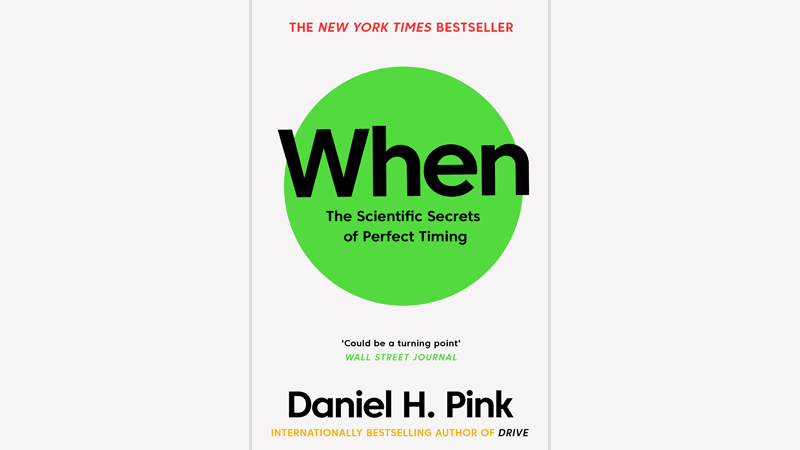
 Imagine you start a business with an aim to soar high in the market; however, after some time your business starts to dwindle. On thinking, you realise nothing was wrong with your business plan or budgeting skills, everything had been spot on; what if you get to know that the decision you took wasn’t bad after all, what had been bad instead was the ‘timing’.
Through the Introduction of ‘When’, Daniel H. Pink ensures that as his readers proceed, they anticipate not to settle for less. The Introduction begins with the Sinking of the Lusitania – an incident that took place back in 1915, in which nearly 1,200 people perished. Mentioning much of the conspiracy theories, Pink sums up the incident saying, “Nobody knows for sure. More than one hundred years of investigative reporting, historical analysis and raw speculation haven’t yielded a definite answer. But maybe there is a simpler explanation that no one has considered. Maybe Captain Turner made some bad decisions. And maybe those decisions were bad because he made them in the afternoon.”
Right in the beginning, we are told that this is a practical book about timing and timing is an art. Therefore, each chapter is accompanied with a section titled ‘Time Hacker’s Handbook’; a collection of tools, exercises and tips ‘to help put the insights into action’. Daniel Pink, through these recurring sections, ensures that as you reach the last page, you are able to identify when is the best time of the day to take optimum decisions. Two Cornell researchers, in 2011, gathered approximately 500m tweets that had been posted by more than 2 million users over the last two years. They analyzed those tweets through the program called Linguistic Inquiry and Word Count, in order to measure how people’s feelings varied through the course of time; they measured the emotional states revealed by individuals in the electronic Tweets they posted. The results were striking.
“Beware of the middle point, the ‘trough’ is more dangerous than most of us realise,” Daniel H Pink writes.
The researchers found that regardless of the time of year – people’s positive emotions rose in strength as the morning progressed and then fell significantly in the afternoon, before climbing back in the evening. It didn’t matter to which region or religion the tweet belonged, Daniel Pink tells us. “Across continents and time zones was the same daily oscillation – a peak, a trough and a rebound.”
“Moods are an internal state but they have an external impact.”
(When by Daniel H Pink)
In other words, mood in the morning turns out to be reasonably upbeat and positive. But as the day progresses, the mood grows more negative and less resolute. Around lunchtime, mood rebounds slightly. But in the afternoon, negativity deepens again, with mood recovering only after evening.
Right in the beginning, we are told that this is a practical book about timing and timing is an art. Therefore, each chapter is accompanied with a section titled ‘Time Hacker’s Handbook’; a collection of tools, exercises and tips ‘to help put the insights into action’. Daniel Pink, through these recurring sections, ensures that as you reach the last page, you are able to identify when is the best time of the day to take optimum decisions
“We are smarter, dimmer, faster, slower and more creative and less creative in some parts of the day than others. Also, another thing to keep in mind is that the best time to perform a particular task depends on the nature of that task. All brainwork is not the same.”
(When by Daniel H Pink)
Pink not only accentuates the startling variation that occurs throughout the day but also provides with the simple to-do steps, following which one can know the idiosyncratic-ideal-time based on one’s chronotype:
What time you go to sleep?
What time you wake up?
What is the middle/midpoint of these two times?
Whatever midpoint that you get, look its type in the graph given below:
According to Pink, “Figure out your type, understand your task and then select the appropriate time.” When is like a Right-Time-Handbook that provides you with apt time account on when-to: exercise, take naps, take vigilance and restorative breaks, have breakfast and lunch. Moreover, it answers our repetitive questions like: when to quit job and when to get married. The middle part of the book, strongly emphasises on the power of break and case for a modern siesta.
“Three principles of successful beginnings: Start right. Start again. Start together.”
(When by Daniel H Pink)
Last part starts off with a fascinating account of Ahilu Aadhav – a Dabbawala in Mumbai. He delivers lunch boxes to the working men of Mumbai after collecting their lunch from their homes. This act of synchronisation is done always on time, right before the train arrives at the platform. “No smartphones. No scanners. No barcodes. No GPS. And no mistakes.” it sets the story in context. The dabbawalas do this by bicycle without the help of digital technology. Yet they have an accuracy rate that cannot be challenged. Dabbawalas have a strong sense of coherence, a fixed pace and a unifying mission that keep them error-free.
When by Daniel Pink surely challenges your conventional outlook with reference to time & timing. It provides you with a guideline on how to and when to set your routine keeping in mind the nature of your task and your chronotype. It is so far, one of the few books that answers the questions beginning with both, how-to & when-to.
“Outside of a dog, a book is a man’s best friend. Inside of a dog it’s too dark to read!”
(When by Daniel H Pink)
The writer can be reached at [email protected]