 Can Lagos hold back the waves?
Sprawled around a lagoon, Nigeria’s frenetic economic capital faces a threat from the Atlantic on its doorstep.
The ocean has pounded the soft, sandy shoreline on a timescale far surpassing human history — but now its waves spell a major threat to the city and its booming population.
The coastline is eroding, driven partly by higher water levels caused by global warming but also from the impact of dredging to provide sand for construction.
Global warming, according to a World Bank study in March, is causing the Atlantic to invade Africa’s western coast by up to four metres (13 feet) a year, badly hitting some economically vital areas.
Attempts have been made to defy the ocean — but critics say they have sometimes just led to new problems.
In particular, a high-end construction project called Eko Atlantic has divided opinion.
Launched in 2007 by billionaire investors with strong political backing, the scheme has been billed as a Dubai for Africa — a hyper-luxury enclave of skyscrapers built on land reclaimed from the seas.
An economic downturn in recent years has stalled the mammoth undertaking, but already millions of tonnes of sand have been hauled from the ocean floor to create a manmade peninsula jutting out into the Atlantic from the affluent Victoria Island.
Surrounding it is what the developers call the “Great Wall of Lagos”, a barrier of rocks and five-tonne concrete blocks intended to run for 8.5 kilometres (more than five miles), designed to withstand the worst storms the Atlantic can throw at it.
While the barrier has still not reached full length, those responsible say it has “saved” the business hub of Victoria Island standing behind it from the ravages of the ocean.
“Today, Lagos is already seeing the benefits of the Great Wall, once flooded roads are now passable and abandoned properties have been reinvested,” Eko Atlantic’s website says.
‘Washed away’
But while it is seen as a solution for some, the mammoth project is described as a major problem for others.
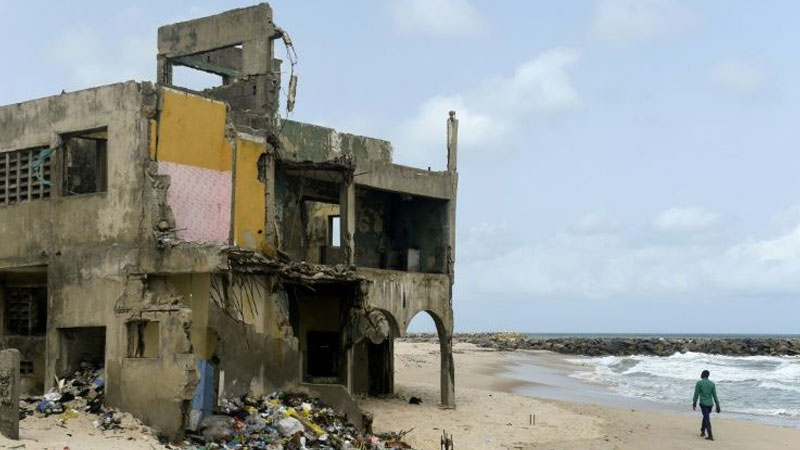
Around 12 kilometres (eight miles) to the east, landowner Wasiu Elegushi says the Eko Atlantic has caused devastating changes to coastal currents, destroying his small middle-class neighbourhood, Alpha Beach.
Since construction began in 2007, locals and researchers say displaced currents have washed away more than 25 metres of land from the shoreline.
“Before Eko, we had nature, palm trees and coconut trees,” Elegushi told AFP.
“The water started to rise. Everything has been washed away.”
The shore-hugging Alpha Beach road has disappeared under the waves and apartment blocks built with prized ocean views just 10 years ago are now occupied only by squatters.
A barrier has now gone up to try to protect the area, but for many residents it appears too late.
“The way the tides would react to the wall was clear to anyone who understands this,” said Tunji Adejumo, an ecologist at the University of Lagos.
“It shows that the promoters had no consideration” for the rest of the coast, he said.
Eko Atlantic did not respond to questions from AFP about the impact of its construction.
Megacity, mega-problems
Experts say Eko Atlantic is simply the most prominent example of the impact of large-scale land reclamation in Africa’s largest metropolis.
With more than 20 million residents — no one knows its exact size — Lagos is also one of the world’s fastest growing cities.
The city has long been vulnerable to flood surges, but environmental safeguards are weak.
One unanticipated consequence of the city’s headlong rush for growth has been that parts of the seabed have become a moonscape as dredgers have pillaged its sand to make concrete.
An extensive impact study for the state government seen by AFP shows that the once smooth ocean floor now has gigantic holes up to eight metres deep, some of them perilously close to the shore.
Experts say such craters can compromise the safety of coastline properties, and some structures in poorer waterfront communities are already collapsing.
Elsewhere, what were once shallow swamplands in Lekki, a peninsula dividing the Lagos lagoon from open sea, were reclaimed in the 1990s to become a middle-class residential area.
Lekki is now home to hundreds of thousands of people, but the former wetlands are progressively sinking and poor drainage is a major source of flooding.
“Several communities (in the city) have already been swept away. If nothing is done, Lagos will be submerged by 2050,” Chief Ede Dafinone, president of Nigerian Conservation Foundation has cautioned.
And in the oceanfront areas bearing the brunt, locals are already counting the cost.
On Alpha Beach, people are gloomy.
“People have land here but don’t even build on it; they’re afraid,” said Bobby Isowshe, who sells refreshments on the beach. “The businesses don’t really do well anymore.”