• Skip to primary navigation
  • Skip to main content
  • Skip to primary sidebar
  • Skip to footer
Trending:
  • Kashmir
  • Elections
Saturday, June 6, 2026

Daily Times

Your right to know

  • HOME
  • Latest
  • Iran-Israel war
  • Gilgit Baltistan Election
  • Pakistan
    • Balochistan
    • Gilgit Baltistan
    • Khyber Pakhtunkhwa
    • Punjab
    • Sindh
  • World
  • Editorials & Opinions
    • Editorials
    • Op-Eds
    • Commentary / Insight
    • Perspectives
    • Cartoons
    • Letters to the Editor
    • Featured
    • Blogs
      • Pakistan
      • World
      • Lifestyle
      • Culture
      • Sports
  • Business
  • Sports
  • E-PAPER
    • Lahore
    • Islamabad
    • Karachi

Agencies

Made homeless by war, Syrians sell furniture to survive

Published on: June 25, 2019 4:42 PM

For years, Abu Ali sold used furniture and home appliances for a living. But he never thought Syria’s war would one day make him homeless and force him to sell his own.

His family is one of dozens stranded in olive groves along the Turkish border, who say they have had to sell their basic possessions to ensure survival.

“I sold them to provide food, drink and clothes for my children,” said the father of five, who now houses his family in a tent.
An opposition bastion in Syria’s northwest has come under heavy regime and Russian bombardment since late April, despite a truce deal intended to protect the jihadist-run enclave’s three million inhabitants.

The spike in violence in and around Idlib province has killed hundreds of civilians, displaced 330,000 more, and sparked fears of one of the worst humanitarian disasters in the eight-year civil war.

Abu Ali, his wife and their children fled their home in southern Idlib in early May, hitting the road north to seek shelter in the relative safety of the olive groves close to the border.

“I used to have a shop to buy and sell used items,” such as fridges and furniture in the village of Maaret Hurma, he told AFP, sitting in the shade of a tree near the border town of Atme.

A few days after fleeing his home village, he hired two trucks for 50,000 Syrian pounds (over $110) to bring “eight fridges, bedroom furnishings, seven washing machines, and several gas stoves” up to the olive grove.
But under the summer sun in the makeshift camp, the merchandise soon plummeted in value.

“I was forced to get rid of it or sell it — even at a very low price,” the 35-year-old said, his chin stubble already greying under a head of thick dark brown hair.

For example, the going price for a fridge originally bought for 25,000 Syrian pounds (more than $55) can be as low as a fifth of that price.

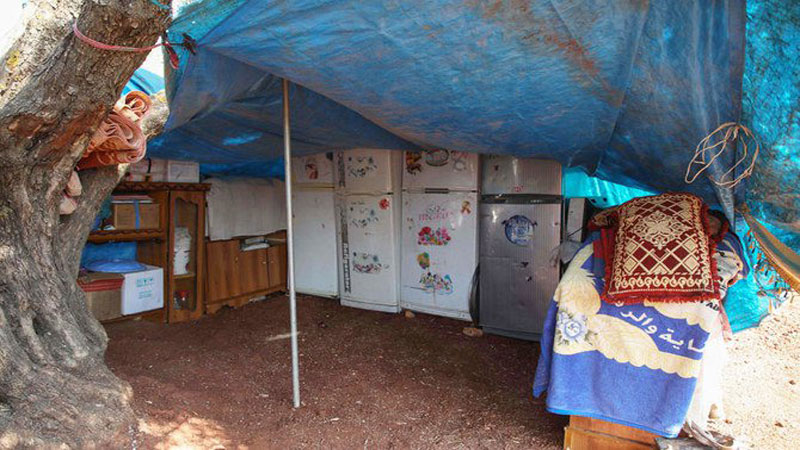
In Atme, some families have stored their fridges and other appliances in a single tent to protect them from the elements.
Outside, a top-loader washing machine sits in the shade of a tree.

Awad Abu Abdu, 35, said he too was forced to part with all his household items for a pittance.
“It was very dear to me. It was all I had accumulated over a lifetime of hard work,” said the former construction worker, who fled the village of Tramla with his wife and six children.

“I sold all our home’s furniture for just 50,000 Syrian pounds,” he said, dressed in a faded grey t-shirt fraying around the collar.

After transport costs, he was left with only half that amount to feed his family, he said.
Abu Abdu accused buyers of “cheating us, exploiting the displaced,” but said he had no other choice.
“Everything’s so expensive… and there are no organizations looking out for us,” he said.

The Idlib region is supposed to be protected by a buffer zone deal signed by Russia and rebel backer Turkey in September.
But the accord was never properly implemented as jihadists refused to withdraw from the planned cordon.
Hayat Tahrir Al-Sham, an alliance led by Syria’s former Al-Qaeda affiliate, took over administrative control of the region in January.

In the town of Atareb — about 30 kilometers from Atme, in Aleppo province — Abu Hussein received a new delivery at his shop of second-hand household appliances and furniture.

“Every day, more than ten cars arrive loaded up with items the displaced try to sell us,” said the 35-year-old.
“This means we have to pay relatively low prices, because the supply is so high” and it’s hard to then sell them all, he said.
Back in Atme, 50-year-old Waleeda Derwish said she hoped she would find someone to buy her fridge, washing machine and television, to help her provide for her eight children.

The widow transported the electrical items to “save them from bombing or looting” in Maaret Hurma, she said, a bright blue scarf wrapped around her wrinkled face.

Now the appliances represent the family’s only lifeline, she said.

“I’m forced to sell them. How else are we supposed to live?“

Filed Under: Top Stories, World Tagged With: furniture, homeless, sell, Syrians, war

Submit a Comment


Primary Sidebar


Latest News

US and Iran exchange strikes near Strait of Hormuz

Alexander Zverev eases past Jakub Mensik in French Open semifinals

Taylor to face Pili in Croke Park farewell

FIFA bans vuvuzelas from World Cup stadiums

France brush off Ivory Coast loss, call it timely World Cup reminder

Pakistan

JAAC declared proscribed party ahead of AJK polls on July 27

Fixed tax scheme for small retailers launched to raise Rs 50bn annually

Govt cuts petrol price by Rs 4 per litre, keeps diesel’s unchanged

Bilawal promises GB voters with land and job rights

Iran declares support for Hezbollah with wider peace deal in doubt

More Posts from this Category

Business

SBP’s ‘Go Cashless’ campaign saw Rs 34bn in digital transactions on Eid

Short-term inflation down by 0.56%

Saudi-Pak Business Council shows interest in infrastructure investment

‘Govt, allies united in efforts to craft people-centric budget’

Rupee records gain against US dollar

More Posts from this Category

World

US and Iran exchange strikes near Strait of Hormuz

CENTCOM space post signals wider US military footprint

US official delivers Trump’s “good hello” to Putin

More Posts from this Category


Footer

Home
Lead Stories
Latest News
Editor’s Picks

Culture
Life & Style
Featured
Videos

Editorials
OP-EDS
Commentary
Advertise

Cartoons
Letters
Blogs
Privacy Policy

Contact
Company’s Financials
Investor Information
Terms & Conditions

Facebook
Twitter
Instagram
Youtube

© 2026 Daily Times. All rights reserved.

Manage Consent
To provide the best experiences, we use technologies like cookies to store and/or access device information. Consenting to these technologies will allow us to process data such as browsing behavior or unique IDs on this site. Not consenting or withdrawing consent, may adversely affect certain features and functions.
Functional Always active
The technical storage or access is strictly necessary for the legitimate purpose of enabling the use of a specific service explicitly requested by the subscriber or user, or for the sole purpose of carrying out the transmission of a communication over an electronic communications network.
Preferences
The technical storage or access is necessary for the legitimate purpose of storing preferences that are not requested by the subscriber or user.
Statistics
The technical storage or access that is used exclusively for statistical purposes. The technical storage or access that is used exclusively for anonymous statistical purposes. Without a subpoena, voluntary compliance on the part of your Internet Service Provider, or additional records from a third party, information stored or retrieved for this purpose alone cannot usually be used to identify you.
Marketing
The technical storage or access is required to create user profiles to send advertising, or to track the user on a website or across several websites for similar marketing purposes.
  • Manage options
  • Manage services
  • Manage {vendor_count} vendors
  • Read more about these purposes
View preferences
  • {title}
  • {title}
  • {title}
We use cookies to ensure that we give you the best experience on our website. If you continue to use this site we will assume that you are happy with it.