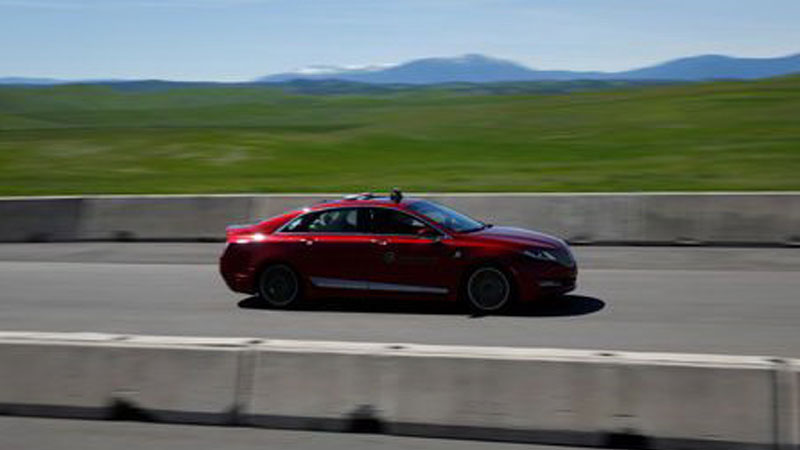
 Half of US adults think automated vehicles are more dangerous than traditional vehicles operated by people, while nearly two-thirds said they would not buy a fully autonomous vehicle, according to a new Reuters/Ipsos opinion poll.
In the same poll, about 63 percent of those who responded said they would not pay more to have a self-driving feature on their vehicle, and 41 percent of the rest said they would not pay more than $2,000.
The poll results outline the challenges that face car and truck makers, delivery companies, technology companies and ride services operators such as Uber Technologies Inc and Lyft Inc. All are plowing capital into developing self-driving vehicles and related hardware. Developers of the technology are making progress, but polls indicate the industry’s efforts to build public trust and commercial demand lag behind.
The findings are similar to those in a 2018 Reuters/Ipsos poll. They are consistent with results in surveys by Pew Research Center, the American Automobile Association and others. In March 2018, after the 2018 Reuters/Ipsos poll, an Uber vehicle operating in self-driving mode struck and killed a pedestrian in Arizona.
Relatively few US residents have seen or ridden in a self-driving vehicle, and experts said suspicion of unknown technology can give way to acceptance once it becomes more familiar.
“People are comfortable with things they know,” said investor Chris Thomas, co-founder of Fontinalis Partners and Detroit Mobility Lab. “When everybody understands the game-changing attributes of automated vehicles, how they can give you back all that time to read or work or sleep, they will start to ask about the value of that recaptured time.”
For companies investing in autonomous vehicles, public mistrust and the unwillingness to pay for self-driving systems are an increasingly urgent problem.
But widespread deployment of fully self-driving vehicles is some years away, industry officials and experts said. Alphabet Inc’s Waymo unit has deployed a small fleet of self-driving vans to provide rides for customers in Arizona, and other companies have self-driving vehicles on public streets in test fleets.
“At the moment, those responses are largely based on zero knowledge and zero experience, so it’s mostly a visceral reaction to something they read about, like the (2018) Uber crash in Arizona,” said Dan Sperling, director of the Institute of Transportation Studies at the University of California, Davis, and the author of several books on future transportation.
Autonomous vehicle companies have been trying for more than two years to get the US Congress to enact legislation that would give a regulatory green light to self-driving cars. So far, opposition has bottled up the industry friendly bills. The National Highway Traffic Safety Administration meanwhile has yet to act on proposals to exempt autonomous vehicles from conventional vehicle safety standards.
Two-thirds of survey respondents said self-driving cars should be held to higher government safety standards than traditional vehicles driven by humans.
“Somebody needs to be held accountable,” said survey respondent Carla Ross, 62, a teacher from Norfolk, Virginia. “Those cars shouldn’t even go on the road until they can guarantee a certain percentage of safety.”
The poll’s findings that most consumers would not pay for self-driving vehicle capability underscores concerns within the vehicle industry about the high costs of the technology, such as lidar sensors and high-powered onboard computers. Lidar is similar to radar but uses laser light instead of radio waves. “I’m concerned that even when we get the technology absolutely right, we will not have the business,” said investor and corporate adviser Evangelos Simoudis, managing director of Synapse Partners, which invests in autonomous vehicle technology startups.
Self-driving expert Bryant Walker Smith, a law professor at the University of South Carolina, said a number of companies “don’t actually want to sell people these cars — they want to rent us these services. They want us to pay every month, every trip.”
For many Americans, “$2,000 is a lot of money,” he said. “If you’d asked people if they’d pay $15,000 for an advanced safety package or even $10,000 for a luxury trim package, the answer in a lot of cases is going to be no.”
The challenges of turning over critical safety systems to robots are now a central issue in debate over how regulators should respond to a pair of deadly crashes involving Boeing 737 MAX airliners. Investigators trying to determine the causes of crashes in Indonesia and Ethiopia are focusing on evidence that an automated flight control system on the jets put the planes into nose dives, and pilots were unable to override the systems.
“If there’s one (airplane) crash a year, it creates huge backlash — and airplanes are far, far safer than cars,” said Sperling.
The Reuters/Ipsos poll surveyed 2,222 people online in English across the United States and it has a credibility interval, a measure of precision, of 2 percent.