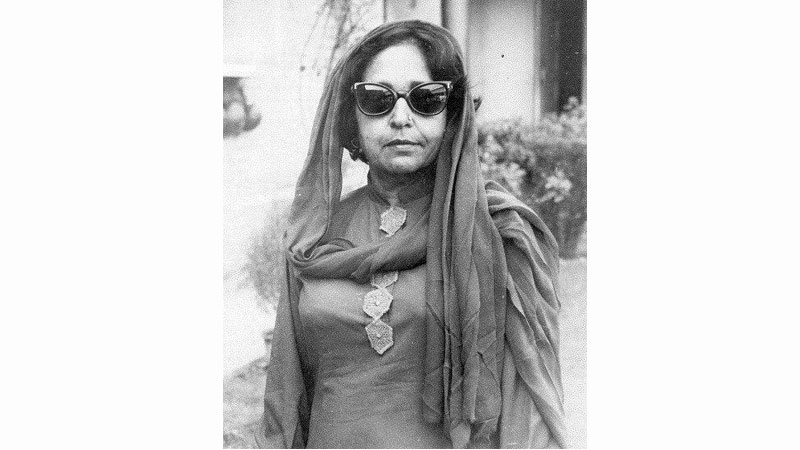
 I remember that Malika Pukhraj telephoned me from Detroit in my hostel, Lucas House, Birmingham UK in the University of Birmingham to fix a recording with Saleem Shahid (father of actor Salman Shahid) for Sunday morning programme for the Asian community. BBC used to air one hour programme ‘Apna Hi Ghar Samajhiye’ (Make Yourself at Home) every Sunday morning at 9 AM and Saleem Shahid was one of the producers. That was my first exposure with the great lady who was on the top of her singing career at that time, famous for singing Ghazals and Kashmiri folk songs. I am talking of sometime in between 1968 to 1972. I attended her recording at BBC Bristol Road Studios. She had to sing live. She gargled her throat with luke-warm water with a little salt in it before singing her songs. More than four and a half decades have passed since this incidence but her strong, tuneful voice still resounds my ears. Mushtaq Hashimi and I were Malika’s son Tanveer’s friends. He was a very good singer as well, amateur of course and would often sing for us in Government College informal get-togethers. Later he joined Armed Forces and we knew him as Major Tanveer. There used to be peacocks in their Canal Road residence in 1960s. Malika’s husband Syed Shabbir Hussain Shah’s rural background was noticeable in the shape of breeding of cattle in the backyard. Malika had totally adapted to her new way of living. Her husband who had brought her from the courts of Maharaja of Kashmir had married her and they lived happily ever after. Born in village Mirpur on the banks of the River Akhnoor sixteen miles from Jammu in 1912, Pukhraj, a name given by her aunt, was given the title ‘Malika’ (Queen) at her birth by Majzoob Baba Roti Ram, a spiritualist in Akhnoor area.
Born in village Mirpur on the banks of the River Akhnoor sixteen miles from Jammu in 1912, Pukhraj, a name given by her aunt, was given the title ‘Malika’ (Queen) at her birth by Majzoob Baba Roti Ram, a spiritualist in Akhnoor area
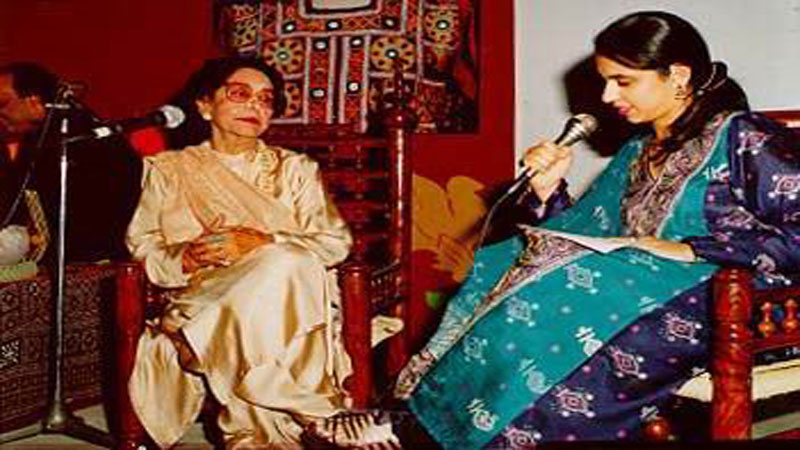 Hobbies: Malika Pukhraj did not remain inactive at home and in her spare time she always stitched designs or flowers in a piece of cloth, an art rarely possessed by women of stature. She matched this art with the modern machinery doing the same bit. Bano Qudsia, the famous writer, had once stated that Malika, as a singer would live long in the history books on music. She was like a bridge between peace time and revolution while water shall keep flowing under the bridge. Bano’s comments about Malika’s voice that it sounded like somebody playing mandolin in an old empty well, has been quoted many times. Malika’s creativity continued to be enhanced all her life, late Ashfaq Ahmad had observed. Justice Nasira Javed Iqbal observed that her voice was like a fountain erupting out of ‘Soz-e-Daroon’ (melody from within). She added that Malika’s heavy vocal tones suited Allama Iqbal’s poetry. His poetry ‘Yei Gumbad-e-Minai’ suited Malika’s voice and Umme-e-Kulsoom from Egypt. Justice Javed Iqbal, Allama’s son declared Malika as Asia’s Umm-e-Kulsoom. He mentioned Malika’s additional quality of being an excellent cook as well as he had the privilege to eat her dishes.
Demise: Malika Pukhraj’s last appearance was in PTV’s programme ‘Khiraj-e-Tehseen’ in 2003. She was flouted by her family and friends. She looked frail. She died the following year on 4th of February, 2004. Her funeral procession started from her residence at West Canal Bank, and was held in the house of her eldest son. She was buried at ‘Shah Jamal’ graveyard in Lahore. I attended the largely attended funeral. She received the Presidential Pride of Performance Award. In 1977 when All India Radio (for which she sang until Partition) was celebrating its Golden Jubilee, she was invited to India and awarded with the ‘Legend of Voice’ award. Malika Pukhraj also recorded her memoirs in the novel Song Sung True.
Published in Daily Times, June 19th 2018.