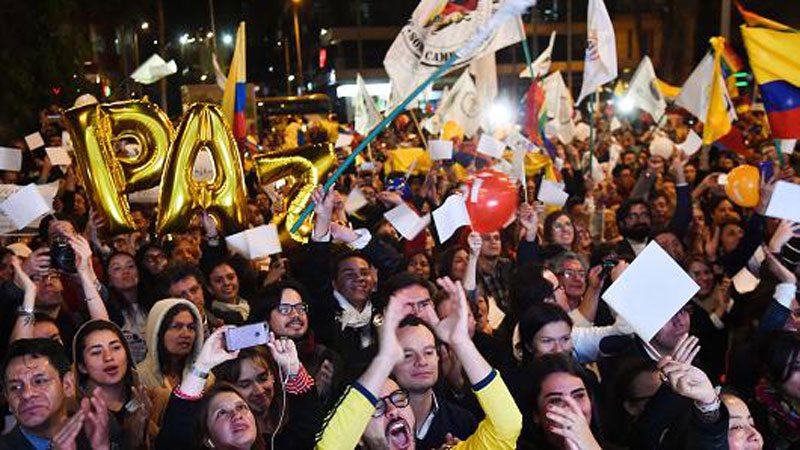
Conservative candidate Ivan Duque won the first round of Colombia’s presidential election Sunday but fell short of the 50 percent threshold needed to avoid a runoff next month.
The 41-year-old senator will face former guerrilla Gustavo Petro on June 17, the first leftist candidate to contest a runoff in Colombia.
Duque polled 39.7 percent of the votes, compared to Petro’s 25 percent, in a poll which showed deep divisions over a peace deal with former rebel movement FARC.
It was the first presidential poll in half a century free of the threat of the FARC, though Duque, 41, has campaigned strongly on a pledge to rewrite a peace agreement with the group.
Polling was “totally normal,” said electoral authority chairman Juan Carlos Galindo. Turnout was a higher-than-usual 53.2 percent in a country traditionally plagued by voter apathy.
The peaceful election was an achievement praised by outgoing President Juan Manuel Santos after casting his ballot in Bogota.
Ironically, the peace Santos made with the FARC, which is now a political party, has opened sharp divisions, reflected in the two candidates to succeed him.
– Rewrite accord –
Duque has vowed to rewrite an accord he sees as too lenient on a group that waged a decades-long war of terror in Colombia before transforming itself into a political party.
Duque’s pledges to defend private enterprise and introduce tax cuts also won him support.
“I want a country of legality, a full-on fight against corruption, a country where peace can breathe throughout the land,” said Duque after casting his ballot in Bogota.
Outside one Bogota polling station, Paula Rubio, 38, said she voted for Duque “to maintain order in the country.”
Petro, a former member of the disbanded M-19 rebel group, defied expectations in a country where presidential elections have traditionally been the domain of the right.
His total of more than 4.8 million votes is almost double the previous best showing for the left in a presidential election, in 2006.
“It’s obviously going to be very polarized in the second round,” said analyst Andres Macais, with both sides scrambling to form alliances with defeated candidates.
Conservatives backing Duque have a majority in the Congress after sweeping the legislative elections in March.
Leftist candidates Sergio Fajardo, a former Medellin mayor who polled 23.7 percent of the vote, and peace negotiator Humberto De la Calle, have previously refused to ally with Petro.
Petro said he wanted a Colombia “present and future” without hatred or vengeance and to leave behind “the machinery of corruption.”
The 58-year-old rallied many Colombians with his campaign speeches against inequality and corruption, making him the country’s first leftist candidate going to the second round of a presidential poll.
“I voted for Petro… who has helped the poor people,” said domestic worker Gladys Cortes, 60.
Analysts said turnout could be a key factor in the second round.
“There is an increase in participation, but abstention is still high, we will have to see if it is still possible to move that absentee vote towards Petro. The second round is going to be very close,” said analyst Medofilo Medina.
– Santos stepping down –
Santos — who was awarded the Nobel Peace Prize for the 2016 deal with the FARC — steps down in August.
Duque, a gray-haired senator and former economist, is backed by the Democratic Center party of former president Alvaro Uribe, which swept legislative elections in March. If successful, he can count on the support of Congress.
Uribe fell out with onetime ally Santos over his drive for peace with FARC, setting up his own party in 2013.
Many voters see Uribe’s guiding hand behind the inexperienced Duque’s campaign. Like Santos, the 65-year-old Uribe is constitutionally precluded from seeking a third term.
Colombia, ravaged by corruption and glaring inequality, is still struggling to emerge from the longest armed conflict in the Americas.
The world’s leading producer of cocaine, the country continues to battle armed groups vying for control of lucrative narco-trafficking routes in areas FARC once dominated.
– ‘No impunity’ –
The peace deal, in effect for little more than a year, remains fragile.
The FARC, now in the form of a political party, did not win much support in March legislative elections, failing to add to the 10 parliamentary seats it was awarded in the peace deal.
“What we Colombians want is that those who have committed crimes against humanity be punished by proportional penalties, which is incompatible with political representation, so that there is no impunity,” Duque recently told AFP.
The senator has pledged to eradicate “the cancer of corruption” and to revive a sluggish economy, while vowing to defend traditional family values.
Petro’s crowds grew steadily as his campaign went on, in what some analysts see as public support for the peace deal and the rehabilitation of FARC as a political party.
“Society has overcome the fear of violence and terror, and what we are seeing today is the political expression of that, filling public places and drawing crowds,” Petro told AFP in the final days of his campaign.