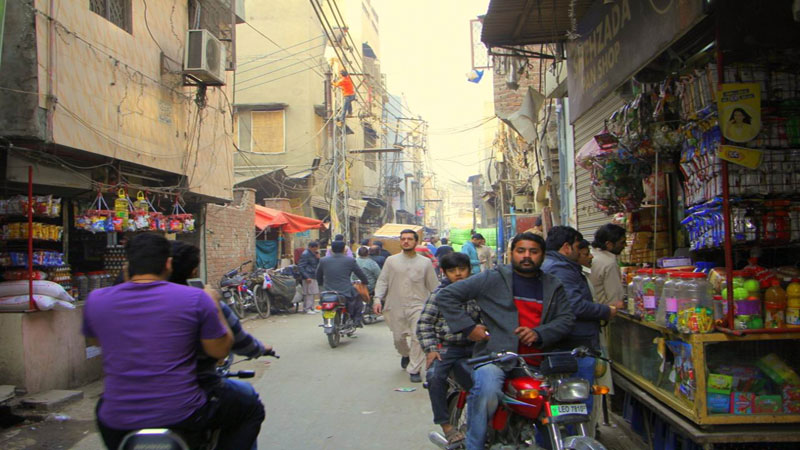
 Inside the Walled City of Lahore, there are marvels hidden and few are lost which need to be dusted. Today I am taking you to a lost rather forgotten marvel of walled city which was once an important part of the city, the Zakki Gate. This gate is less discussed when it comes to the city gates. This is the Yakki Gate of walled city which was once known as the Zakki Gate. The gate was one of the thirteen gates of the Walled City of Lahore which were built during the reign of Mughal emperor Akbar. A 30-feet high fortified wall was constructed along with the gates which gave entrance to the city.
This gate was lost with the passage of time and today no one can mark the location of the gate except for the fact that it was close to Delhi Gate. Zakki Gate was located on the eastern side of the city and has an astonishing and curious history. Let us begin with the interesting fact about its name. There are two opinions on the name of the gate. Firstly, the historic accounts state that the gate was named after a martyr saint Pir Zakki and became known as Zakki Gate.
Once you enter inside this gate you will see two graves of Pir Zakki. Legend has it Pir Zaki was beheaded while fighting with the Mongols, but his headless body kept on fighting Mongols for a few meters or so
Once you enter inside this gate you would see two graves of the same saint there. The tale narrated by history books and locals says that Pir Zaki and his followers died fighting the Mongol invaders who wanted to take over the city. They fought with their lives to save the city and during the riots, Pir Zakki was killed. The story says that Pir Zaki was beheaded, while fighting with the Mongols, but his headless body kept on fighting Mongols for a few meters or so. I have never heard such a story in my life and I was thrilled by it. This is the reason behind two graves of the same person. The head and body were buried in different graves and both graves are respected to this day. As you visit the area of Yakki Gate, you can ask anyone about the graves. His burial chamber is a few steps from the city and in front of it there is the famous Madina Mosque. The second tale implies that during the Mughal era the transport of the nobility was the one person carriage or Yakkas (known as in local language). These used to be parked outside this gate so it came to be known as the Yakki Gate.
You must be thinking why the name changed from Zakki to Yakki. This is another entrancing story. With the passage of time the name of this gate was distorted. As the sound of letter ‘z’ (zee) is still interchangeable with the letter ‘Y’ (Ya) in local language of the region, it became Yakki Gate instead of Zakki Gate over a certain period of time. As the generations passed, among the Lahoris and historians it became known as Yakki Gate and now it is the same called and written by historian and people.
Let’s move inside the Yakki Gate now. The building of this gate does not exist now. It was demolished during the British Raj and was not reconstructed but the graves of Pir Zakki along with some other graves still exist there. This gate is very close to the giant Delhi Gate of Lahore and through the tiny winding streets you can make your way towards the Royal Trail and see the huge monuments like Shahi Hammam and Wazir Khan Mosque. This is an astounding feature of walled city that the narrow tangled streets lead you to various gates and places within the city. The entire city can be explored by walking from one gate to the other through interesting and mesmerising streets.
From Yakki Gate Koocha Kundrawan via Chohatta Qazi Allah Dad, you can make your way to Wazir Khan Mosque and from Gali Beeja Ram you can easily go to Pakistan cloth market. Katri Mian Ghous and Gali Aalo wali Haveli are fascinating sites inside Yakki Gate where you can see the old and attractive architecture. The maze like network of the streets will lead you to interesting havelis and houses. Food shops are in abundance. The famous shop of Chappli Kebab of walled city is near the entrance of this trail. Outside, on the main road you will see a huge fruit and vegetables market.
 The most important feature of this gate is that so far it has not been commercialised like other parts of the Walled City Lahore. Most of the area is a residential zone and you will see families living there since ages and generations. This gate also houses one of the biggest hospitals of Walled city Lahore which is the Muhammad Nawaz Sharif Hospital and was established in 1997. There is a school for blind people inside this gate. As this was a residential area, still you will see some semi demolished mansions of the Mughal courtiers here like Haveli Nadirwali, Laal Haveli, Nizam Haveli and Haveli Raja Inder Nath. Most of these have been converted to mohallahs and katris where many families reside. A number of temples were once located this is gate but a few remains can be seen today. This trail has a real potential of becoming a tourist trail if some effort is done to restore the ages old havelis and remains.
Published in Daily Times, April 13th 2018.