The US Department of Defence has released its first report since President Trump’s unveiling of his new South Asia strategy over the summer. The aim of which was to overhaul American policy vis-à-vis this country, “using a range of tools to expand our cooperation with Pakistan in areas where our interests converge and to take unilateral steps in areas of divergence”. Indeed, just recently, it appeared that Washington had proved true to its word. After all, had the Pentagon not pressed Congress to remove action against Lashkar-e-Taiba (LeT) as a condition for our military reimbursements? Had it not finally understood that pushing Pakistan to pursue Indian interests would not be an entirely pragmatic move?
Nevertheless, where we stand today not dissimilar to where we have always been. Meaning that after cleansing the American wish list of Indian dreams — what remains, in terms of the report’s recommendations, is very much the stick, with virtually no sign of the carrot anywhere. For the latter essentially advocates US unilateral action in order to secure Washington’s strategic objectives in the region, regardless of whether or not this acts against Pakistan’s vital interests. The Abbottabad raid is just one such example. And we all know the impact this had on Pak-US ties. The report points to bilateral action, which would be taken where the interests of both the countries converge.
So let’s take a moment to get this straight: the US would work with Pakistan to act against terror groups but would, at the same time, go it alone if it suspects this country has not flushed out all militant safe-havens from its borders. In essence, what Washington is saying is that it couldn’t really care less for Pakistan’s sovereignty.
During the Clinton era, the US Strategic Command (STRATCOM) came up with an important manual entitled, “Essentials of Post-Cold War Deterrence”. Its main focus was the role of nuclear weapons after the end of the Cold War. Aside from concluding that these WMDs remained a given reality — the STRATCOM report advised the following: “planners should not be too rational about determining . . . what the opponent values the most . . . It hurts to portray ourselves as too fully rational and cool-headed . . . That the US may become irrational and vindictive if its vital interests are attacked should be a part of the national persona we project.” This, of course, is reminiscent of the immediate post-World War-II environment whereby Washington viewed the world as one “Grand Area” which was to be rendered subordinate to the needs of the US economy; such as by way of the Monroe Doctrine that envisaged unfettered American power as the dominant feature of the new world order. Thus for many sitting here in Pakistan, this latest report is simply signals a reversion to form.
The Pentagon stressed that the Taliban needs to realise that victory will never be found on the battlefield, adding: “They must know that their only path to peace and political legitimacy is through a negotiated settlement with the Afghan government.” Defence Secretary Tillerson has made the same point, stressing that the only way forward for this group is to lay down arms and ultimately become part of the Kabul government. It should of course be noted that this is what the Pakistan leadership has been advocating all along, onwards from the Musharraf era. Has the US therefore just come up with Afghan War Aim 3.0?
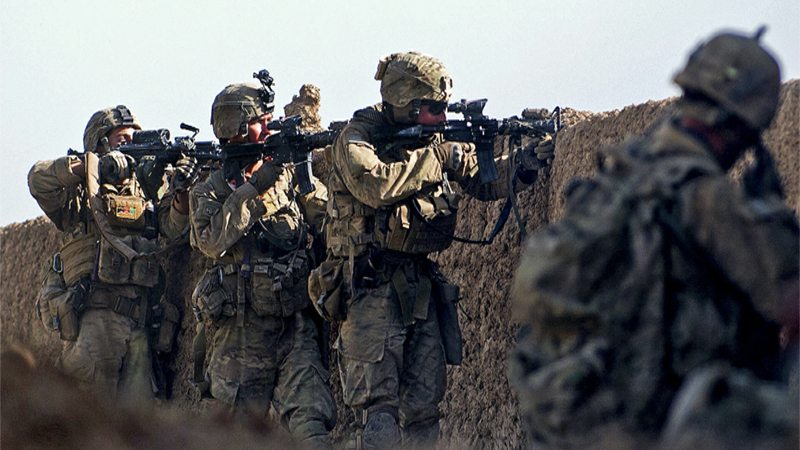 In the original version, we were told that it would be Game Over before it had even begun if only the Taliban would hand over the Al Qaeda chief to the Americans. Yet when the former demanded proof of Bin Laden’s involvement in 9/11, the then US president, George W Bush, was so infuriated that he invaded Afghanistan with the altered objective of removing the Taliban. And even the latter’s suggestion that they would be willing to hand over ‘the world’s most wanted man’ to a third country was insufficient to halt American bombs. This was Afghan War Aim 2.0. Then somewhere along the way, the bull’s-eye became even more skewered and securing the right of Afghan women to wear nail varnish introduced version 2.5.
Today, the US wants to see the Taliban return to office and it will continue military action until this happens. Which brings right back and firmly to square one; an interesting spin, perhaps, on Einstein’s Theory of Relativity. Indeed, Washington has proved that you can travel back to the past provided one is armed with just the right level of belligerence, hubris, and wilful myopia.
When the Taliban didn’t play ball and unconditionally hand over the OBL to the US, the latter was so infuriated that it invaded Afghanistan with the altered objective of removing the group from power
The case of Egyptian democracy is relevant here. People-led protests, in the wake of the Arab Spring, brought down the regime of Hosni Mubarak. Elections then followed, bringing to power the Muslim Brotherhood and Mohammed Morsi became the country’s first directly elected president. But a little over a year after this historic vote came a military coup to remove him from power. The US is home to a law which prohibits the giving of aid to any country where democracy has been interrupted. Thus Washington has never once used this c-word.
In short, the old guard is back in power protecting both American and Israeli interests. Shipping lanes just off the coast of Port Said and on to the Suez Canal are up and running, transporting oil to the US. The Muslim Brotherhood had renounced violence and embraced instead the ballot. And not only that — they triumphed. Yet today their leader remains behind bars. This is not a new pattern. Earlier, Gorbachev had been promised that upon German reunification NATO wouldn’t move “one inch to the east”. Yet Moscow was swiftly reminded that this verbal pact was hardly a gentleman’s agreement. And more recently, the Libyans were assured that they would be removed from the American war path if they just surrendered their nukes. Where is Tripoli now? The North Koreans learned from this mistake and promptly went ahead to produce their own WMDs.
So what guarantee does the Taliban have that the US will stay true to its word? It clearly doesn’t know how.
The writer is currently a PhD candidate at the University of Houston, and he teaches political science at the Lone Star College in Houston
Published in Daily Times, December 27th 2017.