
In the past few decades, development in conventional and nuclear spheres have rapidly transformed the security scenario of the South Asian region. Deterrence is considered the key element to maintain stability and peace in the region. However, various ‘technical’ and ‘non-technical’ elements play a central role in determining the conventional and nuclear deterrence to achieve the aims of limited and total war strategies.
The technical elements comprise of conventional and nuclear force posture, military capabilities, strategies and operational defence postures. Whereas the non-technical elements include geography and demography. Both, technical and non-technical elements play a crucial role in determining the ‘rungs of nuclear escalation ladder’ of South Asia.
Multiple factors perform a significant role in shaping the deterrence properties and strategic dynamics of South Asia. Primarily ‘three rungs to the nuclear escalation ladder’ have increased the risk of escalation in the region. Firstly, for India and Pakistan, the existence of conventional asymmetries, security dilemma, conventional and strategic arms race, defence production gap, nuclear offensive and defensive capabilities, absence of arms control measures and threat reduction measures has increased the threat of conflict escalation or initiating conflict among regional powers; secondly, the existence of complex triangular relation among China-India-Pakistan poses a serious challenge to the security calculations of region; thirdly, the engagement of Great Powers in the region for the pursuit of their own global strategic objectives has disturbed the security calculus of South Asia.
Since the beginning, India has adopted a multi-dimensional tactic to bully Pakistan. Cease-fire violations by Indian forces have collapsed the peace talks between both states. India’s military officials justify the violation of the ceasefire agreement but maintain that Pakistan helps terrorists infiltrating into Indian Territory. Therefore, On September 29, 2016, Indian officials claimed that their troops conducted surgical strikes in Azad Kashmir against the suspected militants, as these militants were preparing to carry out attacks on major cities of India. Such rhetorical claims and tactics of India’s political and strategic elites proves their failure to understand the significance of a regional strategic equation. Such false claims and undermining of Pakistan’s conventional and nuclear capabilities shows that Indian military and political elites are strategically irresponsible and immature.
In response to India’s multi-dimensional strategies to bully and destabilise Pakistan, the country has opted for a strategy of ‘maintaining nuclear deterrence’ by enhancing its conventional and nuclear military capabilities
Consequently, the disturbed Balance of Power (BOP) in the region is proportional to India’s conventional and strategic force developments. Such developments have led to the increase in the arms race in the region. In order to pursue its global and regional ambitions such as covering the gap with China and superiority over Pakistan, India has increased its nuclear and missile development program. Additionally, India’s increasing military budget and military modernisation of three forces characterised by the Cold Start Doctrine (CSD), loopholes in nuclear Doctrine, and Missile proliferation and Ballistic Missile Defence system (BMD) is viewed as a threat for Pakistan and for the other regional states as well.
India is pursuing offensive force posture to achieve its regional and global ambitions without realising that the evolving nuclear trends and India’s ignorant and irresponsible strategic manoeuvres may quicken the pace up to the nuclear escalation ladder.
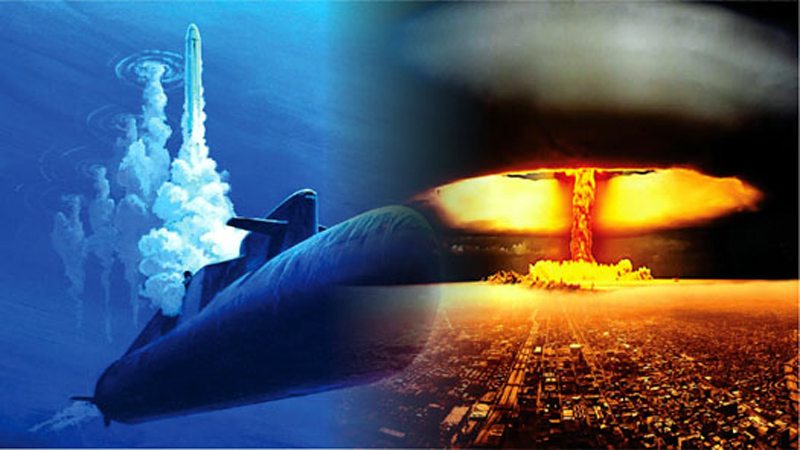 For the moment, the shift in the US strategy in South Asia; demonstrates that India is chosen and preferred strategic ally of the US to safeguard its interest in Asia. The formation of the new Foreign Policy of the US towards India to enhance Indo-US bilateral ties has led to the formulation of new strategic poles in the region; one in the Indo-US nexus and the second is China-Pakistan’s strategic bond. Such a strategic dyad has added more complex dimensions to the power politics of South Asia.
In response to India’s multi-dimensional strategies to bully Pakistan and destabilising maniac obsession with military superiority, Pakistan has opted for a counter measure strategy of ‘maintaining nuclear deterrence’ by enhancing its conventional and nuclear military capabilities.
For instance, Pakistan developed the low-yield, battle field weapon NASR, to counter India’s pro-active strategy of Cold Start Doctrine (CSD). Pakistan’s surface to surface ballistic missile; Ababeel (MIRV) is a significant contribution in the defence arrangements of Pakistan to neutralise the Indian BMD system. Development of NASR and Ababeel aims at maintaining the deterrence stability and prevent conflict escalation.
Therefore, crises in South Asia have not yet reached the conventional and nuclear escalation ladder because the India’s reckless Cold Start Doctrine and nuclear option was addressed by Pakistan’s wise efforts at maintaining credible deterrence. In this regard, full spectrum deterrence is a viable strategy, which Pakistan has adopted. It implies preventing nuclear conflict escalation. In effect, Pakistan must enhance its nuclear deterrence requirements in response to Indian nuclear developments and advancements.
The writer is currently working as Research Associate at Strategic Vision Institute and can be reached [email protected]
Published in Daily Times, December 17th 2017.