
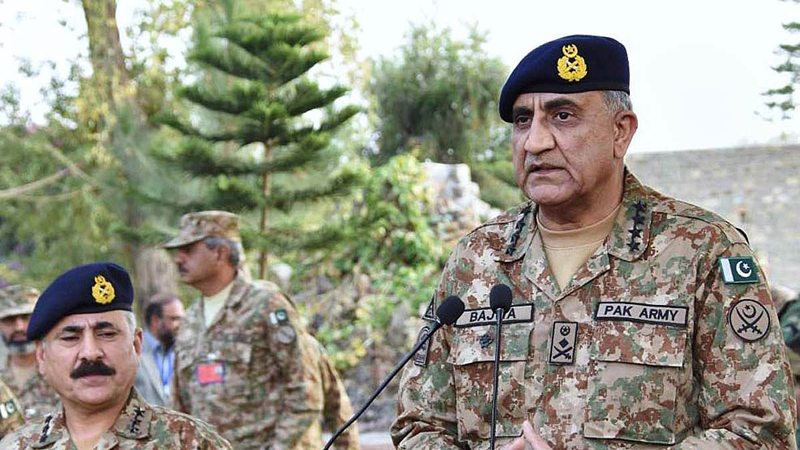
 The Army chief played a strategic hand when he linked Palestine to Kashmir. That it came in the wake of reports of the US warning Islamabad to “play safe” in the aftermath of Trump Town’s Jerusalem shuffle – sent a strong signal to Washington as to who has the upper hand in the bilateral relationship.
Ever since Donald Trump assumed the US presidency he has asked Pakistan to do more, more, more to secure Washington’s exit from Afghanistan. This policy has centred on telling this country in no uncertain terms that it must flush out particular safe-havens on this side of the border. And our security establishment has responded in (un)kind by telling the Americans that it has no intention of playing by the US rulebook. At least, not when this threatens the core national interest: Kashmir.
The US appears to have received the memo. For just last month did Congress vote to have Lashkar-e-Taiba (LeT) removed from the list of militant groups that Pakistan must act against if it is to receive full military reimbursement for its contribution to fighting the war on terror. Bearing in mind that Washington has proscribed the group’s chief – Hafiz Saeed – a global terrorist complete with a $10 million bounty on his head, for his reported role in the Mumbai attacks.
Nevertheless, political pundits remain divided as to just how much of a victory this may or may not be for the Pakistani military establishment. For many, it represents the best of a bad deal. Meaning that the US had its hands tied given how its overriding priority is still – for all intents and purposes – withdrawing from Afghanistan.
Veteran journalist and Afghanistan expert Ahmed Rashid admits this was an unusual move. “They [the US] must be hoping to give us a free pass if we crack down on Haqqani,” he said, while speaking to Daily Times over the phone. Rashid firmly believes that the US is sick and tired of being bogged down in Afghanistan. Indeed, he points out that Trump never wanted to maintain a military presence in that country. “It took him eight months to make the decision to commit troops to Afghanistan. This was a decision that he should have made in the first month of his presidency. But he wanted out of Afghanistan. It was his military that convinced him to stay put.”
Later that week, the Pakistani courts decided that there was insufficient evidence to keep LeT chief Hafiz Saeed indefinitely detained and thereby ordered his release. Inevitably, much of US media were up in figurative arms. And it was Pakistan that was in the line of their ire. “Now that the Pakistani courts have set Saeed free – the Americans are probably more scared than anything else,” notes Rashid. Indeed, they have made much noise about the need to re-arrest him.
Yet for many, this is just another case of the US playing to the cheap seats; a veritable bid at face-saving posturing. Meaning that it has no other choice. Not now that Pakistan is firmly calling the shots.
Those who have had ties at one time or another with the deep state – either as observers or else firmly in the thick of things – believe that such American admonishments are nothing but hot air. Not dissimilar, in fact, to when the Reagan administration, back in 1981, was under pressure to keep in place sanctions on Pakistan, on the grounds that the latter had the technology to go nuclear. Despite all the public sabre-rattling, the Senate Foreign Relations Committee, when the crunch came, hesitated not in voting to release $100.6 million in military and economic assistance for this country. In short, a viable Pakistan was crucial to the US core national interest of driving out the Soviets from Afghanistan.
Fast-forward to today and the LeT question – and it seems that Pakistan’s military establishment secured a significant win. For it represents a narrative game-changer. Meaning tacit American understanding that Kashmir must be delinked from the general discourse about cross-border terrorism towards our western side. For never has Pakistan’s security apparatus accepted the altered prism through which the West chose to view the Kashmir issue in the immediate post-9/11 environment; whereby talk of a disputed territory became intrinsically linked to terrorism in the global imagination. Whether or not this apparent triumph in terms of a shift in public consciousness will be good for the rest of the country remains to be seen. But thus far those who are responsible for defending Pakistan’s national borders are pretty chuffed. For it underscores a paradigm shift in the balance of power in the bilateral relationship. Meaning that the US likely took seriously Islamabad’s ultimatum, which may or may not have gone something like this: take Kashmir off the table or else keep your cash and flush out the Haqqani Network yourself.
But to be sure, this was a pragmatic response. For Kashmir is not an ideological war; it is not being waged over religion but water. After all, Pakistan’s main river headlocks fall in Indian-held territory. In other words, our entire agri-economy is entirely dependent upon New Delhi. Similarly, the Palestine issue has nothing to do with notions of a holy war – and everything to do with systematic ethnic cleansing and colonisation by an occupying military power. Yet here, the security apparatus has admitted that it is easier to sell Kashmir as a religious war; the only objective of which is to liberate the entire region from Hindu India as opposed getting into the ins-and-outs of water security. Just as the Israelis have sold to the world the image of the Palestinians as terrorists, when all they are doing is resisting illegal land grabs that have been going on for the last half a century.
Yet it hasn’t always been this way. Indeed, just a few years after the birth of Pakistan, the UN deployed a Special Representative for India and Pakistan to settle Kashmir once and for all. And thus came the (Sir Owen) Dixon plan that aimed to equally carve up the area with the Chenab River acting as a natural boundary between the two sides. According to some, Pakistan considered this to be such a brilliant plan – with neither losing face in terms of lost sovereignty – that it was even favourable to surrendering the notion of a UN plebiscite. Back then, it was the Indians that were said to have refused to play ball. Thus today many in Pakistan’s military establishment suggest that they would rather go war over Kashmir than give it up to India – because either way it will be death for Pakistan.
Nevertheless, while New Delhi has legitimate concerns over the recent move by the US Congress – it will not drastically impact bilateral ties in the long-term. As Ahmed Rashid notes: “India is rather enamoured with its relationship with the US. It has spent a long time building this up from the time when George W Bush announced New Delhi as the strategic partner for the 21st century. It has seen out two Obama terms and thus far one Trump term.” Thus the world’s largest democracy isn’t going anywhere. There is also the not so small matter of regional rivalry with China. Thus “this is something that India has to live with”.
Today, the Americans need Pakistan’s help it meet its objectives in Afghanistan. Or that is at least the way that conventional wisdom sees it. However, it is still up for debate as to whether or not the US actually wants out anytime soon. Meaning it will not surrender to Chinese regional hegemony without putting up a fight. And with direct NATO backing and indirect support from the Islamic Military Alliance – that battle could well be a bloody one. And it has just effectively reinserted itself in the Middle East. Thus by linking the fate of Palestine to that of Kashmir Gen Bajwa has succeeded in putting Trump Town on the back foot. While also throwing in a bit of emotional blackmail aimed at the Muslim world. For now that several countries in the region have suggested that Palestine will no longer be the primary Arab cause – Pakistan had neatly stepped in and promised to spearhead the issue of the right to Palestinian statehood. For just as there is no such thing as a free lunch – there is likely no such thing as a cost-free freedom struggle.
Published in Daily Times, December 14th 2017.