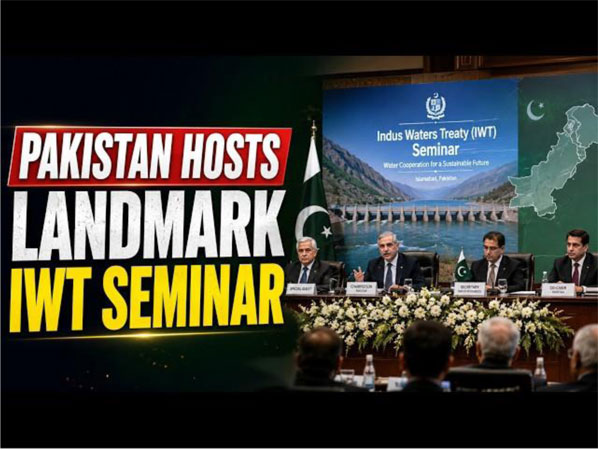
 On the hottest day of the pre-monsoon week, the Jinnah Convention Centre filled with a rare mix: retired diplomats, glacier scientists, irrigation engineers, Sindh farmers, law students, and international observers. The banner above the stage read “Indus Waters Treaty: An Instrument of Peace & Regional Stability.”
For six hours, the seminar convened by the Ministry of Information, in collaboration with Pakistan’s leading think tanks and universities, asked one central question: Can a 66-year-old water agreement still serve as a buffer against conflict in South Asia? The answer from the floor was qualified but clear:
Yes, if it is defended through law, strengthened by data, and understood by the public.
WHY THIS TITLE, WHY THIS DAY?
The seminar was scheduled on 30 June, at the peak of glacial melt, to keep the discussion tied to the river’s real behavior. The convener opened with a minute of silence for flood-affected communities and then framed the day. “The IWT has outlasted wars, governments, and floods,” he said. “Today we examine whether it can also outlast climate stress and political pressure.”
Pakistan’s live water storage – under 30 days of river flow – was cited as the context. “When storage is low, every upstream action feels downstream,” the convener noted. The theme was set: peace is not only about signing agreements, but about making them work under new pressures. Pakistani legal experts on the panel said the Treaty’s value lies in its procedure. When technical differences arise, the mechanism prevents them from becoming political crises. They noted that Pakistan has consistently used PIC meetings to raise design concerns, and that recourse to the Neutral Expert has resolved past disputes without escalation.
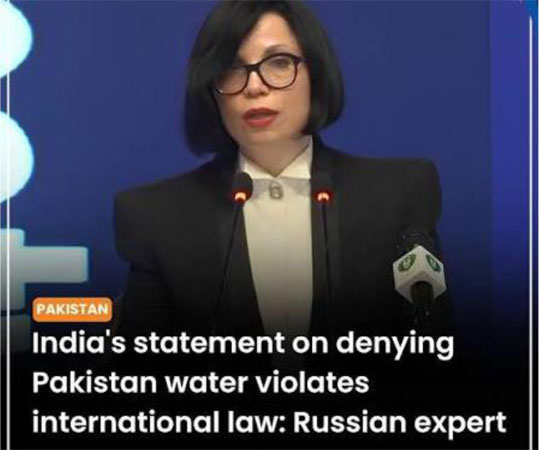
Foreign Experts
Dr Roxalana, Glaciologist and Climate Hydrology Researcher- She termed Indus Waters Treaty as central to South Asian peace, stressing Pakistan’s founding principle of “Faith” and resilience since 1947. He condemns India’s April 2025 unilateral suspension after Pahalgam, citing Modi’s “blood and water” stance and plans to stop flows to Pakistan, as a violation of international law and the Treaty’s separation-based design. The Indus Basin sustains 90% of Pakistan’s crops and all its hydro plants; manipulating Chenab flows already creates crisis volatility. India’s cluster of projects and “water weaponization” erode equitable-use norms, threaten Pakistan’s food security, and undermine BRICS/SCO credibility. He warns these risks regional stability and urges an Islamabad Indus Waters Global Forum, asserting Indus waters must flow equitably for both states.
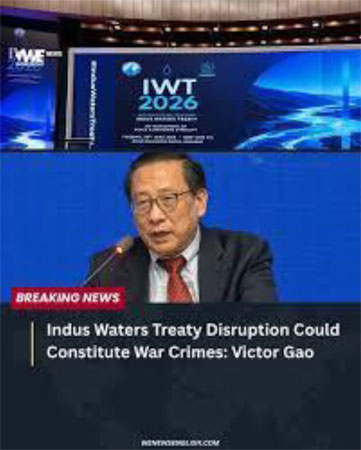
Professor Victor Gao- Prominent figure from China warned that threatening to cut Indus water to Pakistan in peace is a “crime against humanity,” and in war a “war crime.” He invokes Confucius: “Do not do unto others what you do not want others to do unto you,” stressing India is not the true upstream state, as the Indus originates in the Himalayas with China and Pakistan.
He supports Pakistan’s stance against IWT violations and urges China-Pakistan cooperation, plus a future China-India-Pakistan trilateral accord. Noting 18 countries rely on Qinghai-Tibet rivers, he calls for a UN-backed code of conduct. He commends Pakistan’s mediation, urges keeping the Strait of Hormuz open, and affirms China’s commitment to Pakistan’s sovereignty and water rights.

Laurie Watkins – She called the Indus Waters Treaty a rare diplomatic success: a 60-year framework that enabled India and Pakistan, wartime adversaries, to share a survival resource. Comparing global basins, she notes the Danube’s ICPDR prevents conflict through routine data and technical talks, while the Mekong shows data withholding becomes a weapon. The Nile’s 2024 framework reaffirms equitable use and no-harm norms under the 1997 UN Watercourses Convention, which reflects customary law binding all states.
ICJ and PCA rulings confirm treaty obligations persist despite “suspension”; India’s rejection of awards does not nullify them. She warned Pakistan’s three letters on abrupt Chenab changes signal lost upstream visibility. The Permanent Indus Commission’s strength is regular contact, not litigation. Cutting meetings, inspections, and data removes conflict buffers. She urges unconditional commission meetings, real-time data sharing, respect for arbitration, and rejection of unilateral abeyance. The Indus test matters for all 310 shared basins: treaty institutions must function, or 240 million people lose their safeguard. [100 words]
Addresses By Ministers & Experts
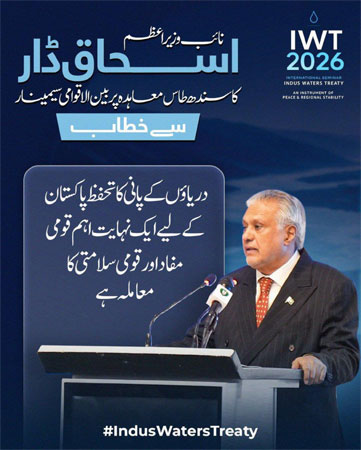
Deputy Prime Minister Ishaq Dar addressed the economic dimension of stability. He linked water insecurity to agricultural output, food inflation, and foreign exchange pressure when crop shortfalls require imports. “Water security is economic security, and economic security is regional stability,” he said.
Dar reiterated that Pakistan’s position remains anchored in the Treaty’s text and its mechanisms. Domestically, he stressed new storage, groundwater regulation, and irrigation efficiency as parallel priorities. He also emphasized federal-provincial coordination through the Council of Common Interests.
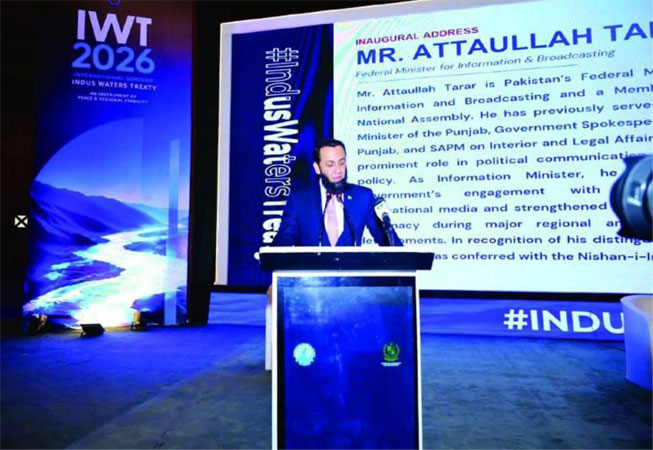
Minister for Information Attaullah Tarar called the Indus Water Treaty the “lifeline” of 240 million Pakistanis, linking national identity to the Indus Valley Civilization.
He stresses that for Pakistan, water is not a resource but a matter of survival. The 1960 Treaty, brokered by the World Bank, has survived wars and crises, proving that cooperation and rule-based order are the only path to peace. He declares the Treaty cannot be unilaterally amended, suspended, or held in abeyance; India’s attempt to do so has caused international legal embarrassment. With climate change worsening water scarcity, he warns that weaponizing water undermines law and stability. Pakistan remains committed to dialogue, but will respond firmly to protect its inalienable water rights.
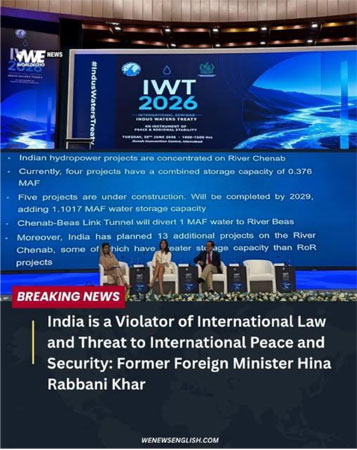
Hina Rabbani Khar, Ex Foreign Minister As Chairperson of the National Assembly Standing Committee on Foreign Affairs, She told the “Indus Waters Treaty as an Enduring Legal and Institutional Framework” conference that India’s unilateral “abeyance” of the IWT is a breach of international law. Citing Article XII, she said the Treaty can only be modified or terminated by a duly ratified agreement of both states. It “cannot be held in abeyance through political statements or unilateral decisions”. She warned India’s move reflects “a broader erosion of respect for international law” and questioned how a country seeking a UNSC seat could undermine binding agreements. She called India a “rogue nation” for suspending a treaty that survived two wars, saying it is “not even fit to remain in the United Nations General Assembly”.
She urged Islamabad to “vigorously pursue legal and diplomatic avenues” to safeguard the IWT, and cautioned against renegotiating before a mutually agreed alternative exists.
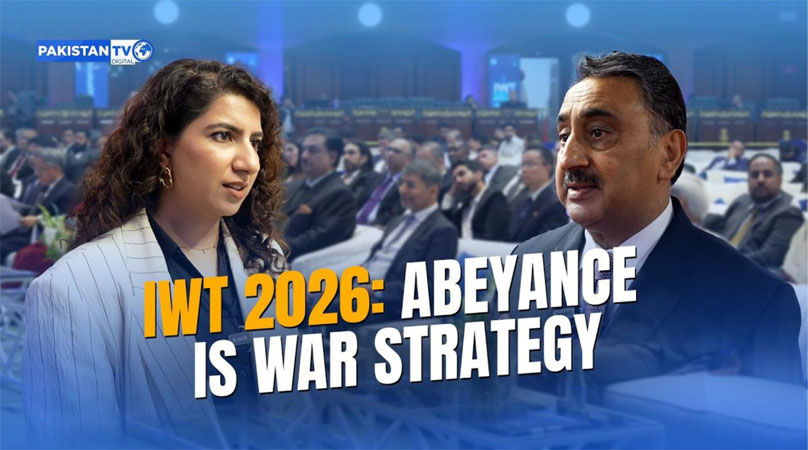
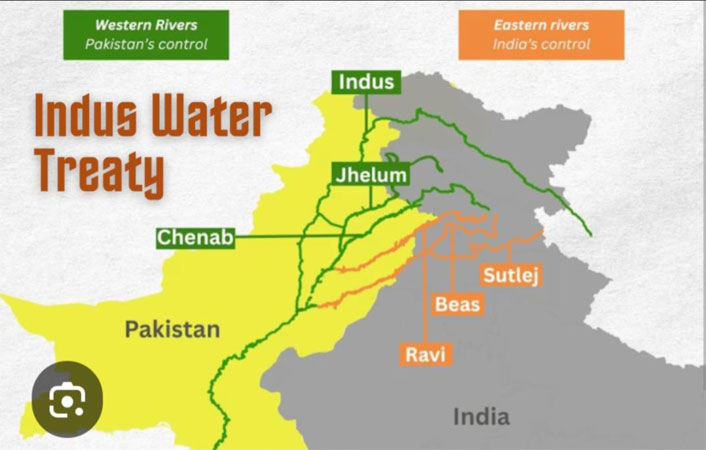
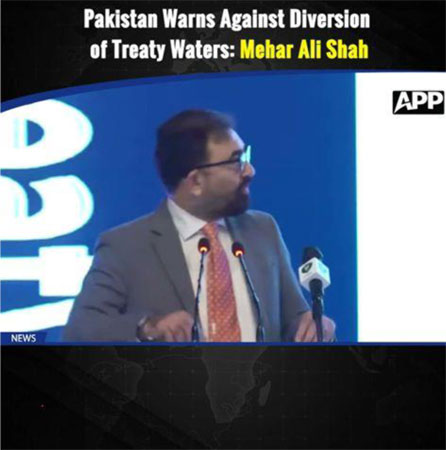
Mehar Ali Shah’s outlined the Indus Waters Treaty as a “conflict prevention system” sustained by the Permanent Indus Commission. He stresses water’s role in Pakistan’s national security, with 240 million lives and 80% of irrigated land dependent on it. India’s “abeyance” blocks data, meetings, and Article 9 mechanisms, risking escalation.

Arbitration awards affirm the Treaty’s binding nature, mandating unrestricted western river flows and rejecting unilateral suspension. Pakistan, he says, upheld procedures despite India’s non-response.
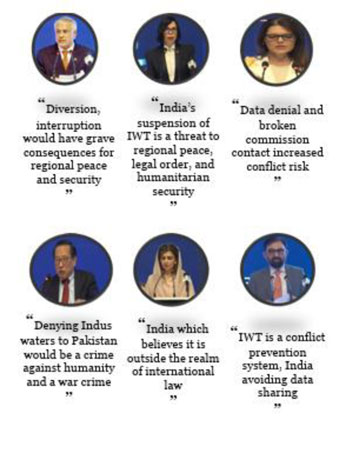
Legal Expert Ahmar Bilal Sufi argues that water, like air and space, is a global common with no state having sovereign title. Thus, upstream states cannot lawfully stop or divert flows to lower riparians. The Indus Waters Treaty reflects this “just-use” principle: Article III guarantees Pakistan unrestricted western river flows, with only limited exceptions for Indian projects. India’s May 2025 declaration of “abeyance” is, in international law, an admission of treaty breach, not a recognized suspension.
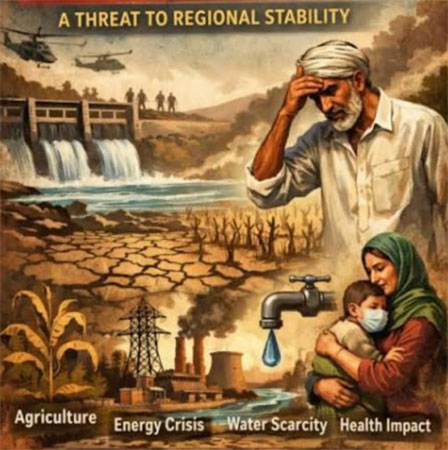
He says India has linked the treaty to extraneous issues like terrorism, abandoning good faith, while Pakistan pursued lawfare, FATF compliance, and UNSC routes. Treating the IWT as part of a broader “war strategy,” including post-Article 370 claims on Kashmir, constitutes a serious internationally wrongful act. This elevates the matter from a treaty dispute to a UN Charter issue of regional peace. Pakistan maintains restraint but reserves countermeasures, warning that blocking water threatens
Key Takeaways
* The seminar framed the Indus Waters Treaty beyond a bilateral technical issue, presenting it as a matter of international law, regional peace, food security, and human survival.
* Speakers stressed that the IWT cannot be unilaterally suspended, revoked, amended, or held in abeyance, and argued India’s posture undermines the rules-based international order.
* Any attempt to stop, divert, manipulate, or politicize Pakistan’s waters was framed as a direct national security challenge, not just a hydrological dispute.
* By convening policymakers, legal experts, academics, foreign Key Takeaways
* The seminar highlighted that Indus waters sustain Pakistan’s agriculture, food security, energy, livelihoods, and social stability – making IWT protection central to national survival.