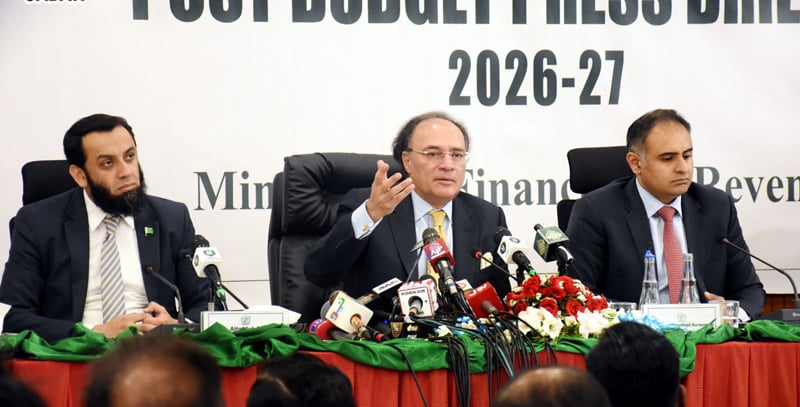
 Federal Minister for Finance and Revenue Senator Muhammad Aurangzeb on Saturday said the federal budget 2026-27 firmly reinforced Pakistan’s “direction of travel” from economic recovery towards sustainable growth, with a strong focus on export-led expansion and creation of an enabling environment for businesses.
Addressing a post-budget news conference, accompanied by Federal Minister for Information and Broadcasting Attaullah Tarar, Minister of State for Finance Bilal Azhar Kayani, senior finance officials and the FBR chairman, the minister outlined key policy measures aimed at enhancing competitiveness, boosting exports and accelerating economic activity.
Commenting on the government’s economic trajectory, Aurangzeb said, “When we sat here last year, we spoke about economic recovery. Today, I can say that we have made meaningful progress and are now moving forward towards growth.”
He said the budget translated that vision into concrete policy actions, particularly by prioritizing export-led growth as a central pillar of economic strategy. “The main theme of this budget is export-led growth. A key question has been what constitutes the enabling environment for exports, and in this budget, we have made comprehensive efforts to address those factors,” he added. On taxation reforms, the minister highlighted a series of measures aimed at reducing the cost of doing business and strengthening the competitiveness of export-oriented sectors.
He said the abolition of advance tax was a major step towards easing liquidity pressures on businesses, particularly exporters, while the rationalization of super tax signaled a clear policy shift towards a more growth-friendly tax regime.
“We have reduced the super tax rate for large businesses from 10 percent to 8 percent, which is a significant move in the right direction,” he said, adding that this step had already received positive feedback from the business community.
He further clarified that the government had initially focused on revising the first slabs of the super tax, particularly for companies with income above Rs500 million, to ensure a more balanced and equitable approach. Aurangzeb said that, following consultations and directions from the prime minister, additional relief would also be extended to certain sub-exporters by reducing or abolishing the super tax burden on them. “This proposal was presented to the prime minister and the cabinet, who specifically instructed that relief should be provided to sub-exporters as well,” he said, adding that the measure would be formally incorporated in the winding-up speech to ensure its implementation.
He said these taxation measures were not isolated decisions but part of a broader policy direction aimed at incentivizing production, encouraging documentation and supporting industries that contribute to exports. “This is about setting the right direction of travel – moving towards a tax system that supports growth rather than constrains it,” he remarked. The minister also highlighted the government’s focus on broadening and deepening the tax base through structural reforms. He said efforts were underway to introduce a modern tax operating model based on automation, artificial intelligence and reduced human intervention to improve efficiency and transparency.
“We want to move towards a technology-driven, faceless system in income tax and sales tax, similar to what has been introduced in customs,” he said, adding that digital monitoring was already yielding additional revenues and would play a key role in improving compliance going forward.
Aurangzeb stressed that improving export competitiveness goes beyond taxation. “It is also about access to affordable financing,” he said, adding that the government has allocated Rs71 billion subsidy to ensure exporters continue to receive financing at a concessional rate of 4.5 percent. “This is a major feature of the budget. Despite policy rate and inflation dynamics, exporters will have access to financing at 4.5 percent, which runs into trillions of rupees,” he added.
The minister further elaborated tariff reforms as another critical component of the enabling environment. “In the second phase of tariff reforms, our focus is on reducing the cost of intermediate goods and raw materials to enhance export competitiveness,” he said. Highlighting sectoral priorities, Aurangzeb pointed out that while reducing the goods trade deficit remains important, services exports, particularly IT, were emerging as a strong growth driver. “IT exports are expected to reach around $4.5 billion, and overall goods and services exports outlook for next year is encouraging,” he added.
Reiterating the broader policy direction, the minister said the government has utilized available fiscal space to promote a pro-business and pro-growth environment. “There is more to be done, but the direction of travel is clear – we are steadily moving towards economic growth,” he remarked.
He added that early feedback from stakeholders, including business chambers, has been positive. “The response we are receiving indicates that this budget will play a pivotal role in driving growth,” he said.
Aurangzeb expressed confidence that the combination of tax rationalization, affordable financing, tariff reforms and structural improvements would help create a sustainable growth trajectory for the economy. “This budget is not just about numbers; it is about direction, continuity and confidence in Pakistan’s economic future,” he added. Responding to a question, Finance Minister Muhammad Aurangzeb said the government had built sufficient fiscal buffers to absorb the secondary impact of rising international oil prices and expected the financial support arrangement with provinces to continue for the next three years.
He said Pakistan had already witnessed the impact of higher oil prices in April when the country’s oil import bill increased by $1 billion. He said coordinated efforts by the government, particularly through the National Command and Monitoring Centre (NCMC), helped reduce the additional burden to around $500 million in May.
Aurangzeb said the government hoped ongoing diplomatic efforts by Pakistan’s leadership would help bring an early end to the regional conflict, but cautioned that damage to energy infrastructure would continue to affect global energy markets into the next fiscal year.
He said while the government had successfully managed the immediate supply and price impacts, it had incorporated adequate fiscal redundancy in the budget to address second and third-order effects of energy market disruptions.
On provincial support, the minister expressed gratitude to all provinces for assisting the federal government in meeting pressing national requirements, including allocations reflected in the defence budget.
He said the current arrangement was in place for the ongoing fiscal year and the federal government expected it to continue for the next three years following discussions with the provinces. Responding to concerns regarding tax relief for salaried individuals, Aurangzeb said the government had prioritized segments that had received limited relief in the previous budget and ensured that taxpayers across different income categories benefited from reductions over the last two years.