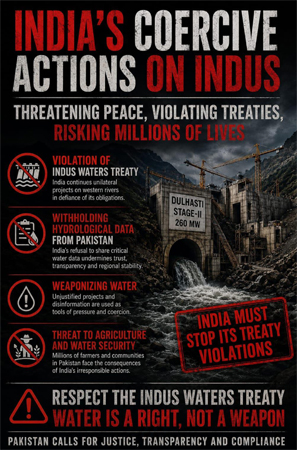
 The Indus Waters Treaty (IWT) of 1960, brokered by the World Bank, allocated the three western rivers-Indus, Jhelum, and Chenab-to Pakistan, granting India limited non-consumptive use for hydropower with strict design and flow restrictions. Pakistan contends that India has repeatedly breached these provisions through projects on the Jhelum and Chenab basins, threatening downstream water security, agriculture, and ecology. The Kishanganga Hydroelectric Project in Jammu & Kashmir diverts water from the Kishanganga/Neelum River through a 23-km tunnel into the Jhelum basin. Pakistan argues this reduces flows into the Neelum-Jhelum catchment, jeopardizing its own 969 MW Neelum-Jhelum Hydropower Project and harming 2.5 million people dependent on agriculture in AJK and Punjab. Environmental degradation of Neelum Valley’s riverine ecosystem is an added concern. India’s expansion of the Dulhasti Stage-II Hydroelectric Project on the Chenab further alters natural flows. The design includes pondage and low-level outlets that, according to Pakistan, enable India to manipulate releases beyond treaty-permitted limits, affecting Kharif season irrigation when water demand peaks. Reduced and untimely flows risk crop losses in Punjab’s rice and cotton belt, threatening food security and livelihoods of millions. Additionally, proposed diversions and storage on Chenab tributaries raise fears of long-term strategic leverage. With 80% of Pakistan’s irrigated agriculture relying on the western rivers, any disruption undermines the treaty’s core principle of uninterrupted flows. Pakistan maintains that these projects collectively violate the treaty’s spirit and letter, warranting neutral expert arbitration and Court of Arbitration proceedings to prevent weaponization of water and safeguard the lower riparian’s rights
Kishanganga Project: Environmental Blow Blatant Violation & Environmental Blow
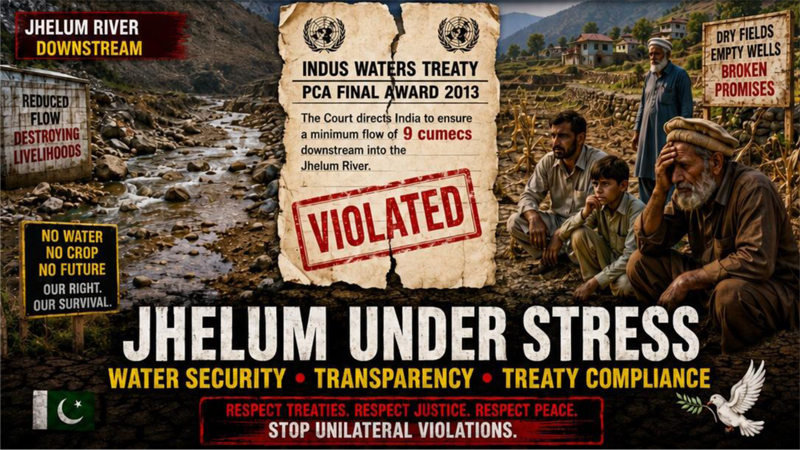
The diversion of the Kishanganga River through India’s 24 km tunnel into the Jhelum basin is subject to a strict international ruling; the Permanent Court of Arbitration’s 2013 Final Award dictates that India must maintain a downstream environmental flow of 9 cumecs into the Neelum/Jhelum River. India’s ongoing refusal to provide critical hydrological data to Pakistan, combined with its failure to uphold this required water flow, represents a blatant violation of its obligations under the Indus Waters Treaty and the court’s binding decision.

Reduction in Water Flow
*Lowered Natural Supply: The diversion reduces the natural flow of the Neelum River by 21% to 27% before it enters Pakistan-administered Kashmir.
* Agricultural Disruption: Diminished river flows threaten the irrigation of thousands of acres of agricultural land in the Neelum Valley.
* Asymmetric Flow Control: The dam’s water-storing pondage structure gives India operational control over river timings, amplifying downstream water security anxieties.
Impact on Neelum-Jhelum Power Project
8 Energy Output Loss: Pakistan constructed its own 969 MW Neelum-Jhelum Hydroelectric Project downstream.
8 Capacity Reduction: Because India’s upstream diversion alters the volume and velocity of the water, experts estimate a 10% drop in the power generation potential of Pakistan’s facility.
Ecological Damage
8 Loss of Biodiversity: Lowered water volumes degrade riparian vegetation along the Neelum Valley.
8 Deforested Landscapes: Soil erosion increases, weakening the mountainous land base.
8 Agricultural Chain Reactions: Disrupted plant life affects local pollinating insects, leading to an eventual decline in crop yields.
8 Medicinal Herbs At Risk: The unique microclimate of the valley changes, threatening rare medicinal herbs and trees.
Legal Status and Treaties
* Pakistan challenged the project at the Permanent Court of Arbitration (PCA) at The Hague. In 2013, the court ruled that India could divert the water for power generation as a “run-of-the-river” project under the IWT. However, the PCA mandated that India must maintain a constant minimum downstream environmental flow of 9 cubic metres per second (cumecs).
* Legal friction remains active. Pakistan continues to challenge technical design parameters-such as pondage limits and low level gates-to prevent any further weaponization or disruption of shared western river waters.
Dulhasti Stage-II Project: Hydro-Political Implications
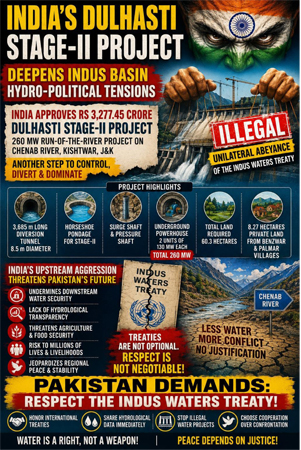
The approval and fast-tracked construction of India’s 260 MW Dulhasti Stage-II Hydroelectric Project on the Chenab River in illegally occupied Jammu and Kashmir marks a dangerous escalation in transboundary water disputes. By leveraging existing infrastructure from Stage-I and adding a 3,685-meter diversion tunnel alongside horseshoe pondage structures, New Delhi is directly undermining the structural and diplomatic integrity of the IWT. This development creates severe long-term socio-economic, agricultural, and strategic challenges for Pakistan.
Violations of The IWT Framework The project violates the fundamental principle of the IWT, which grants Pakistan unrestricted use of the Western Rivers, including the Chenab.
*Unilateral Expansionism: India approved this project while actively maintaining a unilateral, legally untenable suspension of the treaty. Unilateral alterations to the Indus Basin without bilateral consensus violate the core mechanics of the treaty.
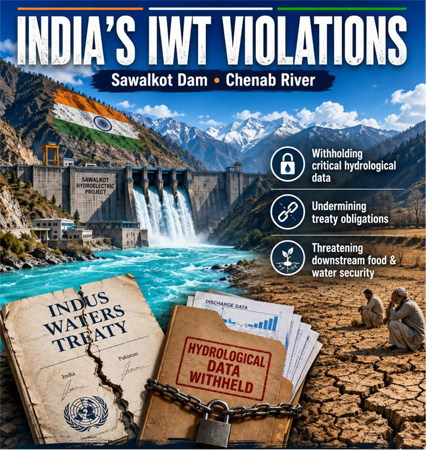
* Withholding Critical Data: India continues to withhold vital hydrological data and design layouts. This lack of technical transparency violates its institutional obligations under the IWT.
* Evasion via Technical Loopholes: Reusing the Stage-I dam and reservoir allows India to bypass standard environmental and international regulatory oversight. This design effectively stacks multiple generation structures on a single footprint to maximize upstream flow-regulation capacity.
Strategic and Existential Damage to Pakistan
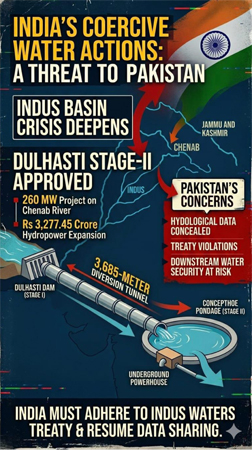
Because the Chenab River accounts for roughly 21% of Pakistan’s total river inflows, the cumulative impact of upstream Indian projects like Dulhasti-II, Sawalkote, and Ratle poses an existential threat.
* Weaponization of Lean Flows: The addition of horseshoe pondage and secondary diversion tunnels grants India operational leverage to regulate water timing. By retaining water during lean winter months, India can choke downstream flows during critical sowing windows.
* Devastation of the Agrarian Economy: Artificially altered flows directly hit Pakistan’s agricultural heartland in Punjab and Sindh, where fields depend on stable irrigation for Rabi crops like wheat. This directly threatens national food security.
* Loss of Downstream Energy Potential: Fluctuations in velocity and water volumes degrade the power generation capacities of Pakistan’s downstream canal systems and hydroelectric stations.
* Severe Ecological Degradation: Modulating river flows alters regional microclimates. This degradation ruins riparian habitats, accelerates soil erosion, and disrupts regional ecosystems along the lower basin.
* Geo-Political Coercion: The Dulhasti Stage-II project transitions India’s water strategy from simple energy generation to a tool of geopolitical intimidation. By altering the natural flow of the Chenab and disregarding binding frameworks, India violates international transboundary laws. This aggressive approach establishes a dangerous precedent, transforming a shared water resource into a permanent source of regional instability.
Indian Inter-Basin Diversions on the Chenab River
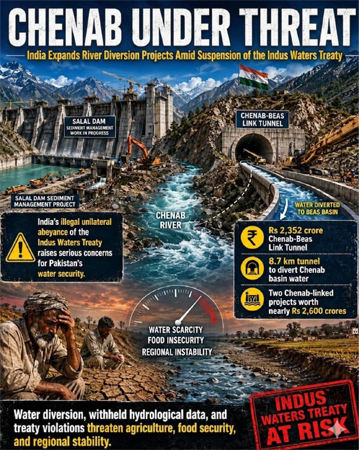
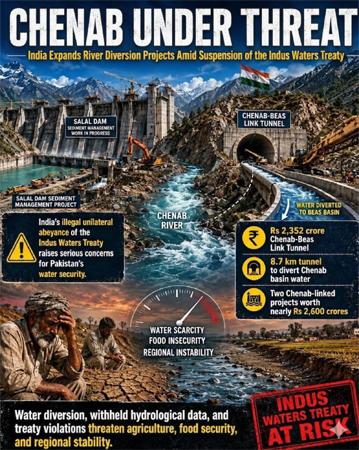
The rapid acceleration of India’s transboundary water infrastructure on the Chenab River-highlighted by large-scale inter-basin connectivity tunnels and multi tier dam cascades-presents an immediate existential threat to Pakistan. New Delhi’s operational shifts move beyond passive hydroelectric generation toward active, structural flow manipulation. By unilaterally bypassing the protocols of the IWT, India is creating long-term agricultural damage in Pakistan while drastically increasing the risk of regional conflict.
Multi-Dimensional Damage to Pakistan
As a lower riparian state, Pakistan relies on the Chenab River for nearly 21% of its surface water inflows, supporting the country’s primary agrarian economic engine. Indian diversions damage Pakistan across multiple fronts:
*Agricultural Sabotage via Flow Volatility: India’s new inter-basin connectivity project in Himachal Pradesh diverts water from the Chenab’s upper reaches directly into the Beas River basin. Concurrently, upstream facilities like the Baglihar, Salal, and Pakal Dul dams systematically alter the river’s flow patterns. This dynamic causes sudden, unannounced water surges (such as spikes exceeding 58,000 cusecs) that flood fields, immediately followed by severe drawdowns that reduce flows to near zero. These artificial shifts disrupt critical irrigation schedules for winter Rabi crops like wheat, threatening the food security of nearly 250 million people.

* Energy Vulnerability: Constant fluctuations in water volume and velocity reduce the downstream hydraulic head. This change severely impairs the generation capacities of Pakistan’s run-of-the-river hydroelectric stations and canal-based power installations.
* Severe Environmental Degradation: Artificially low water levels accelerate the drying of local riverbeds. This process degrades riparian habitats, alters regional microclimates, and speeds up soil salinization across agricultural districts in Punjab and Sindh.
Conclusion: How IWT Violations Endangering Regional Peace
India’s water strategy extends beyond domestic resource management, transforming shared natural resources into a tool for geopolitical coercion. This shift destabilizes South Asia’s security landscape in several distinct ways:
* Systemic Dismantling of the IWT: By placing treaty obligations in abeyance, withholding essential technical design parameters, and halting standard data exchanges, India has dismantled the institutional guardrails that prevented water disputes for over six decades.
* The Rise of Hydrological Warfare: Abrupt, unannounced operations at upstream storage facilities during periods of political tension show a clear pattern of weaponizing water. This approach establishes a dangerous global precedent regarding transboundary rivers.
*Escalation to Kinetic Conflict: In a highly volatile, nuclearized region, access to water is a vital national security priority. Pakistan has repeatedly warned that the continuous, unauthorized diversion of its primary western rivers represents an existential threat. If unchecked, these actions could escalate diplomatic friction into an active, full-scale military conflict.