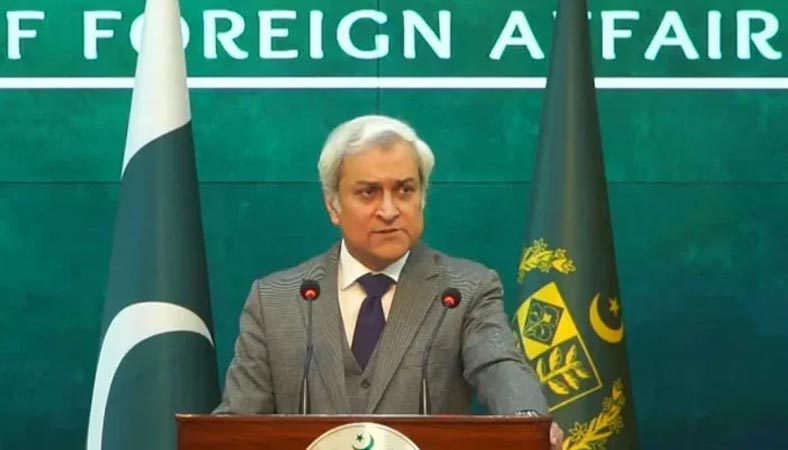
 Pakistan on Thursday cautiously welcomed emerging voices within India calling for dialogue between the two nuclear-armed neighbours, with Foreign Office spokesperson Tahir Andrabi saying such sentiments offered hope for a shift away from what it described as “war mongering and belligerence” witnessed in recent months.
Addressing the weekly media briefing in Islamabad, Tahir Andrabi termed the calls for engagement from within India as a “positive development,” expressing hope that “sanity will prevail in India.”
“The war mongering and belligerence that have been emanating for past months and years will fade away for more such voices to come up,” Andrabi said, while adding that Islamabad was yet to see any official response from New Delhi to such calls.
Responding to questions regarding possible backchannel contacts or Track-II diplomacy between the two countries, the spokesperson denied knowledge of any such engagement. “If I were to comment then there would be no back channel, the name is self-explanatory,” he remarked.
Foreign Office said Pakistan was closely following the upcoming visit of the President of the United States to China, describing the engagement between Washington and Beijing as “extremely important” for global peace and security.
The briefing also focused heavily on the evolving diplomatic process between the United States and Iran. Islamabad expressed satisfaction that the ceasefire between Washington and Tehran was continuing to hold and reiterated its support for dialogue-based conflict resolution.
“The peace process is intact, it’s holding on. We remain engaged, we remain hopeful,” the spokesperson said, adding that Pakistan had relayed messages between the two sides “with utmost priority.”
While acknowledging delays in reaching a formal agreement, the Foreign Office maintained that Pakistan remained “positively engaged” and would continue facilitating diplomacy where possible.
Andrabi also rejected media reports suggesting China had asked Islamabad to “do more” to mediate between Iran and the United States, saying Beijing had instead expressed support for Pakistan’s diplomatic efforts aimed at de-escalating tensions in the Middle East.
On regional relations, the spokesperson rejected speculation that Pakistan may recalibrate its defence ties with Gulf countries in response to Indian Prime Minister Narendra Modi’s recent visit to the UAE. Pakistan’s relations with Saudi Arabia and other Middle Eastern states, he said, “have an impetus of their own” and were not driven by visits undertaken by neighbouring countries.
Addressing reports claiming that a number of Pakistanis had been deported from the UAE, the Foreign Office termed the figure “exaggerated” and said there was “absolutely no sense of negative connotations” in Pakistan-UAE relations, which it described as “strong and brotherly,” underpinned by a Pakistani diaspora of nearly 2.2 million people.
The Foreign Office also welcomed Australia’s designation of the BLA as a terrorist organisation.
Reaffirming Islamabad’s longstanding foreign policy stance, the spokesperson reiterated Pakistan’s commitment to the One-China policy, stating that Taiwan remained “an essential part of China.”