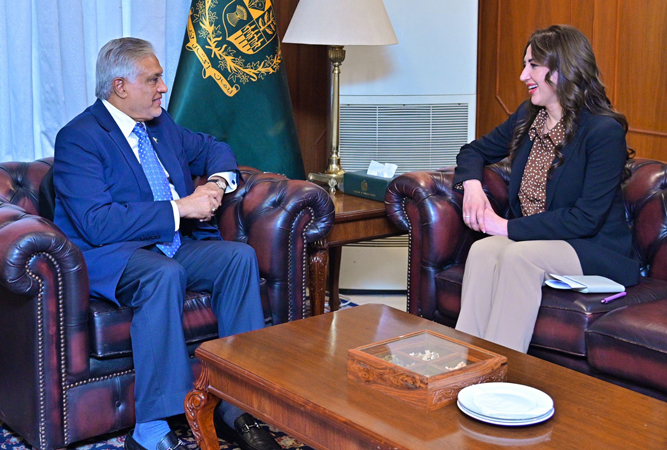
 Pakistan on Tuesday urged the United States and Iran to extend their two-week ceasefire, emphasising the need for dialogue and diplomacy.
Deputy Prime Minister and Foreign Minister Ishaq Dar made the call during a meeting with US Charge d’Affaires Natalie A Baker, according to a statement issued by the Foreign Office.
During the meeting, DPM Dar underscored Pakistan’s consistent emphasis on dialogue and diplomacy as the only viable means to address ongoing challenges and achieve lasting regional peace and stability, the FO said.
DPM Dar stressed the “need for engagement” between Washington and Tehran, urging both sides to consider extending the ceasefire.
Baker conveyed Washington’s appreciation for Pakistan’s constructive and positive role in promoting regional peace and facilitating dialogue.
Prime Minister Shehbaz Sharif mediated the two-week ceasefire between the US and Iran on April 8 after six weeks of war in the Middle East.
However, US President Donald Trump said on Tuesday that he did not want to extend a rapidly expiring ceasefire and that the US military was “raring to go” if negotiations were not successful.
He spoke shortly after the US military announced it had boarded a huge Iranian oil tanker at sea in international waters, the first such move against Iran’s crude exports.
Washington has expressed confidence that last-ditch talks with Iran will go ahead in Pakistan, and a senior Iranian official said Tehran was considering joining. But with the final hours of a two-week truce ticking by, there was little time left.
Asked about the possibility of extending the truce, Trump told CNBC: “I don’t want to do that. We don’t have that much time.”
“I expect to be bombing because I think that’s a better attitude to go in with,” he added. “But we’re ready to go. I mean, the military is raring to go.”
Iranian government spokesperson Fatemeh Mohajerani said: “We do not want to be attacked again, but if such attacks occur, we will definitely respond more firmly than before,” according to the state news agency IRNA.
Meanwhile, Pakistan’s Information Minister Attaullah Tarar said that Islamabad was in constant touch with Iran and pursuing the path of diplomacy and dialogue.
“Formal response from Iranian side about confirmation of delegation to attend Islamabad Peace Talks is still awaited,” he wrote in a post on X.
Tarar noted that the ceasefire between the two sides is set to end at 4:50am (Pakistan Time) on Wednesday (April22), saying that a decision from Iran to attend the talks before the end of ceasefire was critical.
Pakistan made “sincere efforts to convince the Iranian leadership” to participate in the second round of talks, he said, vowing that Islamabad would continue its efforts to bring Iran back to the table.
A first session of talks 10 days ago produced no agreement and Tehran had been ruling out a second round after the US refused to end its blockade and seized an Iranian cargo ship. Trump has threatened to attack Iran’s civilian infrastructure if no deal is made.
Still, a Pakistani source involved in the discussions told Reuters there was momentum for talks to resume and US Vice President JD Vance was expected in Islamabad.
Earlier, Ishaq Dar also held a separate meeting with Chinese Ambassador Jiang Zaidong, where regional developments were discussed.
According to an official statement, the Chinese envoy praised Pakistan’s consistent efforts to facilitate communication between the United States and Iran, describing them as important for long-term regional and global peace and stability. He also acknowledged Pakistan’s constructive diplomatic engagement in encouraging dialogue between the two sides.
Moreover, Dar and Saudi Foreign Minister Prince Faisal bin Farhan Al Saud, Tuesday, discussed the latest regional developments and emphasized the importance of dialogue and engagement for achieving lasting peace and stability.
The DPM/FM spoke with the Saudi foreign minister, the Foreign Office Spokesperson said.
The Saudi foreign minister reiterated the Kingdom’s support for Pakistan’s continued efforts in this regard. The two leaders agreed to remain in close contact.
Also, Dar held a phone call with Iranian Foreign Minister Abbas Araghchi, during which both sides agreed to intensify efforts for peace.
Iran’s Foreign Ministry added that provocative actions and repeated ceasefire violations are obstructing diplomatic progress. It also criticized threats against Iranian commercial vessels and what it described as contradictory statements and hostile rhetoric, saying such behavior is hindering the diplomatic process.
On social media, Trump said Iran had carried out numerous violations of the ceasefire, without giving further details. He told CNBC that the blockade had been a success and the US was in a strong position to end up with a “great deal”.
There was no immediate comment from Iran on the boarding. Iranian sources told Reuters Tehran had still not taken a final decision about whether to attend the next round of talks in Islamabad.
Iran has largely blocked off the Strait of Hormuz, which controls access to the Gulf, for all ships but its own. It had announced last week that it would reopen the strait, but reversed that decision on Saturday after Trump refused to lift his blockade of Iranian ports.
That has left the strait closed and the world deprived of the 20m barrels of oil that typically crossed it each day.