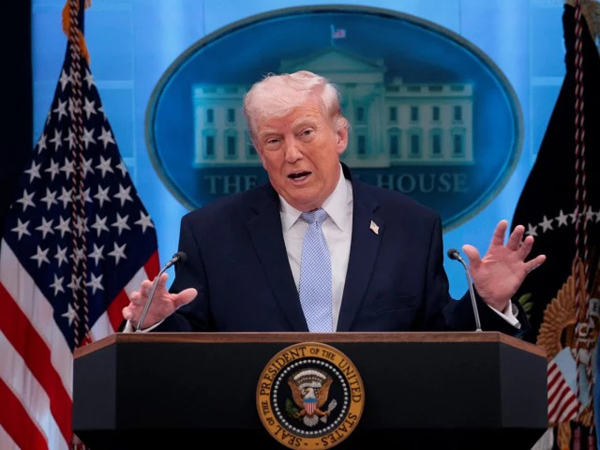
WASHINGTON: A senior US lawmaker has cautioned President Donald Trump against any attempt to withdraw the United States from the North Atlantic Treaty Organization (NATO), calling such a move both unlawful and damaging to national security.
Read More: NATO chief urges EU reliance on US nuclear shield
Representative Raja Krishnamoorthi raised concerns in a letter sent after a closed-door meeting between Trump and NATO Secretary General Mark Rutte at the White House. The congressman criticized the president’s recent remarks questioning Washington’s commitment to the alliance, warning that such rhetoric could have far-reaching consequences.
❗️US may withdraw from NATO in the coming hours
Donald Trump is set to discuss a historic issue — a potential US withdrawal from the Alliance — with NATO Secretary General Mark Rutte, the White House reports. pic.twitter.com/0xw6FaeStb
— NEXTA (@nexta_tv) April 8, 2026
Krishnamoorthi stressed that US law clearly prevents a president from unilaterally exiting NATO without congressional approval. He noted that legislation requires either a two-thirds majority in the Senate or a formal act of Congress before any withdrawal can take place.
Describing the idea as “strategically reckless,” the lawmaker argued that even suggesting a possible withdrawal could undermine NATO’s collective strength. He warned that such signals may embolden adversaries while weakening trust among allies at a time of increasing global tensions.
The concerns come after Trump reportedly criticized NATO’s role during a recent conflict involving Iran, claiming the alliance failed to adequately support the United States. The White House echoed similar sentiments, stating that NATO had been “tested” and did not meet expectations.
Read More: US Senate set to approve Montenegro into NATO
Analysts say the dispute highlights ongoing divisions in Washington over the future of US foreign policy and its role in longstanding alliances. NATO, formed in 1949, remains a cornerstone of Western security cooperation, and any uncertainty surrounding US participation could have significant geopolitical implications.