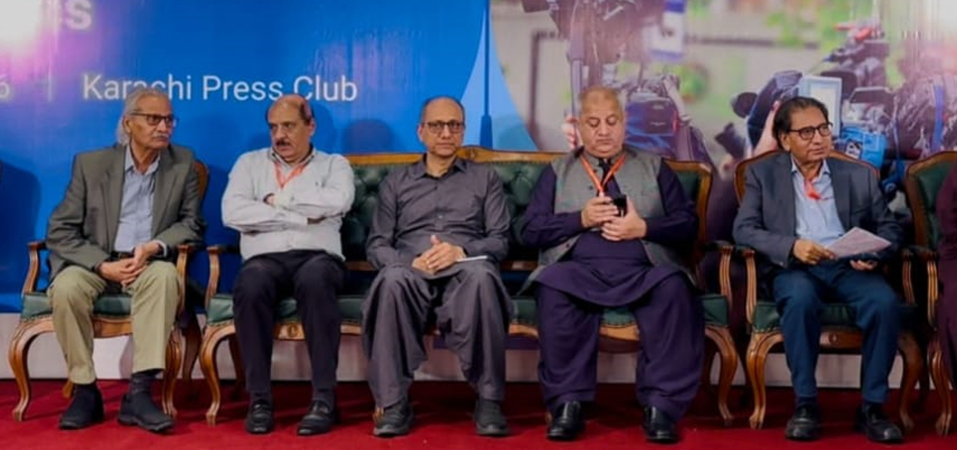
 Sindh Minister for Labour, Human Resources and Social Protection, Saeed Ghani, has said that achieving true and ideal press freedom in Pakistan requires the elimination of the wider flaws and distortions embedded in society.
He said it was the responsibility of the State of Pakistan and successive governments to address the problems faced by media workers and to ensure that the support being extended to media owners, newspapers and social media platforms also reaches journalists and other media employees.
He expressed these views on Thursday while addressing the Provincial Convention on Media Laws, Regulation and Ethics, organised by the Karachi Union of Journalists (KUJ) at the Karachi Press Club, where he attended as the chief guest.
Among those who also addressed the convention were Senator Mian Raza Rabbani, Pakistan Federal Union of Journalists (PFUJ) President Afzal Butt, Secretary General Hassan Ansari, KUJ President Tahir Hassan Khan, former PFUJ Secretary General Nasir Zaidi, Tauseef Khan, Mazhar Abbas, Habibuddin Junaidi, veteran film star Mustafa Qureshi, Sardar Liaquat and others.
The event was also attended by Leader of the Opposition in the Sindh Assembly Ali Khurshidi, PTI’s Zubair Ahmed, Karachi Deputy Mayor Salman Murad, Director Information Sindh Majid Khan, Younis Bandhani, Ahmed Chinoy, along with leaders of various journalist bodies and members of the media fraternity.
Addressing the convention, Saeed Ghani said that in the presence of seasoned leaders, office-bearers and representatives of journalistic organisations, he could perhaps not speak on the history of the media and its freedom better than they could. However, he stressed that genuine democracy cannot flourish unless the judiciary, the media and society as a whole are truly free.
He said that political parties, trade unions, student unions, civil society and all institutions must be free if Pakistan is to move towards an ideal democratic order. According to him, restrictions on any one of these sectors amount to restrictions on democracy itself.
Saeed Ghani said that while much is said about freedom of the press, it is equally important to ask whether the media is itself fulfilling its responsibilities. He remarked that when institutions and individuals are either unable to perform their roles properly or are prevented from doing so, it becomes impossible to move in the right direction.
In a sharp remark on the judiciary, he said that after Iftikhar Chaudhry, judicial independence had evolved in such a way that it had, in his words, become “independent even of the Constitution”.
He added that society itself also bears some responsibility for the restrictions imposed on institutions, and said that ideal press freedom can only be realised through broader social reform.
Speaking candidly as a political worker, Saeed Ghani also admitted that political parties themselves are presently unable to perform the role they ought to play.
He further said that the state and governments must not only resolve the issues confronting the media sector, but also ensure that the financial and institutional support being given to television channels, newspapers and social media owners translates into meaningful relief for media workers.
He urged both media houses and media professionals to become the voice of those whose voices are unheard or unable to reach the corridors of power.
Speaking at the convention, host and KUJ President Tahir Hassan Khan, along with other speakers, said the media was passing through an exceptionally difficult period, the likes of which had rarely been seen in the past.
They said the purpose of the convention was to raise awareness about the grave challenges facing journalists and to deliberate on ways to address them.
The speakers described the PECA law as a “black law”, alleging that its purpose was to suppress journalism and undermine freedom of expression. They said the prevailing circumstances confronting media houses and media workers were tantamount to the systematic destruction of the media industry.
According to the speakers, there are currently between 30 and 34 laws in the country that can potentially be used against the media. They argued that the PECA law represents the worst modern form of the old Permit Law of 1822.
They maintained that the history of media in Pakistan has been marked less by regulation and more by restrictions and censorship. They stressed that the curbs imposed on the media must now be lifted, saying that the press was effectively operating under a regime of complete control.
The speakers said that under such suffocating conditions, journalists were being forced to work in an environment where the reporter in search of news often becomes the news himself.
They also alleged that a deliberate and organised conspiracy was under way to divide journalist organisations so that media workers could not unite on a single platform.