 Recent article in ‘The Independent’, by Eric Lewis, calling for the release of former Prime Minister Imran Khan, reflects a growing trend of attempting to internationalize domestic legal matters. Such narratives frequently prioritize personality-driven advocacy over institutional stability and the rule of law. Pakistan’s current diplomatic standing is rooted in state-led institutional continuity rather than the fate of any single political figure.

The Fallacy of Political Victimhood vs. Judicial Due Process
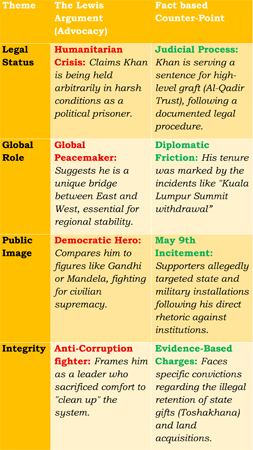
The argument that former PM is a victim of “arbitrary detention” departs from legal reality and enters the realm of selective advocacy. He is not being held without cause; he is a convicted individual facing multiple cases within Pakistan’s established legal framework.

Central to these is the Al-Qadir Trust case, involving a 190-million-pound settlement. In January, 2025, an accountability court handed Khan a 14-year prison sentence, citing documentary evidence that he and his spouse received hundreds of kanals of land in exchange for facilitating illegal monetary transfers.

To recast a conviction based on documented graft as “political victimization” is to suggest that popularity should grant immunity from the law. Judicial outcomes are determined in courts, not in op-eds, and the principle remains simple: sovereign legal systems cannot be overridden by external commentary.

Stability Beyond Personalities: Institutional Statecraft
A recurring, flawed claim in external commentary is that Pakistan’s stability hinges on one individual. This indispensability myth ignores the reality of how modern states function. Since 2024, Pakistan’s diplomacy has illustrated a sophisticated shift toward institutional statecraft.
Islamabad has actively positioned itself as a “net regional stabilizer,” most notably through its role in U.S.-Iran backchannel diplomacy. In March 2026, Pakistan, alongside Turkiye and Egypt, emerged as a critical bridge facilitating indirect communication between Washington and Tehran. This engagement helped secure a strategic pause in hostilities, proving that Pakistan’s role as a facilitator is a product of its geographic and institutional importance, not the personal magnetism of a former leader. The state’s ability to host dialogues and convey high-stakes proposals underscores a continuity in foreign policy that transcends individual tenures.

The Legacy of Diplomatic Inconsistency
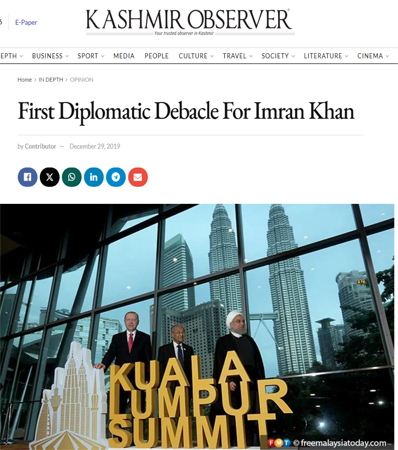
While advocates point to Khan’s global reach, historical context suggests a record of significant diplomatic friction. Khan’s tenure was marked by episodes that strained vital relationships, specifically the 2019 Kuala Lumpur Summit, which he withdrew at the last moment.

This move was widely viewed as a “foreign policy disaster” that forced a last-minute withdrawal, damaging Pakistan’s neutrality and credibility.
These were not markers of stable, visionary diplomacy, but rather instances of inconsistency and impulsivity that the state has since had to carefully recalibrate.

Legal Accountability is Not a Security Risk
Finally, the warning that legal accountability for Khan could trigger a “world in chaos” or a national bloodbath function as a pressure tactic rather than a sober analysis. This framing attempts to elevate an individual’s legal fate into a question of national survival, a tactic that undermines democratic norms.
The events of May 9, 2023, serve as a sobering reminder of the dangers of such rhetoric. The violent riots, which targeted state institutions and military installations, were a direct consequence of an “incitement-based” political strategy.
In March 2026, anti-terrorism courts underscored the gravity of these actions by sentencing dozens of involved individuals to rigorous imprisonment. Upholding the law in the face of such insurrection is not vengeance; it is the primary duty of a sovereign state to protect its institutions from populist volatility.
Conclusion

The “Free Imran Khan” narrative relies on a romanticized version of leadership that ignores the requirements of governance and the consequences of Conclusion graft. Pakistan’s path forward lies in the strengthening of its judicial and diplomatic institutions. Courts must be allowed to decide cases based on evidence, and the international community must respect that a nation’s stability is best served by the equal application of the law, not by the exceptionalism of a single politician.