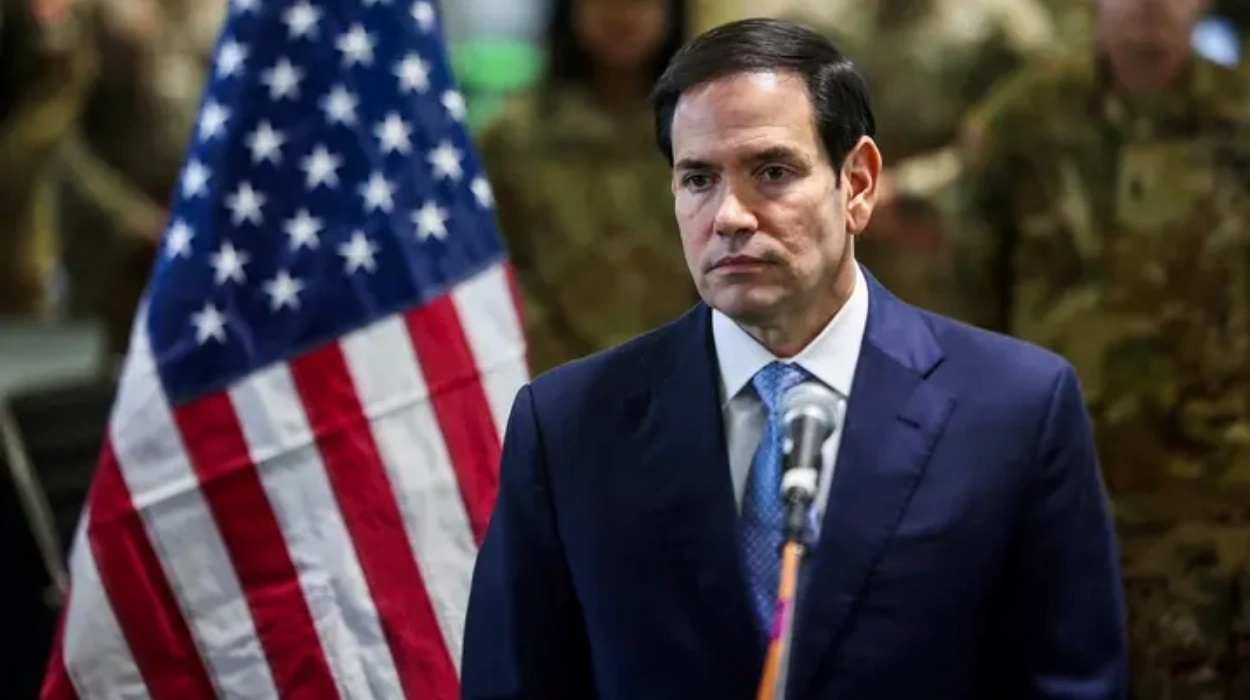
US Secretary of State Marco Rubio arrived in France for a high-stakes gathering of Group of Seven (G7) foreign ministers, as tensions over global conflicts and energy security dominated the agenda. The meeting marked the first in-person session since President Donald Trump publicly urged allies to take a firmer stance on Iran.
Read More: Putin tells Ukraine troops in Russian region to ‘surrender’
Rubio used the occasion to reiterate Washington’s long-standing concerns about burden-sharing, particularly in relation to the war in Ukraine. He stressed that while the United States has been a leading supporter of Kyiv, the conflict is not fundamentally America’s responsibility. Rubio added that US foreign policy must ultimately reflect domestic priorities and accountability to American citizens.
SECRETARY RUBIO: The U.S. is constantly asked to help in wars and we have. But when we had a need, it didn’t get positive responses from NATO. A couple leaders said that Iran was not Europe’s war. Well, Ukraine isn’t our war, yet we’ve contributed more to that fight than anyone. pic.twitter.com/AEDMLBbLFQ
— Department of State (@StateDept) March 26, 2026
.@SecRubio to reporter Q on Trump criticizing lack of NATO support in Iran war: “There was a couple of leaders in Europe who said that this was not Europe’s war. Well, Ukraine is not America’s war and yet we’ve contributed more to that fight than any other country in the world.” pic.twitter.com/iwQSziz6hG
— CSPAN (@cspan) March 26, 2026
His remarks come at a sensitive moment, with European leaders increasingly uneasy about Washington’s strategic direction. Officials are expected to press the US over allegations that Russia has provided Iran with intelligence and technological support amid escalating tensions in the Middle East.
EU foreign policy chief Kaja Kallas warned that the wars in Ukraine and the Middle East are closely linked, claiming that Moscow may be assisting Tehran in targeting American interests. French Foreign Minister Jean-Noël Barrot also highlighted ongoing cooperation between Russia and Iran, though Moscow has denied such claims.
Meanwhile, concerns are also mounting in Washington. Lawmakers, including Representative Gregory Meeks and Representative Don Bacon, have questioned recent decisions to ease certain sanctions on Russian oil transactions. They warned that such moves could undermine efforts to curb Russia’s influence and potentially fuel further aggression.
Read More: After ‘snub’ claims, Pakistan secures spot at US critical minerals summit
As the G7 meeting unfolds, divisions between the US and its allies over strategy, security, and economic pressure are likely to remain in sharp focus.