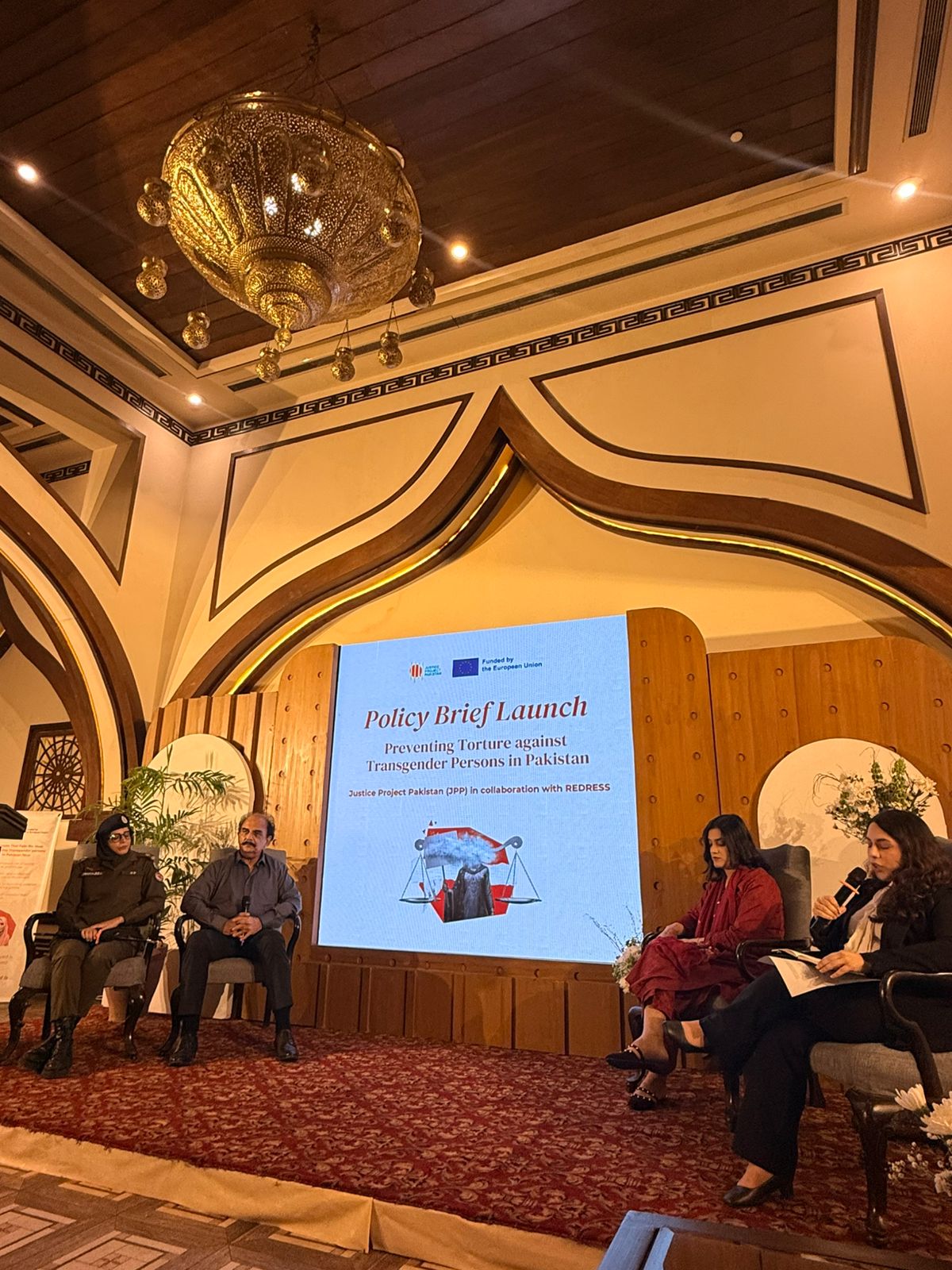
Lahore, March 26, 2026 — Transgender persons in Pakistan face a heightened risk of torture and police abuse, a new policy brief launched by Justice Project Pakistan (JPP) in collaboration with REDRESS at Emerald Hall, Faletti’s Hotel, Lahore warns.
The findings come amid growing concerns over custodial abuse and weak enforcement of existing legal protections.
Despite progressive laws, including the Torture and Custodial Death (Prevention & Punishment) Act 2022, gaps in implementation continue to leave transgender individuals among the country’s most marginalised communities, vulnerable to abuse and without effective avenues for redress. Survivors face significant barriers in reporting torture, registering complaints, and accessing legal remedies, resulting in widespread impunity. The brief urges urgent, enforceable reforms to strengthen legal protections, oversight, and access to justice in Pakistan, in line with constitutional and anti-torture obligations.

Opening the event, Sarah Belal, Executive Director of Justice Project Pakistan, highlighted the urgent need to move beyond legal frameworks toward meaningful protection in practice.
“Violence against transgender persons in Pakistan is not incidental, it reflects a systemic shortcoming. When laws exist but protections and accountability do not, the justice system fails those who need it most. This policy brief builds on the incredible activism being carried out by the transgender community to outline concrete, enforceable reforms to ensure that their rights are protected in practice, not just on paper.”

Talking to the media, Neeli Rana, a transgender rights activist and community mobiliser, underscored the importance of accountability and effective implementation of existing laws.
“Protecting vulnerable communities, including transgender persons, is a core responsibility of the criminal justice system. Strengthening implementation of existing laws and ensuring accountability for custodial abuse are essential to upholding the rule of law.”
She further highlighted the deep-rooted social exclusion faced by transgender persons in Pakistan.

“Transgender persons in Pakistan are not just marginalised by systems, they are rejected by society at large. From everyday discrimination to violence and harassment, their lives are shaped by exclusion at every level. When society refuses to recognise their dignity, it becomes easier for abuse to go unchecked.”
The policy brief was formally launched during the event.
A panel discussion on “Policy Dialogue” brought together Mahnoor Chaudhary, Program Director at Khawaja Sira Society; Dr. Khurram Sohail Raja, Head of Forensic Medicine and Toxicology at Aziz Fatima Medical and Dental College; and SP Monazza Karamat, First Lady SP Headquarters Lahore.

Panelists discussed gaps in implementation and stressed the need for stronger safeguards, improved oversight, and survivor-centred responses within the criminal justice system.
The launch was attended by representatives from government institutions, law enforcement, media, civil society organisations, and legal practitioners.