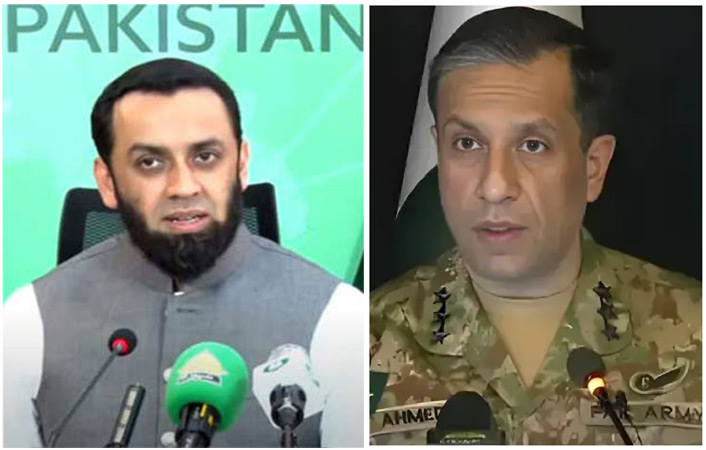
 Information Minister Ataullah Tarar on Wednesday announced that Pakistan has decided on a “temporary pause” in the ongoing Operation Ghazab Lil Haq against the Afghan Taliban in view of Eidul Fitr and at the “request of brotherly Islamic countries”.
The information minister made the announcement in a post on the social media platform X.
Operation Ghazab lil-Haq was launched on the night of February 26, following unprovoked firing by the Afghan Taliban from across the border.
In his post, the information minister said, “In view of the upcoming Islamic festival of Eidul Fitr, upon its own initiative as well as on the request from the brotherly Islamic countries of the Kingdom of Saudi Arabia, the State of Qatar and the Republic of Turkiye, the government of the Islamic Republic of Pakistan has decided to announce temporary pause amidst ongoing Operation Ghazab lil-Haq against the terrorists and their support infrastructure in Afghanistan.”
Tarar said the pause would be applicable from “midnight March 18/19 to midnight March 23/24”.
“Pakistan offers this gesture in good faith and in keeping with the Islamic norms,” he said.
“However, in case of any cross-border attack, drone attack or any terrorist incident inside Pakistan, Operation Ghazab Lil Haq shall immediately resume with renewed intensity,” he warned.
In a separate post, he said provided an update on the operation and Afghan Taliban and Fitna al Khawarij losses.
According to the minister, 707 had been killed and more than 938 had been injured. He said that 255 posts had been destroyed and 44 posts had been captured.
He said that 237 tanks, armoured vehicles and artillery guns had been destroyed, adding that 81 terrorists and terrorist support infrastructure locations across Afghanistan were effectively targeted by air.
He reiterated that on the night of March 16, armed forces targeted Afghan military installations in Kabul and Nangarhar.
“In these strikes, Pakistan’s forces destroyed drone storage and technical support infrastructure and ammunition storage sites in Kabul and Nangarhar, which were being used by the Afghan Taliban and terrorist elements to carry out attacks against innocent Pakistani civilians,” he said.
“Similarly, Pakistan armed forces effectively targeted and destroyed Afghan Taliban posts in the Bajaur, Kurram, Torkham, Khyber, North and South Waziristan sectors,” he said.
Separately, ISPR Director General Lieutenant General Ahmed Sharif Chaudhry on Wednesday stated that the strike carried out in Kabul earlier this week had targeted an ammunition storage site.
He made the remarks while speaking to a private TV channel.
The military’s spokesperson stated that the public needed to understand the context behind Operation Ghazab Lil Haq, which was launched against the Afghan Taliban last month, specifically that it was not a “standalone” military campaign, but rather a part of Pakistan’s ongoing war against terrorism. “This war has been imposed upon Pakistan by terrorists and their sponsors,” he said. He said that it was common knowledge that India was behind terrorism in Pakistan and was using Afghanistan as “a base of operations”.
When asked about the recent drone attacks in Islamabad, Rawalpindi and other areas, he questioned whether there was a drone manufacturing industry in Afghanistan. He said this supported Pakistan’s narrative that someone was providing these drones to be used against Pakistan, identifying India.
“They are providing rudimentary drones so that their signatures can be claimed as not theirs,” he said, adding that it highlighted the deep nexus between India’s intelligency agency and the Afghan Taliban.
He said that Afghanistan had acted as a base of operations for every act of terrorism in Pakistan, pointing to the suicide bombing in an imambargah in Islamabad’s Tarlai area. “Innocent children, people and worshippers were killed during Friday prayers. Where did the terrorist come from? Afghanistan,” DG ISPR said.
DG ISPR added that terrorist leaders, such as Noor Wali Mehsud, Bashir Zeb and Gul Bahadur were “being hidden” in Afghan territory.
Outlining the operation’s “immediate context”, the DG ISPR said that last month, multiple terrorist hideouts along the Pak-Afghan border were struck. He added that the banned Tehreek-i-Taliban Pakistan (TTP) was struck, not Afghans.
“They (Afghan Taliban) then struck. They hit 53 locations in Pakistan and our posts along the border,” he stated. “Everyone [must know] that they initiated it and we responded, and we are going to take them to task.”
He added that 81 locations in Afghanistan were targeted in airstrikes to eliminate “terrorist support infrastructure”.
Speaking about the strike in Kabul, DG ISPR said that there was an ammunition and drone storage site, which was targeted. He added that there was video footage of the strike, which was publicly available.
“We hit that … if you strike ammunition, there are secondary detonations. Our intelligence was correct; we hit an ammunition storage site, so the ammunition exploded,” he said.
“When it did, people in Kabul saw the explosion and fireballs, which lasted for some time. Old missiles like Russian Scud missiles, ammunition, drones and equipment exploded. That is what we struck.”
He also highlighted the Afghan Taliban’s lack of credibility.
“There is no credibility to their claims; the world knows it, we know it. They make claims and then delete them. They are discredited and liars,” he said. “Has anyone asked how someone can set up a drug rehabilitation centre around an ammunition depot where you store weapons? Is there a hospital anywhere in the world which has been built next to an ammunition store?” he asked.
Lt Gen Chaudhry said that the rehabilitation centre was a “military containerised structure”.
“That was a military containerised structure in which they probably kept suicide bombers who were being trained, or they were hiding terrorists, or housing Afghan Taliban fighters.
“I don’t know what was in there. That was not our target, but if they claim that there were drug addicts at the site, then this is an old habit of theirs where they use drug addicts as suicide bombers, and it was most likely some training facility,” he said.
“We must understand that Afghanistan is not a state per se; this is a territory captured by the Afghan Taliban, which is a terrorist organisation,” he said.
He added that according to UN reporting, 22 terrorist organisations were operating in Afghanistan.
“Afghanistan has become a centre for all of the world’s terrorists. It’s a can of worms, which has been closed by Pakistan,” he said. He added that the war on terror was not just Pakistan’s war, but “a war for the whole world”.