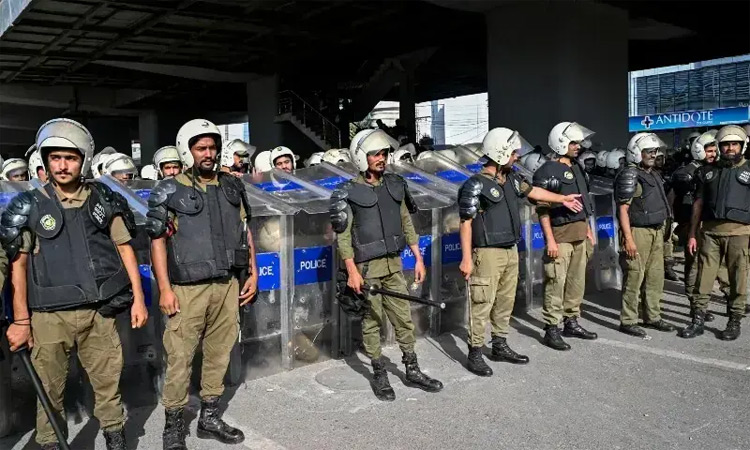
 The Punjab Home Department has announced a seven-day extension in the enforcement of Section 144 across the province, effective until March 14, 2026. The measure has been taken in view of potential terrorist threats and concerns over public safety.
Under the notification, public gatherings, processions, and demonstrations involving four or more people are prohibited without prior permission. Unauthorized assemblies at public places will also be restricted. Law enforcement personnel on duty, as well as gatherings related to weddings, funerals, official meetings, and court proceedings, are exempted from the ban.
A complete ban has also been imposed on the display and use of all types of weapons in public areas. Intelligence reports indicate that sensitive gatherings could be targeted for terrorist or sectarian activities.
The provincial authorities have directed district administrations and police departments to strictly enforce Section 144 to ensure the safety of citizens and maintain law and order. All necessary measures will be taken to protect lives and property.
Rawalpindi Police put security on high alert amid prevailing situation
The Rawalpindi Police have placed security on high alert across the district and tightened surveillance at key locations in view of the prevailing situation, police said on Sunday.
A police spokesperson said special and joint pickets had been set up on interprovincial highways as well as at entry and exit points of the district, where snap checking and screening of vehicles and commuters were under way.
Senior Superintendent of Police (SSP) Operations Malik Tariq Mehboob, along with divisional Superintendents of Police (SPs) and Sub-Divisional Police Officers (SDPOs), was present in the field to review and brief personnel about the security arrangements.
The spokesperson said strict monitoring and checking were also being carried out at transport terminals, buses and wagons, while passengers were being screened to ensure safety.
Search, sweep and combing operations were continuing in the surroundings of sensitive installations, he added.
Personnel of the Elite Force, Dolphin Squad, Muhafiz Squad and police stations were performing continuous and effective patrolling duties across the district, while Safe City cameras were being used to monitor important locations and highways round the clock.
City Police Officer (CPO) Rawalpindi Syed Khalid Mahmood Hamdani directed all supervisory officers to remain in the field and ensure strict monitoring and proper supervision of personnel deployed on sensitive duties.
He said the Rawalpindi Police were utilising all available resources to ensure protection of the lives and property of citizens and maintain foolproof security arrangements across the district.
Police have conducted flag march across the district to demonstrate their preparedness for maintaining law and order and ensuring foolproof security.
The march was organised on the directions of City Police Officer (CPO) Rawalpindi Syed Khalid Mahmood Hamdani and was led by Senior Superintendent of Police (SSP) Operations Malik Tariq Mehboob.
According to a police spokesperson, the flag march began from Police Lines Headquarters and passed through various areas.
Divisional Superintendents of Police (SPs) Sub-Divisional Police Officers (SDPOs), Station House Officers (SHOs), as well as personnel of the Dolphin Squad and Elite Force also participated in the march.
Punjab to establish central monitoring system for security of shrines
Secretary Auqaf Punjab Dr. Ehsan Bhutta has said that modern security systems have been fully activated at the entrance gates of major shrines across the province, including Lahore’s Badshahi Mosque, the shrine of Bibi Pak Daman and Data Darbar.
In a special conversation with APP at his office here on Sunday, he said that CCTV cameras, metal detectors and walk-through gates had been made fully operational to ensure the safety of devotees visiting the shrines.
He said that in view of security threats emerging through Afghanistan, foolproof security arrangements have been made both inside and outside the shrines. To further strengthen the security system, the Auqaf Department is establishing a central control room and monitoring cell at its head office in Lahore on the pattern of the Punjab Home Department.
Dr Bhutta said the monitoring cell will conduct round-the-clock live surveillance of major shrines across the province, including those in Lahore. For this purpose, CCTV cameras installed at various shrines will be connected with the central control room through radio frequency, enabling direct monitoring from the Auqaf headquarters.
He said the project will cost a total of Rs126 million, while about Rs60 million will be spent on the installation of the control room and monitoring system. The project is expected to be completed soon and will become operational by June.
Responding to a question, the Auqaf secretary said that shrines such as Data Darbar and others are national assets visited by hundreds of thousands of devotees, therefore, their security and administrative systems are being modernized.
He further said that a central monitoring mechanism has also been introduced to ensure transparency in the donation system at Data Darbar. As a result, the shrine’s income has increased significantly. Earlier, the weekly average income ranged between Rs 2.5 million and Rs3 million, which has now increased to between Rs 4.5 million and Rs5.4 million.
Dr Ehsan Bhutta added that further steps are being taken to facilitate visitors and ensure their safety. Due to the large number of devotees visiting shrines, close coordination is being maintained among the police, volunteers and shrine administration.