
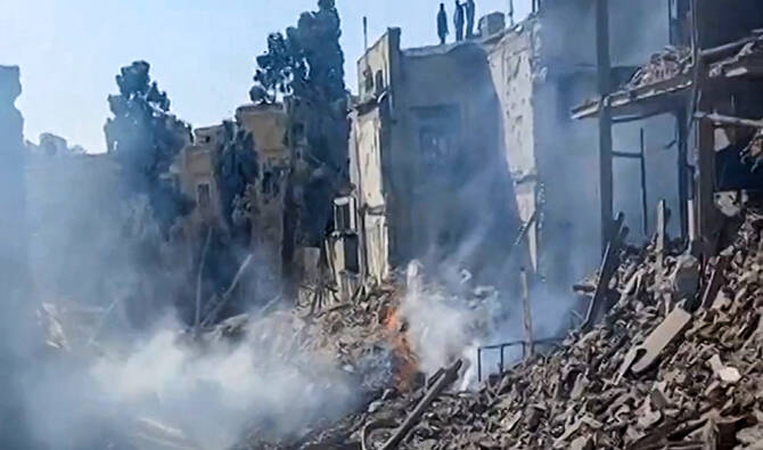
 Pakistan has taken a public stand against the unprecedented United States-Israeli airstrikes that were later said to have assassinated Iran’s Supreme Leader Ayatollah Ali Khamenei.
At an emergency UN Security Council session convened hours after the strikes, which examined the repercussions of US and Israeli air strikes on Iran and exposed divisions among the 15-member body over rising regional tensions, Islamabad’s representative, Ambassador Asim Iftikhar Ahmad, condemned the “initiation of unwarranted attacks” on Iran as a violation of international law. Ambassador Ahmad noted with alarm that the assault came just as renewed negotiations were underway between Tehran and Washington, warning that such military action “undermine[s] the peace and stability of the entire region.”
Crucially, Pakistan’s statement did not stop at decrying the hit on Khamenei. In a carefully balanced message, it also denounced Iran’s subsequent missile attacks on neighbouring countries. Islamabad “condemned attacks against Saudi Arabia, Bahrain, Jordan, Kuwait, Qatar and the UAE” and affirmed solidarity with those states. By explicitly invoking the UN Charter’s ban on use of force against any state’s sovereignty, Pakistan positioned itself on principle–opposing aggression from whichever side it came. The Pakistani envoy urged all parties to halt escalation and return to dialogue, stressing that “diplomacy and dialogue should be the guiding principles” going forward.
“We particularly laud Oman’s role in facilitating and mediating dialogue between Iran and the United States,” he said, focusing on mediation and aligning Pakistan firmly with diplomatic efforts over military alliances.
In a poignant aside, he offered condolences for civilian victims of the violence, including schoolchildren in Iran and even a Pakistani national killed in the strikes on the UAE. With millions of its citizens living and working across the Middle East, Pakistan has a lot at stake in the conflict’s fallout. Ambassador Ahmad noted that the safety of these expatriates remains a top priority, and he said Islamabad was closely coordinating with regional leaders to help resolve the crisis peacefully.
Pakistan’s stance won rare public praise from Tehran. Iran’s UN ambassador expressed “special gratitude” to Pakistan (alongside China and Russia) for its principled support at the UN and for providing “every possible diplomatic and moral support” in the face of the attacks. The Iranian envoy noted that only a handful of nations had openly condemned the killing of Khamenei, and he lauded Islamabad for speaking out when many others stayed cautious. At the same time, Tehran pointedly urged Pakistan to prevent the crisis from sparking sectarian strife on its soil. In remarks directed at Pakistan’s public, Iran’s representative appealed to “all religious groups and citizens” in the country to remain calm and refrain from violence. He warned that any unrest in Pakistan would only “strengthen the plans of Iran’s enemies” – a clear reference to how destabilisation could play into the hands of those who seek to exploit Sunni-Shia divides. Those concerns were not abstract. Within hours of Khamenei’s death, anger on Pakistan’s streets boiled over.
Pakistan’s leadership has been at pains to frame its response as driven by principle, not geopolitics. Prime Minister Shehbaz Sharif, in a message of condolence, joined “the people of Iran in their hour of grief” and lauded Ayatollah Khamenei’s martyrdom with the reverence due a fallen ally. Crucially, Sharif’s statement also voiced concern over the breach of international norms inherent in the assassination. “It is an age-old convention that the heads of state/government should not be targeted,” the premier noted pointedly, underscoring what many see as a dangerous new precedent. President Asif Ali Zardari echoed the sentiment, calling the killing of Khamenei and other senior Iranian figures a “grave loss” that would be “deeply felt across the Muslim world”. While mourning with Tehran, Pakistan’s government has simultaneously reached out to its Arab partners who came under Iran’s retaliatory fire. In telephone diplomacy, PM Sharif assured King Abdullah of Jordan – whose country was hit by stray Iranian missiles – of Pakistan’s solidarity and “deep concern” over the spiralling situation. The flurry of phone calls between Pakistan and Oman, the UAE, Qatar, Saudi Arabia and Iran underscores Pakistan is playing its due role in emphasising the urgent need for restraint, de-escalation, and dialogue to preserve regional peace and stability, offering Pakistan’s support in any effort to defuse the crisis. The careful outreach to both Iran and the Arab states illustrates Islamabad’s tightrope walk: it stands against the extrajudicial killing of Iran’s leader, yet it cannot condone Tehran lashing out at its neighbours in revenge.
There is a domestic political calculus as well. Islamabad’s bold condemnation of Washington’s actions is a striking show of an “independent foreign policy” – a phrase its diplomats have touted – even as Pakistan remains financially tied to Western lenders and keen not to rupture relations with the U.S. entirely.
The country’s press and policymakers are openly questioning what a new Middle East war could mean for Pakistan’s security and already-reeling economy. Security analyst Hassan Khan took to X to appreciate Pakistan for “following independent foreign policy on issue of national interests,” while many others are asking whether the nation can afford to take sides at all, or whether it must spearhead diplomatic solutions instead. With this in mind, Pakistan is expected to push for an urgent regional dialogue – possibly through forums like the Organisation of Islamic Cooperation – to pull the Middle East back from the brink.
A diplomatic source insisted their stance is not about siding with any one country, but about upholding international law and preventing a wider war.