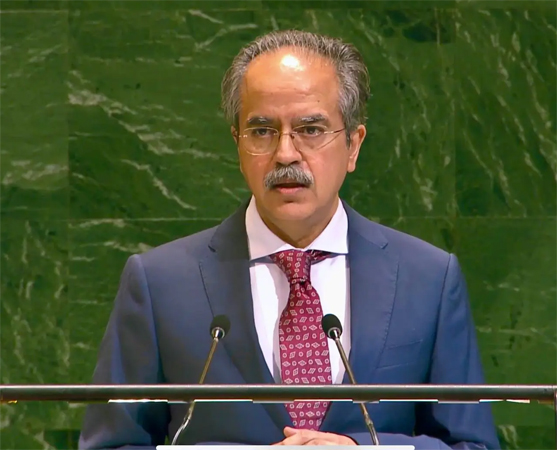
 Pakistan Friday reaffirmed its opposition to adding new permanent members to the UN Security Council, arguing it would increase the 15-member body’s dysfunction and violate the principle of sovereign equality.
Speaking in a resumed session of the long-running Intergovernmental Negotiations (IGN) aimed at reforming the Security Council, Ambassador Asim Iftikhar Ahmad, permanent representative of Pakistan to the UN, said that the demand for individual permanent membership is clearly something that runs counter to the principles of reform.
As part of the Uniting for Consensus (UfC) group, Ambassador Asim Ahmad said Pakistan advocates for expanding only non-permanent, elected seats to enhance democratic representation in order to ensure “REFORM FOR ALL – PRIVILEGE FOR NONE”.
Full-scale negotiations to reform the Security Council began in the General Assembly in February 2009 on five key areas — the categories of membership, the question of veto, regional representation, the size of an enlarged Security Council, and working methods of the council and its relationship with the General Assembly.
Progress towards restructuring the Security Council remains blocked as G-4 countries — India, Brazil, Germany, and Japan — continue to push for permanent seats in the Council, while the Italy/Pakistan-led UfC group opposes any additional permanent members. arguing it would create “new centers of privilege”.
As a compromise, UfC has proposed a new category of members — not permanent members — with a longer duration in terms and a possibility to get re-elected.
The Security Council is currently composed of five permanent members — Britain, China, France, Russia, and the United States — and 10 non-permanent members elected to two-year terms.
The IGN framework is geared towards restructuring the Council to make it more representative, effective, and accountable.
In his remarks, the Pakistani envoy emphasized that the campaign for individual permanent membership cannot be a basis for reform governed by those agreed principles.
The overwhelming majority of the United Nations’ membership, he said, recognizes that permanent membership and the veto are at the core of the Council’s paralysis and inaction seen too often over the years.
“For them, this is not a peripheral concern; it is the central fault line that undermines the Council’s credibility and effectiveness,” Ambassador Asim Ahmad pointed out.
“Where so much effort has gone into this reform debate, and at a time when the multilateral system is under extreme stress, with calls for reform for a UN that is fit for purpose, the demand for special privileges must have no space in these discussion.”
Highlighting Pakistan’s “consistent” position, he said that new permanent members will not neutralize the “inordinate” influence of the existing permanent members; rather, they risk entrenching and expanding it.
“Two wrongs cannot make a right and a larger oligarchy is no antidote to an elite power club,” the Pakistani envoy remarked.
“A circle of permanence even though expanded, will remain a closed circle. No wonder some of the P-5 (permanent members) are happy to expand this club, primarily to protect their own outdated status in today’s Council.”
Pakistan, he said, was of the opinion that the best way to balance the unequal power of the five permanent members is through a more democratic and accountable approach, including a meaningful increase in elected, non-permanent members. “This,” he added, “would shift the internal balance of an expanded Council in favour of the wider membership, and ensure that the required majority for the adoption of resolutions rests predominantly with elected members, thereby enhancing transparency, inclusivity, and accountability in the Council’s decision-making process while preserving the principle of sovereign equality.”
In this context, Ambassador Asim Ahmad said Pakistan fully understands and respects Africa’s demand for permanent seats, which is on behalf of and for the entire region and is therefore fundamentally different from other proposals that are divisive as they seek permanent membership for individual States.
“Any concept, in our view, must ensure genuine rotation and fair regional representation,” the Pakistani envoy said, stressing the need to cater to under-represented regions, and to accommodate the interests of sub-regional and cross-regional groups, including SIDS (Small Island Developing States) and the OIC, as also provided for and agreed in the UN’s Pact for the Future.
“Flexibility is the keyword here, and we heard a lot of that word this morning, yet there are others who remain fixated,” he said in reference to G-4.
“They don’t move at all, while calling for negotiations. Simply put, convergences that have to be the basis of a so-called consolidated model cannot be achieved without flexibility.”