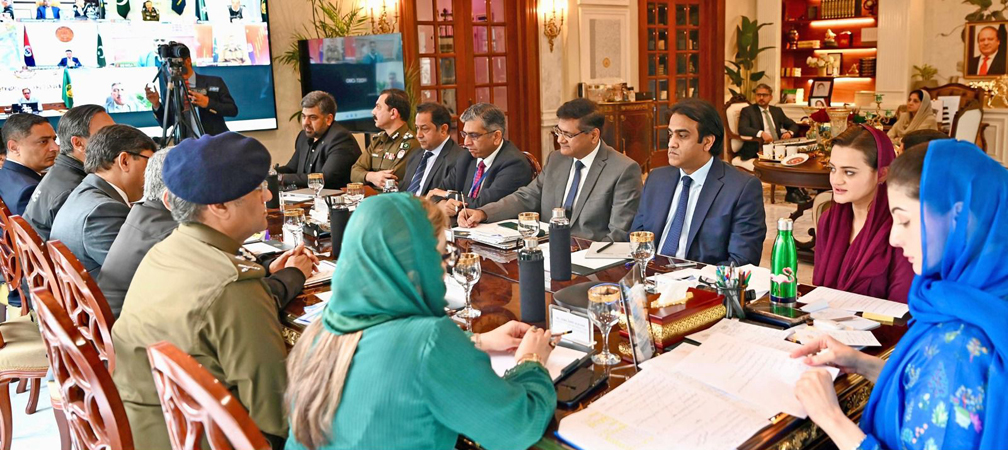
 Punjab Chief Minister Maryam Nawaz Sharif has set a three-month timeline for implementing wide-ranging police reforms and directed senior police leadership to personally engage with citizens to gather feedback on policing performance.
Chairing a special meeting to review reform measures, here on Sunday, she instructed the Inspector General of Punjab Police and senior officers to ensure respectful conduct toward every citizen. She ordered the installation of panic buttons outside all police stations to enable immediate registration of complaints and facilitate quick redress.
The chief minister granted in-principle approval for audio and video recording of police investigations to enhance transparency. She directed that minor complaints against police officials be resolved within two to three hours to improve public trust.
Approving funds for body-worn cameras, she directed that at least 10 officials in every police station be equipped with the devices. A total of 14,000 body cameras and 700 panic buttons will be installed across the province as part of the reform drive.
CM Maryam Nawaz also ordered the introduction of an online FIR tracking system and a facility for citizens to register FIRs online for lost documents and identity cards. Police officials will be allowed to ask five basic questions at the time of FIR registration to streamline the process.
On traffic management, she directed strict enforcement of lane discipline and instructed district administrations to ensure proper lane markings and public awareness regarding safe road-crossing practices. The meeting also witnessed the launch of the Traffic Police One App and the Safe City Monitoring App to improve monitoring and citizen services.
During the briefing, officials informed the meeting that overall crime in Punjab had declined by 48 percent, while major crimes had decreased by up to 80 percent. It was also shared that reducing police response time to eight minutes had significantly lowered negative public feedback.
The chief minister said that individuals involved in violence against children deserved no leniency. She emphasized that police reforms were essential to restoring public confidence in law enforcement.
She called for the formulation of short-, medium- and long-term reform strategies, introduction of citizen management and e-tag information systems, and training initiatives to familiarise college students with policing. She further directed that complainants, especially women, be treated with respect and that mobile police stations be dispatched to assist women unable to visit police stations.
Reiterating that no citizen was less important than a VIP, Maryam Nawaz stressed that public dignity must be safeguarded at all times, including during security arrangements.
Separately, Maryam Nawaz visited the Maryam Nawaz School and Resource Centre for Autism, where she met children and interacted with them.
During the visit, the chief minister spent time with autistic children, expressed affection and encouragement, and reviewed various sections of the facility. She appreciated the efforts being made to provide specialised education and care to children with autism.
Special Assistant to Chief Minister on Special Education Sania Ashiq Jabeen briefed the chief minister on the institution’s services, support programmes and facilities available for children and their families.
The chief minister reiterated the government’s commitment to strengthening inclusive education and ensuring better facilities for children with special needs across Punjab.