 Pakistan, along with seven other Muslim-majority countries, condemned on Sunday the repeated violations of the ceasefire in Gaza by Israel, asserting that these actions risked undermining efforts for restoring stability at a time when regional and international partners were working collectively to advance the second phase of US President Donald Trump’s plan.
The eight countries – Pakistan, Egypt, Indonesia, Jordan, Qatar, Saudi Arabia, Turkiye and United Arab Emirates – had worked with Trump’s administration on a plan last year on a plan to end Israel’s genocide and invasion in Gaza.
Implementation of the plan began in October 2025, leading to a ceasefire in Gaza more than two years after the onslaught began. Israel, however, has repeatedly violated the truce, carrying out strikes in the Strip.
Meanwhile, work is ongoing on the second phase of Trump’s plan, shifting focus from ceasefire implementation to demilitarisation, technocratic governance and reconstruction.
In a joint statement, the foreign ministers of the eight countries that worked on the plan, said strongly condemned Israel’s repeated violations of the ceasefire in Gaza, “which have resulted in the killing and injuring of more than a thousand Palestinians”.
“These actions risk escalating tensions and undermining efforts aimed at consolidating calm and restoring stability, at a time when regional and international parties are working collectively to advance the second phase of President Donald Trump’s peace plan and to implement the United Nations Security Council Resolution 2803,” the statement said.
It said the foreign ministers of the eight countries “consider that these repeated violations constitute a direct threat to the political process and hinder ongoing efforts to create appropriate conditions for transitioning to a more stable phase in the Gaza Strip, both in terms of security and humanitarian conditions, and stress the necessity of full commitment to ensuring the success of the second phase of President Trump’s peace plan”.
They called on all parties to “fully uphold their responsibilities during this critical period and to exercise the utmost restraint, in order to preserve and sustain the ceasefire, refrain from any actions that may undermine the current process, and create favourable conditions to move forward toward early recovery and reconstruction, as well as advancing a just and lasting peace grounded in the Palestinian right to self-determination and statehood, in accordance with international law and relevant UN Security Council resolutions, and the Arab peace initiative”.
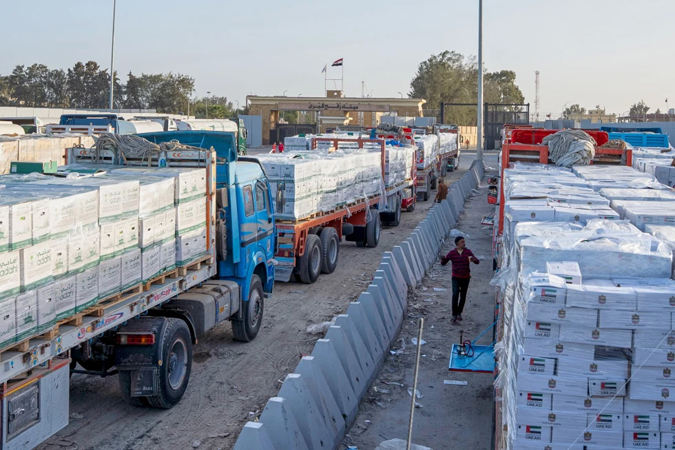
Separately, Israel is set to partially reopen the Rafah crossing between the war-devastated Gaza Strip and Egypt on Sunday, following months of urging from humanitarian organisations, though access will be limited to the movement of people.
The Rafah crossing is a vital gateway for both civilians and aid, but has remained closed since Israeli forces seized control of it in May 2024 during the war with Hamas, aside from a brief and limited reopening in early 2025.
Israel had previously said it would not reopen the crossing until the remains of Ran Gvili — the last Israeli hostage held in Gaza — were returned.
Entry and exit “will be permitted in coordination with Egypt, following prior security clearance of individuals by Israel, and under the supervision of the European Union mission”, it added.
However, key details remain unclear, including how many people will be allowed to cross and whether those seeking to return to Gaza will be permitted entry.