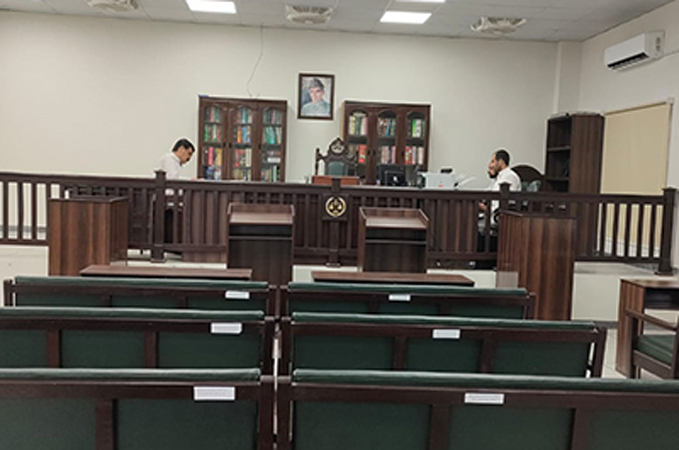
 The District & Sessions Court of Islamabad on Monday completed the cross-examination of prosecution witness Anis ur Rehman in the controversial tweet case against lawyers Iman Mazari and Hadi Ali Chatha.
The case is being heard by Additional District and Sessions Judge Muhammad Afzal Majoka at the District and Sessions Courts Islamabad. During the hearing, both Iman Mazari and Hadi Ali Chatha appeared before the court. On the request of the prosecution, the court initially took a break in the proceedings. After the hearing resumed, Hadi Ali Chatha began cross-examining the witness. During questioning, Anis ur Rehman informed the court that he holds an MPhil degree in Computer Science and has completed departmental training.
When asked to point out any single tweet containing content against the state, he replied that all tweets were part of a broader narrative. He said no tweet mentioned armed struggle. He added that the term “disinformation vector” was used in his report and stated that the content was based on manipulation. When asked to explain the term further, he said he was unable to do so at that time.
Separately, the District & Sessions Court of Islamabad issued arrest warrants for former Khyber Pakhtunkhwa chief minister Ali Amin Gandapur in a case related to the recovery of liquor and weapons, and directed police to begin the process to declare him a proclaimed offender.
The hearing was held in the court of Judicial Magistrate Mubashir Hassan Chishti. During the proceedings, Ali Amin Gandapur did not appear before the court. The court noted that the accused had failed to attend multiple hearings despite prior notices. Expressing concern over his continued absence, the court issued non-bailable arrest warrants. The judge also directed the police to publish public notices in leading national newspapers on the same day to complete the legal process required to declare the accused a proclaimed offender.
In its written order, the court stated that repeated non-appearance by the accused was causing delays in judicial proceedings. The order added that, under the law, further steps had become necessary to ensure the presence of the accused before the court.