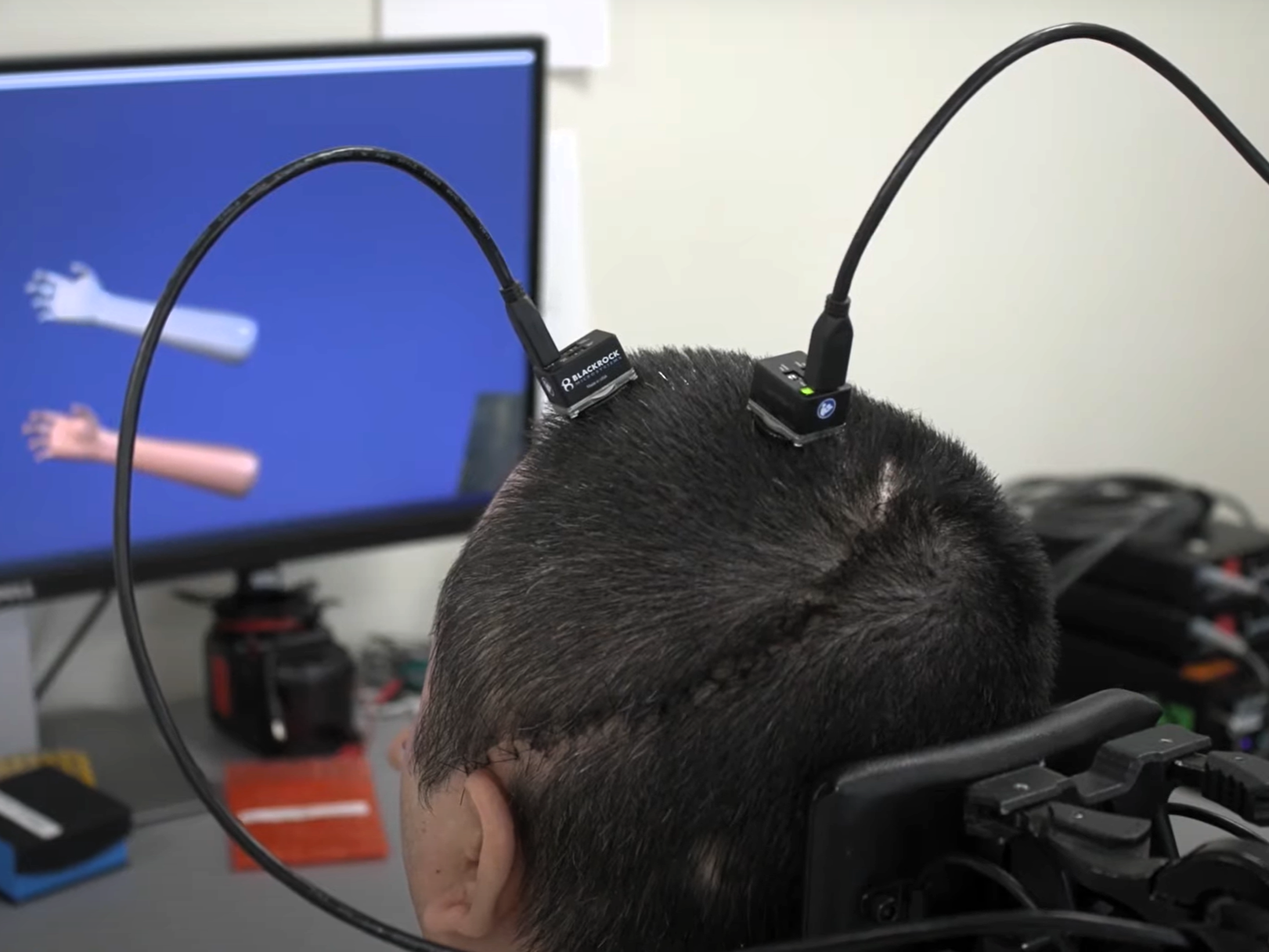
SHANGHAI — A 28-year-old man paralysed for eight years regained the ability to control digital devices using only his thoughts just five days after undergoing brain chip surgery in China. The milestone marks the first clinical trial of a fully implanted, fully wireless Brain-Computer Interface (BCI), developed by Shanghai NeuroXess. The device connects the nervous system to external machines, allowing users to act purely through thought.
Read More: Man dies after chairlift accident in Lower Kohistan
The system is minimally invasive, with 64 electrodes, each one percent the width of a human hair, implanted in the brain. Associated hardware, including the processor, battery, and antenna, is placed beneath the skin of the chest.
A key innovation is a built-in battery paired with an external wireless charging dock, enabling the user to operate the device independently throughout the day. Zhang Xu, a neuroscientist at the Chinese Academy of Sciences, noted that the battery is a major advancement for sustained power and long-term usability in human applications.
Neuralink’s first patient in the UK, Paul, who is paralyzed by motor neuron disease, has received a brain implant.
Just hours after surgery, he was able to control a computer with his thoughts and is now using it to play games and regain independence. pic.twitter.com/rEPIK41RpK
— Tesla Owners Silicon Valley (@teslaownersSV) December 14, 2025
NEURALINK TURNS YOUR BRAIN INTO A REMOTE FOR ANY DEVICE
Your brain got promoted from “thinking” to “controlling every device in the room.”
Mind Control:
• Think it – and devices react like loyal pets
• Robotic arms, wheelchairs, lights, locks… all obey straight… https://t.co/WbuVxXSRvI pic.twitter.com/JEd3sgKHCQ
— Mario Nawfal (@MarioNawfal) December 6, 2025
The patient quickly demonstrated the system’s capabilities. Within five days, he regained control over basic functions, and after six weeks, he could perform more complex tasks such as browsing the internet, playing video games, controlling smart home devices, and even operating a wheelchair. Professor Mao Ying of Huashan Hospital confirmed that the patient can now manage household appliances and mobility with his mind.
This achievement closely rivals work by Elon Musk’s Neuralink, where patients have demonstrated control over robotic arms. Musk recently stated that over 10,000 people have registered interest in participating in Neuralink trials.
The success in China highlights the rapid advancement of BCI technology, offering hope for improved independence and quality of life for paralysed individuals worldwide. Experts say further trials and refinements could expand the system’s functionality, bringing brain-controlled devices closer to everyday use for those with severe mobility impairments.