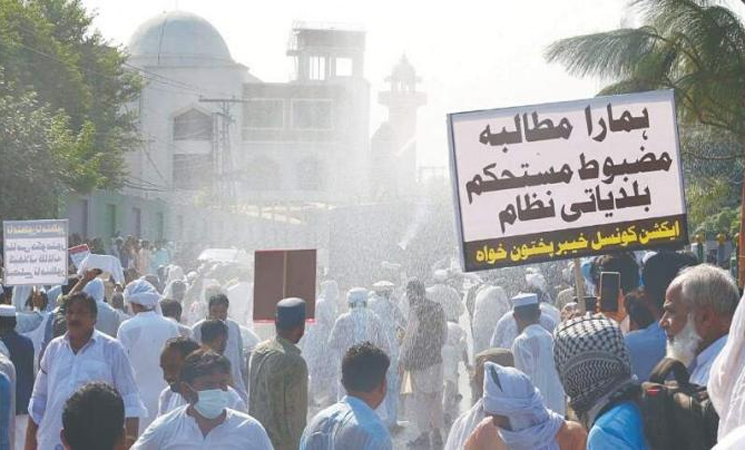
 Jamaat-e-Islami Khyber Pakhtunkhwa has termed the negligence of provincial government in providing powers to local government representatives as worst insult to the public mandate and announced that Jamaat will extend full support to the forum where LG representatives from across the province will protest and struggle for their rights.
These views were expressed by Jamaat-e-Islami Pakistan Deputy Ameer, Professor Muhammad Ibrahim Khan while addressing a press conference at Peshawar Press Club on Thursday on the completion of the first phase of the local government system.
Ameer Abdul Wasi of Khyber Pakhtunkhwa Central, former Senior Provincial Minister and Ameer of Khyber Pakhtunkhwa North, Inayatullah Khan and Ameer of Hazara Province Abdul Razaq Abbasi accompanied Professor Ibrahim.
Director Media Khyber Pakhtunkhwa Central Ahmed Furqan Khalil and Secretary Information Noorul Wahid Jadoon were also present on the occasion.
Speaking on the occasion, Prof Ibrahim said that for the past 13 years, the Pakistan Tehreek-e-Insaf government had been in power in Khyber Pakhtunkhwa, which had set the worst example of imprisoning elected public representatives in its own local government system.
The local government system, which was introduced in two phases, is completing its first phase today, while the most controversial local government system in the province’s history will complete its term in March. These local government elections were marred by controversy from the first day and till the last day, the elected representatives continued to protest on the streets to achieve their legitimate and constitutional rights. The provincial government continued to use brutal baton charge, tear gas shelling and state coercion on the elected representatives of the people, he added.
He said that local government elections were the backbone of true democracy. The provincial government of the PTI did not allow this system to function from the first day and wherever the administrators, councilors or NC and VC chairmen of the opposition parties were elected, they were deprived of funds and powers, and thus the elected public representatives spent the entire period protesting on the streets.