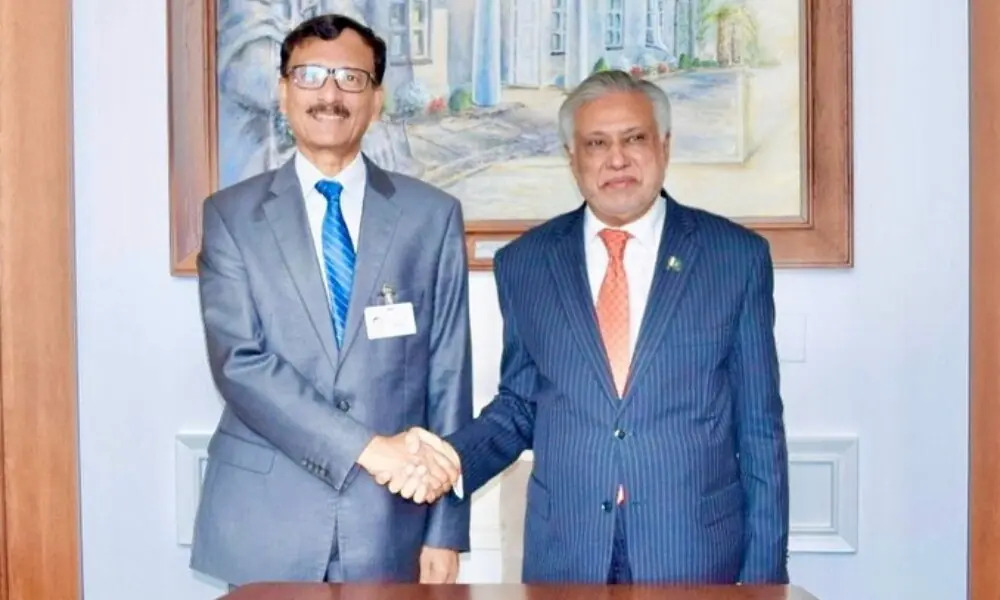
Bangladesh has hinted that a regional grouping with Pakistan, excluding India, could be “strategically possible” in the future. Foreign Affairs Adviser Mohammad Touhid Hossain made the statement while addressing a media query at the foreign ministry.
He clarified, however, that this option may not be feasible for other countries like Nepal or Bhutan, due to their geopolitical positions and relations with India.
This development comes after Pakistan’s Deputy Prime Minister and Foreign Minister Ishaq Dar mentioned the initiation of a new trilateral partnership involving Bangladesh, China, and Pakistan. Dar’s comments, made at the ‘Islamabad Conclave’, suggested that this grouping could eventually expand to include other countries within and outside the region.
Read more: High-level military talks boost Pakistan–Bangladesh defence outreach
Touhid acknowledged Dar’s statement but did not elaborate further, suggesting that there may be potential for progress, though it remains uncertain.
The conversation follows a visit by Foreign Minister Dar to Bangladesh in August 2025, which marked a shift toward a more pragmatic diplomatic approach. During the visit, both sides discussed enhancing trade, educational exchanges, and cultural ties.
Most notably, they addressed the revitalization of regional cooperation through the South Asian Association for Regional Cooperation (SAARC), which has been dormant since 2016 due to India’s refusal to participate.
Both Bangladesh and Pakistan have shown a growing interest in reinvigorating regional cooperation, but India’s ongoing hostility towards Pakistan has hindered progress in SAARC. Since the cancellation of the 2016 SAARC summit in Islamabad, the organization has struggled to function effectively.
Countries like Bangladesh, Sri Lanka, and Nepal have been trying to push for regional cooperation, independent of Indo-Pakistani tensions.
Read more: Pakistan, Bangladesh resolve to revive ‘old connections’
Interestingly, China has expressed interest in supporting a “SAARC minus India” configuration, focusing on trade, connectivity, and climate resilience. This version of SAARC would aim to continue regional collaboration without being obstructed by bilateral disputes.
As Bangladesh considers this possibility, it appears that there may be growing momentum for alternative regional groupings that focus on practical cooperation and mutual development.