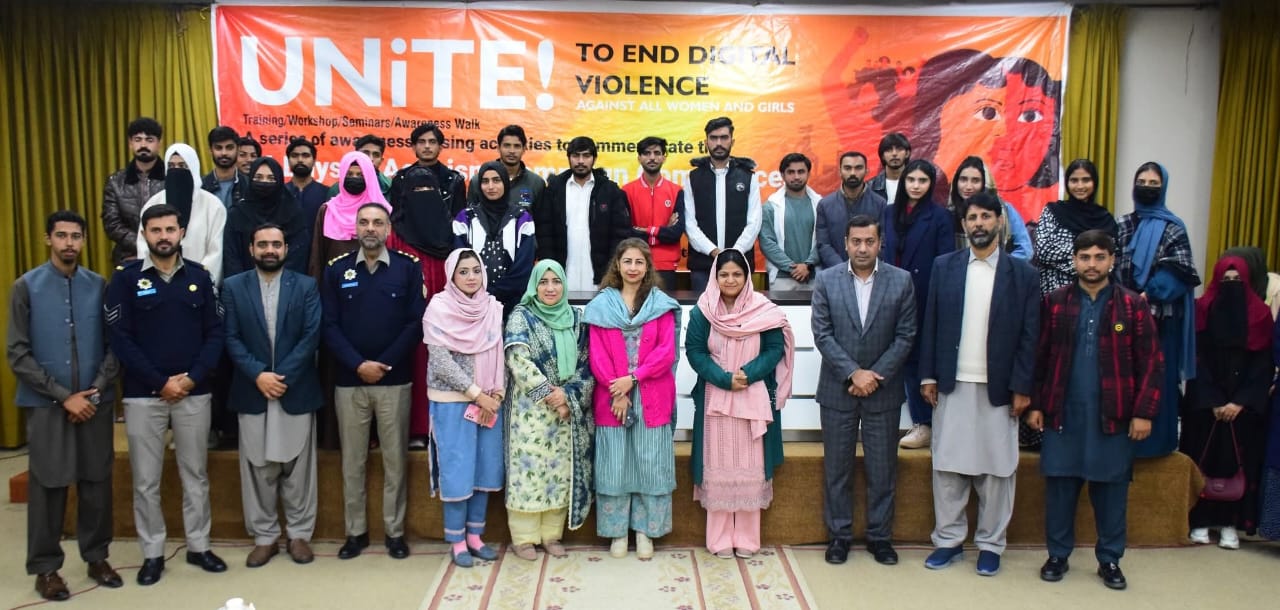
Participants pose for a group photo at the end of the seminar on Monday.
GUJRAT — There’s an urgent need for community engagement to curb digital exploitation at workplaces, speakers at a seminar at Hafiz Hayat Campus of the University of Gujrat have said.
The one-day seminar on “Community Engagement Against Digital Exploitation at the Workplace” was organised by the Hayatian Sociological Society (HSS) of the Department of Sociology. It was part of ongoing departmental efforts to raise awareness about digital exploitation and violence against women, particularly through social media, while exploring preventive solutions.
Distinguished speakers included Chairperson of Psychology Department Prof. Dr Bushra Akram, Inspector Motorway Police Dr Shamraiz Iqbal and Chairperson of Zoology Department Dr Razia Iqbal. The seminar was chaired by Dr Muhammad Shoaib, Chairperson of Sociology Department.
Prof. Dr Bushra Akram emphasized psychological and social training, especially for women, to counter digital crimes. She warned that digital blackmail often leads to depression and highlighted persistent gender disparities in upbringing and social roles. Urging caution in sharing personal data online, she stressed that trust and privacy are essential safeguards.
Dr Shamraiz Iqbal underscored the rising incidence of digital crimes, reminding participants that data privacy is a personal responsibility. He pointed to government initiatives such as the National Cyber Crime Investigation Agency, Women Protection and Punjab Safe City apps and helplines as vital resources against digital fraud.
Dr Razia Iqbal described digital violence as a pressing issue of the modern age, calling for strict adherence to laws and a shift in community mindset to reduce exploitation.
In his closing remarks, Dr Muhammad Shoaib termed digital violence a serious social concern, linking rising divorce rates to misuse of digital platforms and urging stronger intergenerational ties. Dr Zaheer Abbas, who conducted the proceedings, noted that digital fraud has already destroyed many households, making public awareness an urgent necessity.