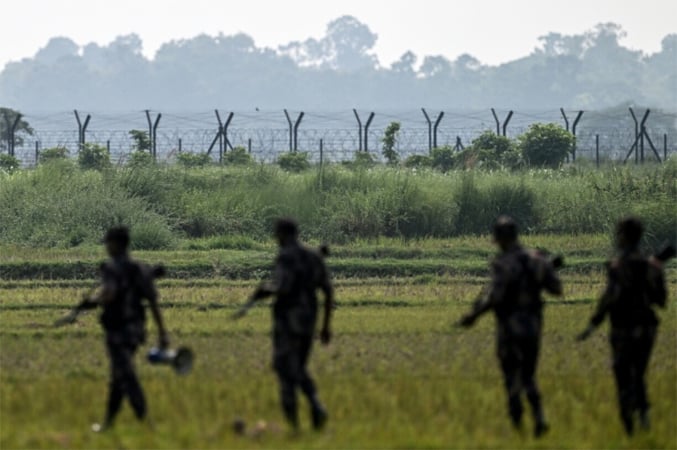
 Rice farmer Mohammad Ismail Hossain fears violence could blight his quiet fields in southwestern Bangladesh, on the front line of a growing Indian push to expel undocumented migrants.
The countries share a porous 4,096-kilometre (2,500-mile) border, with communities on either side often so interwoven that crossings — illegal or not — are common.
Under Prime Minister Narendra Modi, India has been stepping up deportations of illegal migrants to Bangladesh, a campaign that critics say unfairly targets Bengali-speaking Muslims.
Rights groups say those efforts have gathered more momentum since Modi’s Hindu-nationalist party won power in West Bengal state, which borders Bangladesh, for the first time last month.
“(India) says that those found to be Bangladeshi would be sent back after verifying their documents,” Hossain, 66, told AFP at a tea stall in the border region of Khulna-Jessore.
“But no one seems to be verifying anything. They are pushing people in, left, right and centre,” he said.
Authorities say many people in the border region lack proper documents to prove their citizenship, mainly due to poverty, a lack of awareness and a long history of informal movement.
“If the situation escalates, there could be a bigger conflict, with shots being fired… India, being the larger country, can forcefully do anything,” said a worried Hossain.
The borderland communities long predate the 1947 partition of British India, which delineated the frontier of the nation now called Bangladesh.
Along some stretches, it is often difficult to distinguish one country from the other.