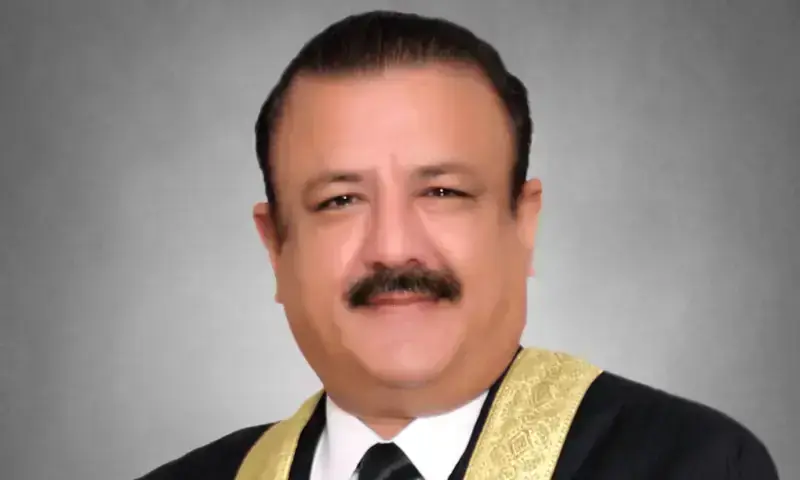
ISLAMABAD: The Islamabad High Court (IHC) on Tuesday declared maintainable a petition seeking verification of Justice Tariq Mehmood Jahangiri’s law degree and directed the judge, along with other respondents, to submit their replies within three days.
Read More: Supreme Court Restores Justice Tariq Mehmood Jahangiri
The hearing was conducted by a division bench comprising IHC Chief Justice Sardar Muhammad Sarfraz Dogar and Justice Muhammad Azam Khan. The petition was filed by Advocate Mian Dawood amid controversy over the judge’s LLB degree, which had been cancelled by the University of Karachi.
University of Karachi told Islamabad High Court that syndicate meeting on Aug 31, 2024 unanimously resolved that LLB degree of Justice Tariq Jahangiri be cancelled. University however didn’t reveal that its decision has already been suspended by Sindh High Court & matter is still… pic.twitter.com/14Eiyiw3V6
— Hasnaat Malik (@HasnaatMalik) December 9, 2025
However, the HEC claimed, it had never verified Justice Jahangiri’s law degree at any stage, nor had the judge ever approached the commission for verification. https://t.co/AkreacFY5x
— Asad Ali Toor (@AsadAToor) December 9, 2025
Justice Tariq Jehangiri profile:
1. Advocate General, Islamabad.
2. Deputy Prosecutor General of NAB
3. Judge, Islamabad High Court.
During all these appointments,
his degrees were duly verified. Now CJ Dogar of IHC has stopped him from judicial work on the basis of propaganda… pic.twitter.com/1zeHfut4VC— Taimur Ali Khan Mohmand (@TAKM__) September 16, 2025
The university’s notification, dated September 25, stated that Justice Jahangiri had been found guilty of using unfair means and barred for three years from admission to any university or college, as well as from appearing in examinations.
The University of Karachi also clarified that he had never been enrolled at Islamia Law College, Karachi, in 1989. Previously, the IHC had restrained Justice Jahangiri from performing judicial duties pending the Supreme Judicial Council’s decision, but the Supreme Court later allowed him to continue working.
During Tuesday’s proceedings, the IHC sought relevant records from the Higher Education Commission (HEC) regarding the authenticity of the judge’s law degree. Mian Dawood argued that under Article 193 of the Constitution, a high court judge must be a qualified advocate, and the court must clarify whether Justice Jahangiri’s degree is genuine.
He maintained that allegations arising after a judge takes oath fall under the Supreme Judicial Council’s remit, citing precedent from the Justice Mazahir Ali Akbar Naqvi case.
The Islamabad Bar, representing around 8,000 lawyers, opposed declaring the petition maintainable, arguing that the matter fell under the jurisdiction of the Bar Council and Supreme Judicial Council, not the high court.
Read More: Justice Jahangiri’s degree case adjourned
The Bar contended that questions regarding the judge’s advocacy experience or degree should be addressed through the Bar Council. Despite this opposition, the court declared the petition admissible and directed all parties to submit their responses within three days, moving the case forward for further scrutiny.