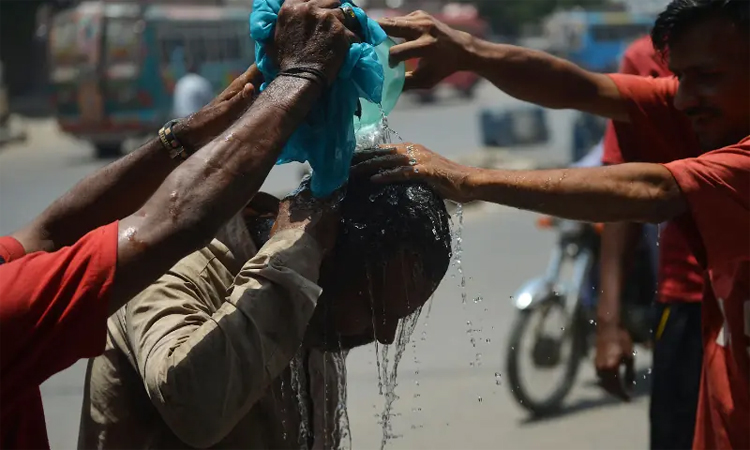
 Karachi is among the nine densely built megacities in Asia and the Pacific which are particularly vulnerable to heat and are projected to become substantially hotter in the years ahead, a report released by the UN Economic and Social Commission for Asia and the Pacific (UN-ESCAP) on Wednesday said.
The report, titled Asia-Pacific Disaster Report 2025: Rising Heat, Rising Risk, stated that urban areas are already at high risk for extreme heat due to the urban heat island (UHI) effect. Densely built surfaces trap heat and raise city temperatures above those of surrounding rural areas.
It added that this challenge is being exacerbated by rapid and often unplanned urbanisation and insufficient green spaces, further warning that UHI would raise temperatures by 2 to 7°C, on top of global warming.
As access to cooling, water and healthcare comes under increased strain, children, the elderly and outdoor workers in densely populated urban areas are disproportionately affected. Higher-income areas usually lie in cooler, greener neighbourhoods, exacerbating issues of equity and environmental justice, the report says.
Cities including Seoul, Tokyo, Beijing, Delhi, Karachi, Dhaka, Manila, Jakarta and Phnom Penh were identified as high-risk locations.
It added that during the period 2041-2060, countries projected to be the most arid include Mongolia, Pakistan, Uzbekistan, Iran and Turkmenistan, as higher temperatures evaporate more surface water, drying out soils and vegetation and causing droughts and water shortages.
“Asia and the Pacific were impacted by various natural hazards and climate-induced extreme events in 2024 and 2025, and the fastest-growing climate-related hazards are driven by extreme heat,” the report reads.
The report shows that rising temperatures are “impacting all, everywhere”, with expanding and intensifying risks to food systems, public health, urban living, rural livelihoods, infrastructure and the ecosystem.
It warns that across the Asia-Pacific region, the increasing frequency and intensity of extreme heat events are now creating a silent but growing health emergency.
“Under all future climate scenarios, heat stress is projected to rise sharply across Asia and the Pacific, with mortality potentially doubling by 2050,” the report added.
The report said that the urban poor are highly exposed, especially in densely populated cities where extreme heat is amplified by the UHI effect.
On the other hand, it noted that the region has had considerable experience with managing cascading disasters, but stated that the rising threat of extreme heat demands a new level of urgency.
“Every country needs to act now, with the implementation of regional cooperation initiatives turbocharged to meet the scale of this evolving disaster risk landscape,” the report read.
According to the report, the melting of glaciers is one of the most disastrous consequences of global warming.
It “exacerbates changes in tele-connected systems of oceans and atmosphere across distant regions – disrupting monsoon patterns, snow and melt dynamics, and permafrost thaw, which all lead to the increased frequency, intensity and expansion of floods, landslides, droughts, land degradation and sand and dust storms”, the report read.
According to UN-ESCAP, glaciers around the world have lost about 5 per cent of their volume this century. Out of 58 countries in Asia and the Pacific, 17 contain glaciers which can melt into lakes that burst their banks, leading to sudden glacial lake outburst floods (Glof).
“The glaciers with the highest Glof risks are in High Mountain Asia, where a total of 9.3 million people are exposed to 2,211 glacial lakes,” the report stated. “By 2060, countries like Iran, Mongolia, Myanmar, Turkiye and Uzbekistan could lose over 70pc of their glacier mass … posing Glof risks.”
New projections in the 2025 report highlight the scale of the threat. By 2100, regional disaster losses could increase from $418 billion under the current scenario to $498 billion under a worst-case climate scenario.
Additionally, the frequency of days above critical heat thresholds is set to increase sharply, with south and southwest Asia, parts of southeast Asia and northern and eastern Australia trending toward chronic heat exposure.
The report called for strategic, long-term action grounded in science, innovation and regional cooperation, emphasising the need to place heat at the centre of multi-hazard planning, supported by heat-ready early warning systems that use interoperable alerting, agreed metrics and trusted last-mile communication.
With only 54 per cent of global meteorological services issuing warnings for extreme temperatures, expanding heat-health warning systems in just 57 countries could save approximately 100,000 lives each year, the report notes.
Over the past five decades, the Asia-Pacific region has been experiencing more frequent and more severe climate-related extreme events, which often overlap and intersect to create multi-hazard events, with widespread, cascading impacts.
Intensifying multi-hazard risks, including earthquakes, tsunamis, landslides, floods and cyclonic storms, threaten much of the region’s critical infrastructure.