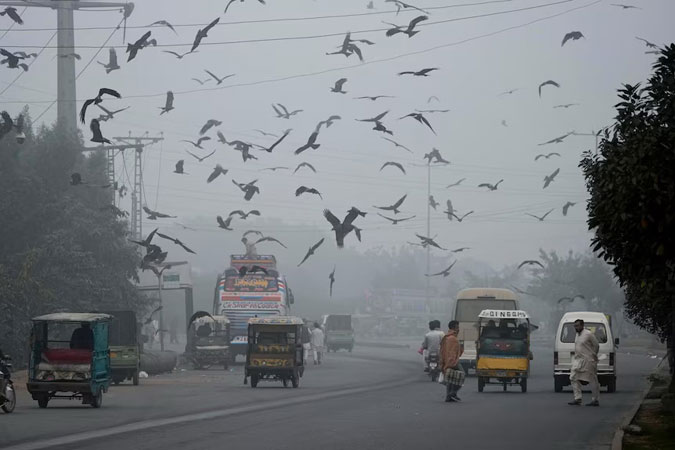
 As Punjab faces yet another season of toxic air, the haze hanging over the province has become more than just a visual blight – it is a silent killer. Hospitals in Lahore are receiving thousands suffering with smog-related ailments as air pollution levels in the city continue to surge. Doctors warn that the situation has escalated into a full-blown health emergency.
Lahore was ranked second among the world’s most polluted cities, with its concentration of fine particulate matter (PM2.5) averaging around 262 microgrammes per cubic metre – over 17 times higher than what the World Health Organisation considers safe.
According to global air quality monitoring agency IQAir, Lahore’s overall AQI was recorded at 318 on Wednesday, while certain localities reported readings between 647 and 855. However, since the provincial monitoring network cannot register readings above 500, experts suggest that the real concentration of pollutants may be significantly higher.
Amid the thick blanket of smog that continues to suffocate the city, respiratory infections, eye irritation, asthma attacks, and cases of chest congestion have gripped the public, who are flocking to the city’s hospitals for treatment.
At the province’s largest public healthcare facility, Lahore’s Mayo Hospital, doctors have been placed on high alert. “We are seeing dozens of new cases daily of asthma exacerbations and acute respiratory infections caused by the smog,” said Dr Fareed Ahmad, Senior Pulmonologist.
“People must adopt strict precautionary measures and avoid unnecessary outdoor exposure, especially during the early mornings and evenings,” he advised.
Dr Ahmad also urged the public to “use face masks, keep windows closed, and drink plenty of fluids,” as “prevention is crucial right now.”
Even though thousands are suffering, a rather sad observation was noted by Dr Saleem Us Zaman, Head of Pulmonology at a Lahore hospital, who stated that “children are being hit hardest by the toxic air.”
“We are seeing healthy children coming in with severe coughing, wheezing and even early signs of heart strain,” he said, adding that “smog is no longer just an environmental issue, it’s a medical crisis.”
Doctors warn that even healthy individuals remain at risk, as the air quality of Lahore worsens.
Dr Hajra Khan at the Indus Hospital in Lahore warns that smokers, or those with already compromised immune systems, remain at a higher risk of contracting respiratory diseases due to the smog. However, she notes that the general public, regardless of age or immunity, must mask up and limit outdoor exposure as “everyone remains at risk.”
Beyond the immediate health toll, economists estimate that the smog also brings hidden economic losses through reduced worker productivity, medical expenses that are racking up, and lost school days.
Experts blame multiple factors for the recurring smog crisis that grips Lahore – including unchecked vehicle emissions, industrial pollution, and the large-scale burning of crops in nearby rural districts.
The stagnant winter air and lack of wind prevent the pollutants from dispersing, trapping them close to the ground and forming a suffocating haze, explain experts.
In regards to Lahore’s PM2.5 levels, Environmental Researcher Prof Dr Mubawer Sabir said the levels “are not random spikes but are sustained, endangering every citizen.”
Despite repeated government claims of action, enforcement remains inconsistent.
The Punjab Environment Protection Department (PEPD), in its October 2025 report, noted a “marginal improvement” in overall conditions due to ongoing government and community-driven anti-smog initiatives. Further, officials claim that over 140 smoke-emitting vehicles have been fined, 52 cases of stubble burning registered, and several industrial units sealed, with 21,983 citizens signing pledges under the Plastic-Free Punjab initiative.
Further, the Punjab government has resorted to periodic school closures and has restricted outdoor activities in order to limit exposure, but doctors and environmental experts insist these are only temporary solutions.
The overall air quality shows little improvement, however, leaving official claims largely unfounded and citizens frustrated. “We need sustained policy enforcement, cleaner transportation, and strict regulation of emissions, otherwise, the situation will worsen each year,” warned Child Specialist Dr Ghulam Fareed.
Officials from PEPD point to their “Green Punjab” app for public complaints, but critics argue that such reactive measures fall short of addressing the root causes of the crisis, leaving cosmopolitan cities like Lahore at the mercy of worsening air but with no real measures to mitigate it.
The city’s average Air Quality Index (AQI) was recorded at 177, placing it in the “unhealthy” category.
Meanwhile, the MET Office forecast dry weather conditions for the next 24 hours. Data from IQAir indicated that the PM2.5 concentration in the provincial capital was 18.4 times higher than the World Health Organization’s annual guideline value.
Dry weather persisted in Lahore on Wednesday, and similar conditions are expected to continue on Thursday.
The MET officials said continental air was prevailing over most parts of the country. They forecast dry weather across most regions, with cold to very cold conditions during morning and night in hilly areas. Smog or shallow fog patches may develop over a few plain areas of Punjab during morning and night hours.