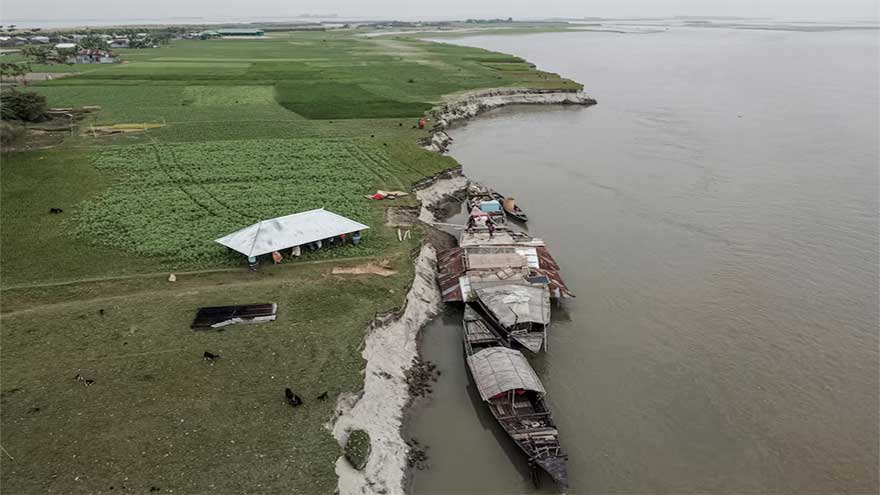
KURIGRAM – In northern Bangladesh, families like Nurun Nabi’s are facing relentless displacement as the Brahmaputra River swallows their homes and farmland. Nabi, a farmer and father of four, has had to move twice this year alone, losing rice and lentil fields to the advancing river. “The river is coming closer every day. We are born to suffer,” he said, describing the constant struggle.
Hundreds of families across the Kurigram district experience similar hardships annually. The chars—temporary islands formed by river sediment—offer only short-term refuge, with homes repeatedly destroyed by floods and erosion. Elderly residents like Habibur Rahman describe waking up to vanished riverbanks, a stark reminder of life’s uncertainty in these fragile landscapes.
Read More: Bangladesh lends land to islanders as water devours homes
Climate change has intensified the problem, experts say. Accelerated Himalayan glacier melt and erratic monsoon patterns have caused rivers such as the Brahmaputra and Teesta to swell unpredictably, leading to severe erosion and flooding. Despite contributing less than 0.5% of global emissions, Bangladesh suffers disproportionately from climate-induced disasters. The World Bank estimates that by 2050, one in seven Bangladeshis could be displaced by such events.
Local initiatives are helping communities adapt. On Kheyar Alga Char, 300 families have stayed put for three years thanks to geobags and raised villages that reinforce riverbanks and elevate homes above floodwaters. Johurul Islam, who lost his home more than ten times, said, “For the last three years, the river didn’t take our land. For the first time, I feel a little confident about the future.”
Read More: Nine dead, million seek shelter as cyclone hits Bangladesh
Still, for many residents, survival remains uncertain. Women bear the brunt of repeated moves, facing challenges of cooking, childcare, and safety amid floods. As global leaders convene at COP30 in Brazil, the plight of Bangladesh’s riverbank communities serves as a stark call for urgent climate action and international support for vulnerable nations.