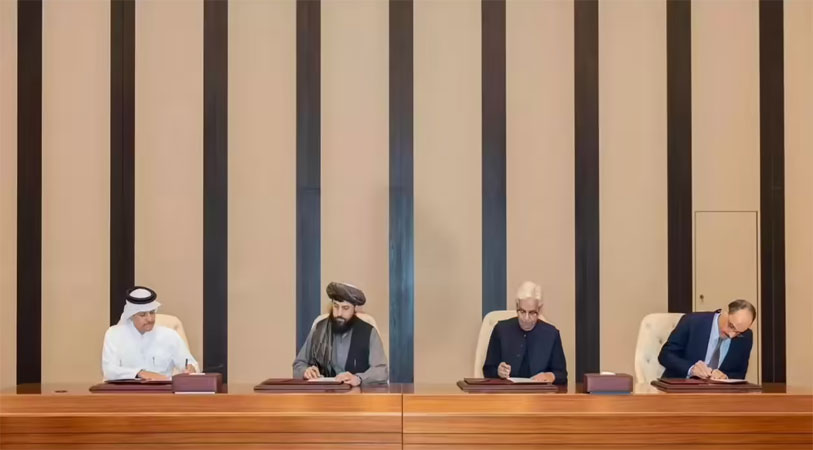
 Defence Minister Khawaja Asif said on Friday that the talks between Pakistan and Afghanistan are “over” and have “entered an indefinite phase” as negotiators failed to bridge deep differences between the two sides.
“Right now, as we speak, negotiations are over,” said the defence minister while speaking to the media.
Earlier, officials and sources said the talks stalled without any agreement. “The talks in Istanbul are deadlocked,” a senior security source said, confirming that discussions had hit an impasse.
The third round of Pakistan-Afghanistan talks began on Thursday in Istanbul and was planned to continue for two days.
The defence minister added that the Afghan Taliban delegation again came to Istanbul “without any programme” and that they were not willing to sign a written agreement. “They said that they would only respect the verbal agreement, but there is no room to do that.”
Asif elaborated that during the earlier rounds, the negotiators urged for another round. “Even after the talks in Istanbul failed, they committed that they would participate in the next round.”
“Our returning empty-handed reinforces a lack of faith in Afghanistan. The situation, God forbid if it flares up, if there are attacks on us from their soil, then we will respond depending on the velocity or gravity of the situation,” said the minister.
He clarified that the ceasefire stands for the time being, but warned that the “moment there is a ceasefire violation from their side, we will respond befittingly”.
“If they have put forward any unacceptable demands, then it is a means of escape, since they knew they would be unsuccessful, they can turn around and say that Pakistan denied our demands,” added the minister.
He reiterated that Pakistan has one main demand: the cessation of attacks from Afghan soil.
Separately, FO Spokesperson Tahir Hussain Andrabi told reporters that the Pakistani delegation had presented its case to the mediators in a comprehensive and evidence-based manner.
“The Pakistan delegation has handed over its evidence-based, justified, and logical demands to the mediators with a singular aim to put an end to cross-border terrorism,” Andrabi said. “The mediators fully endorsed Pakistan’s stance on the basis of evidence provided by our side, as well as the tenets of international law and principles.”
Minister for Information Attaullah Tarar thanked Turkiye and Qatar for mediating talks, but said the onus lies on Kabul to fulfil its long-standing international, regional, and bilateral pledges on controlling terrorism, in which it has so far failed.
In a post on X, the minister said Pakistan does not harbour any ill-will against the Afghan people but will never support any measures by the Afghan Taliban regime that could be detrimental to the interests of Afghanistan or neighbouring countries.
He added that Pakistan will continue to exercise all options necessary to safeguard the security of its people and protect its sovereignty.
The dialogue process was launched after border clashes in early October. The first round in Doha produced a fragile ceasefire, while the second, also in Doha, ended with only a general agreement to develop a mechanism for verifying compliance and a decision to continue talks.