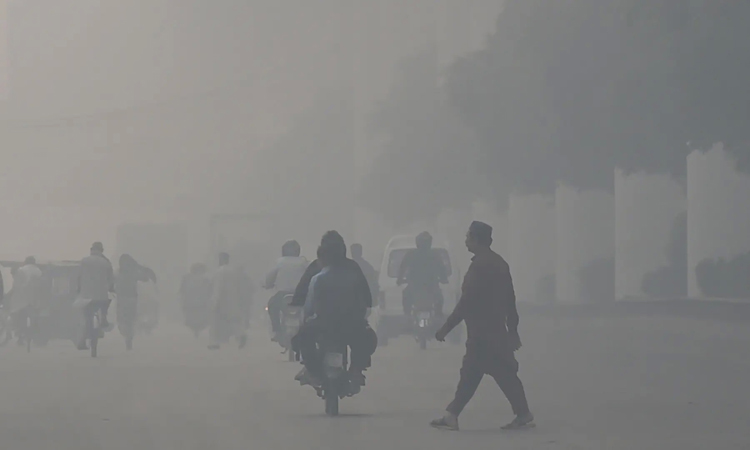
 Lahore continued to rank as the most polluted city in the world in terms of air quality, global monitor IQAir said on Wednesday.
A day ago, the city’s Air Quality Index (AQI) reached a severe peak of 422 but dropped to 341 today – still categorised as “hazardous” – keeping it at the top of the list of cities with the poorest air quality.
Behind the Punjab capital in the rankings were New Delhi with an AQI score of 232, Beijing at 222, Kinshasa and Kathmandu at 155 each, and Karachi at 140.
The Punjab government has taken notice of the situation and raised a high alert, including revising school timings across the province to begin at 8:35am.
In response to the crisis, the Lahore Waste Management Company (LWMC) has also launched a large-scale anti-smog operation, deploying 16 mechanical washers, 50 regular washers, and 400 workers for road washing and water sprinkling.
Meanwhile, Senior Provincial Minister Maryam Aurangzeb has said that, under the directions of Chief Minister Maryam Nawaz Sharif, comprehensive measures for environmental protection and smog control are being implemented across Punjab. Joint operations by the Environmental Protection Agency (EPA), Forest Department, and Police have been intensified in Faisalabad, Bhakkar, and other districts under a zero-tolerance policy.
In Faisalabad, the EPA launched decisive actions against violations of environmental laws. To curb smog, 19 individuals were arrested, multiple industrial units were sealed, and heavy fines were imposed. One factory that had been sealed earlier was illegally reopened by its owners during the night. The Environment Department and Police jointly demolished the factory and took all 19 persons into custody.
Maryam Aurangzeb said the Chief Minister has issued clear instructions that no leniency will be shown to those contributing to pollution. All industrial units have been directed to strictly comply with environmental SOPs, otherwise legal action will be unavoidable. The Environment Department has identified units using substandard fuels, and action against them is underway. Daily field inspections are being conducted to ensure effective smog mitigation.
The Senior Minister emphasized that cooperation from the industrial and commercial sectors is essential to control smog. All units have been instructed to operate in accordance with environmental regulations. According to the annual report by SUPARCO (Space & Upper Atmosphere Research Commission), this year Punjab recorded a 65% reduction in crop residue burning. Last year, the environmental violation score stood at 838, which has now dropped to 294 – a major improvement resulting from Chief Minister Maryam Nawaz Sharif’s vision and farmer-friendly policies.
The SUPARCO report highlights that the use of balers, super seeders, and Kubota machines has replaced traditional stubble burning practices, significantly reducing air pollution. Out of 6.4 million acres of agricultural land, 3.6 million acres have been cultivated, while around 400,000 acres were saved from burning.
Maryam Aurangzeb termed this progress as the result of the “Super Seeder Revolution”, calling it the most significant agricultural technology shift since the laser land leveler of the 1980s. She reaffirmed that the Punjab Government will not hesitate to take tough decisions for the sake of a sustainable future. “Arrests or demolitions alone are not enough; real change comes from enforcement and effective monitoring,” she said.
Under the Chief Minister’s direction, the Forest Department and Para Force carried out a joint operation in Bhakkar, reclaiming 64 kanals of valuable forest land from illegal occupants, worth billions of rupees. During the operation, over 100 mud houses, 25 shops, sheds, and kiosks were demolished. The government plans to launch a new tree plantation campaign on the recovered land to restore environmental balance. Maryam Aurangzeb said that a green Punjab is our vision, and encroachments on forest lands will not be tolerated. The operations by the Forest Department and Para Force are a practical demonstration of Punjab’s commitment to environmental protection.
According to the Smog Monitoring and Forecasting System of the Environment Department, polluted air masses from the industrial and agricultural regions of Indian Punjab, Haryana, and Delhi are entering the skies of Lahore, Kasur, and Faisalabad from the east. Between 12 AM and 6 AM, easterly and north-easterly winds (90°-120°) intensified pollution levels. Although mild improvement was observed in the afternoon due to a shift in wind direction, low evening wind speeds caused PM?.? and PM?? particles to remain trapped near the surface. Lahore’s average AQI ranged between 245 and 275, falling in the unhealthy category.
Maryam Aurangzeb said that SUPARCO’s report is proof of Chief Minister Maryam Nawaz Sharif’s hard work and vision for a cleaner environment. “If we continue in this direction,” she added, “Punjab will witness environmental improvement similar to Beijing’s transformation in the coming years. China and the UK overcame smog through the right strategies, and we will succeed too.”
The Punjab Government remains committed to protecting public health and clean air, with no exemptions for violators. Environmental teams across all districts are actively working to ensure that the positive results of smog control and environmental reforms directly benefit the people.