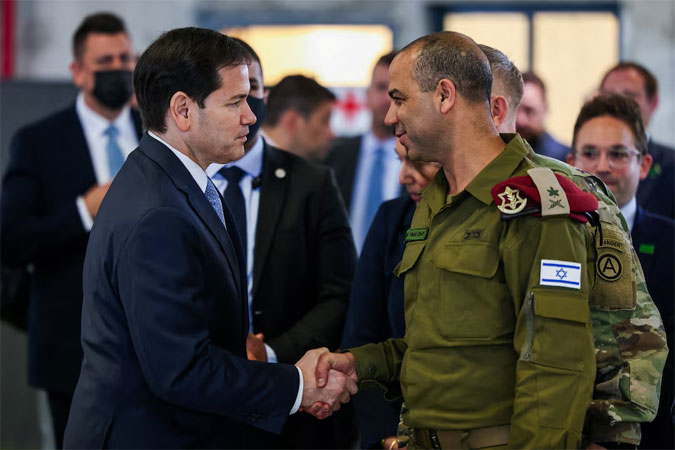
 An international security force to be put in place in Gaza under a ceasefire agreement will have to be made up of countries that Israel is “comfortable with”, U.S. Secretary of State Marco Rubio said on Friday during a visit to Israel.
Rubio added that the future of governance in Gaza still needs to be worked out among Israel and partner nations but could not include Hamas, adding that any potential role for the Palestinian Authority has yet to be determined.
The US State Department on Friday appointed a career foreign service officer and the current ambassador to Yemen, Steven Fagin, as the civilian lead for a new center working to implement a peace deal in Gaza and get humanitarian aid into the Palestinian enclave, the department said in a statement.
The announcement came after Secretary of State Marco Rubio visited the Civil-Military Coordination Center in southern Israel, and pledged that more U.S. diplomats would be joining the roughly 200 U.S. military personnel posted there.
“Ambassador Steven Fagin will serve as the civilian lead of the Civil-Military Coordination Center, which is supporting the implementation of the President’s 20 Point Peace Plan for Gaza,” the department said.
The center was opened this week by the U.S. Central Command, with Lieutenant General Patrick Frank, commander of U.S. Army Central, appointed as its military lead.
Fagin has served as U.S. ambassador to Yemen since 2022, although he has performed the role from outside the country, which is controlled by the Houthi government not recognized by Washington.
Erdogan urges US, other press Israel to stop violating Gaza truce
Turkish President Tayyip Erdogan said the United States and others must do more to push Israel to stop violating the Gaza ceasefire agreement, including the possible use of sanctions or halting arms sales.
NATO member Turkey, one of the most vocal critics of Israel’s attacks on Gaza, has joined the ceasefire negotiations as a mediator after largely indirect involvement. Its increased role followed a meeting last month between Erdogan and U.S. President Donald Trump at the White House.
“As Turkey, we are doing our utmost for the ceasefire to be secured. The Hamas side is abiding by the ceasefire. In fact, it is openly stating its commitment to this. Israel, meanwhile, is continuing to violate the ceasefire,” Erdogan told reporters on his return flight from a regional Gulf tour.
“The international community, namely the United States, must do more to ensure Israel’s full compliance to the ceasefire and agreement,” he said, according to a transcript of his comments shared by his office on Friday.
“Israel must be forced to keep its promises via sanctions, halting of arms sales.”
Ankara has said that it would join a “task force” to oversee the implementation of the ceasefire, that its armed forces could serve in a military or civilian capacity as needed, and that it would play an active role in the reconstruction of the enclave.
Israeli Prime Minister Benjamin Netanyahu hinted on Wednesday that he would be opposed to any role for Turkish security forces in the Gaza Strip.
U.S. Secretary of State Marco Rubio, on a visit to Israel aimed at shoring up the ceasefire, said on Friday that a planned international security force for Gaza would have to be made up of “countries that Israel’s comfortable with,” but declined to comment specifically on Turkey’s involvement.
Asked about Netanyahu’s comments, Erdogan refrained from his usual criticism of the Israeli leader and appeared to soften his earlier commitment to taking a role on the field in Gaza, saying talks on the issue were still underway.
“Talks are continuing on the task force that will work in Gaza. The modalities of this are not yet clear. As this is a multi-faceted issue, there are comprehensive negotiations. We are ready to provide Gaza any form of support on this issue,” he said.
He also reiterated a previous call for Gulf countries to take action now on financing efforts to rebuild Gaza, saying nobody could single-handedly complete this task.