A few women of substance could make their way to power and authority in Indian History. Nawab Sikandar Begum (1818-1868) of Bhopal state is one such great reference who carved out an important niche for herself on account of her administrative genius, valour, pragmatism and a great reformative character. She also becomes the first female Muslim ruler to pen down a book on her observations and experiences of Hajj. She was bestowed knighthood by Queen Victoria, making her the first-ever female knight in India and second in the British Empire after Queen Victoria.
Her ascent to the throne seems predestined in a state founded by her great-grandfather, Dost Muhammad of Orakzai. While she was just a toddler, her Father died in an accidental gun fire in 1819, paving the way for 107 years of female rule in the state of Bhopal. Her Mother, Qudsia Begum, a widow of 19 years, ably struggled through the succession issues and palace intrigues to secure a safe rule for her illustrious daughter, Sikandar Begum.
In 1837, after ruling for 18 years, Qudsia Begum handed over the reins of power to her 27-year-old daughter and son-in-law, Nawab Jahangir Khan, who later passed away after a few years of their marriage.
This travelogue is devoid of emotive and spiritual colours, unlike those hajj travelogues written abundantly by the latter writers.
Nawab Sikandar Begum proved to be very mature and shrewd in running the affairs of state at a time when Indian history was undergoing a great transition. The independence war of 1857 had created ripples of anxiety in the Indian society. She had to decide whether to go her way with the Britishers or to stand with the rebels. While her own Mother was seen extending financial help to the freedom fighters, she chose to stay loyal to the British rule. In a daring reply to a threat letter sent by the famous lady warrior Rani of Jhansi, she said, “My canons are waiting for you: if you can dare come I will see you.” Keeping Bhopal calm while Delhi burnt with turbulence was no ordinary feat. Nawab Sikandar Begum was able to ensure peace and order on account of her great administrative measures taken well in time.
Amongst the 550 princely states under British rule, the State of Bhopal stood out on account of the great administrative measures taken for the public welfare. During the reign of Nawab Sikandar Begum, Persian was replaced with Urdu as the court’s language in 1862. She introduced bureaucracy with a Secretariat and a customs office. She established the Police and intelligence department for the first time in Bhopal, which worked tremendously well to keep a check on anarchy in the turbulences of 1857. She developed a proper revenue department and divided the state of Bhopal into 21 administrative districts. A proper postal service department functioned well in those days, and road infrastructure was developed along with certain architectural wonders constructed. She focused heavily on women’s education and founded Victoria School for girls in Bhopal. These were unusual accomplishments in mid-nineteenth-century India by a female Muslim ruler who wore no veils and worked diligently to improve the lot of her people.
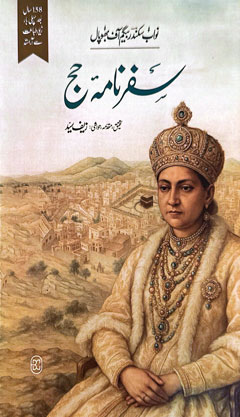
The positive liaison of Nawab Sikandar Begum with the British rulers enabled her enough space to get the Jamia Masjid of Delhi unlocked for the Muslim worshipers to freely offer their prayers after the 1857 turmoil. In 1863, she decided to perform Hajj with her family members and other companions. The entire journey from beginning to return took a complete 6 months despite having the comfort of travelling through train and Ship. The lady ruler of the princely state had the goodwill of her British Masters at many challenging turns in her journey, yet it was not smooth sailing at all.
The travel from Makkah to Madina was not safe, and she had serious reasons to return home after performing Hajj without going to Madina. Upon her return, she wrote in 1867 at the request of her former political agent of Bhopal, Henry Durand, a detailed account of her Hajj travel. This can also be taken as one of the first Hajj Travelogues in Urdu. The same couldn’t be published earlier and remained unexplored in the library of the Centre for Asian Studies, University of London. Prominent literary scholar and writer Zaif Syed undertook to publish this historic writing in collaboration with publisher Book Corner after 158 years.
Though Nawab Sikandar Begum of Bhopal was not the first ever female pilgrim from India, she was the first to write her account of the Hajj journey. The hajj travelogue written by her narrates rare information about the Arab society, politics, administration and hardships of the pilgrims in those times. Her presentation of details is quite different from the one written 10 years earlier by Richard Burton under some ‘specific objectives’. She wrote about the state of affairs as they were. This travelogue is devoid of emotive and spiritual colours, unlike those hajj travelogues written abundantly by the latter writers.
The observations recorded come from the mind of a female ruler who was quite dissatisfied to see the state of affairs in Hijaz of those times. She is critical of the poor cleanliness and talks about the slave trade, lack of educational pursuits in locals and street fights on petty issues. She draws a dismal sketch of Jeddah upon her arrival and is very blunt in her remarks. It is a significant account to get a rare insight into the lives and practices of those times. Performing hajj was not as easy an act as it is now for the pilgrims. Nawab Sikandar was confident to undertake many improvements if ever given an opportunity to rule Hijaz. Her personality and passion are a great study that the book under review offers to the readers. The Iron Lady of Bhopal left indelible impressions and high standards of excellence to be followed by the future women of South Asia.
The writer is a Senior Superintendent of Police currently serving in Punjab. He can be reached at [email protected]