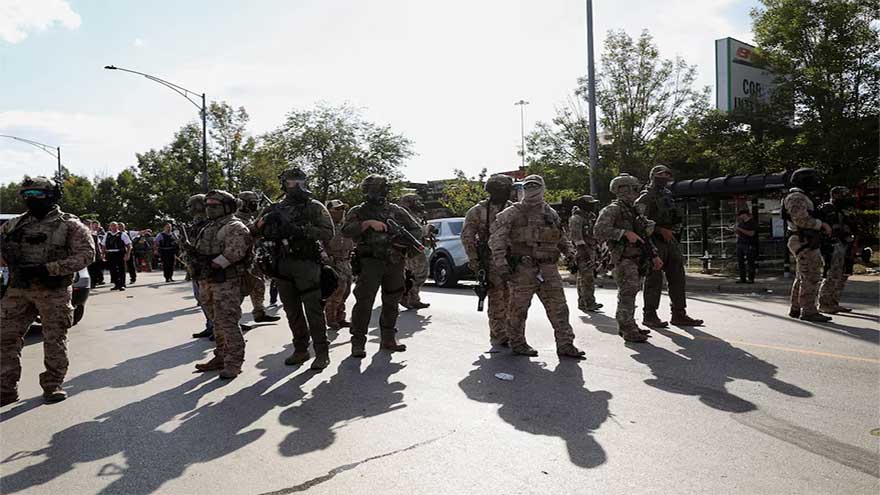
CHICAGO/WASHINGTON – President Donald Trump ordered the deployment of 500 National Guard troops to the Chicago area on Wednesday, defying objections from both Mayor Brandon Johnson and Illinois Governor JB Pritzker, who condemned the move as an unnecessary militarization of their city.
The deployment — which includes 200 troops from Texas and 300 from Illinois — was justified by the administration as a measure to protect federal personnel and property, including Immigration and Customs Enforcement (ICE) agents.
Trump’s decision marks another flashpoint in his escalating confrontation with Democratic-led cities resisting his immigration enforcement policies.
Read More: Trump Deploys Troops to Chicago Amid Rising Crime
In an extraordinary move, Trump called for the jailing of both Mayor Johnson and Governor Pritzker, neither of whom has been accused of any criminal wrongdoing. “Chicago Mayor should be in jail for failing to protect ICE officers! Governor Pritzker also!” Trump wrote on social media.
Both officials have been vocal critics of Trump’s immigration crackdown. Johnson recently signed an executive order declaring Chicago an “ICE-Free Zone,” barring federal agents from using city property for immigration operations. “This is not the first time Trump has tried to have a Black man unjustly arrested. I’m not going anywhere,” Johnson responded online.
Pritzker, seen as a potential 2028 Democratic presidential contender, accused Trump of pursuing an authoritarian agenda: “Trump is now calling for the arrest of elected representatives checking his power. What else is left on the path to full-blown authoritarianism?”
Read More: Texas National Guard Arrives in Illinois Amid Legal Clash
By Wednesday evening, hundreds of protesters had gathered in downtown Chicago, chanting slogans such as “Todos somos Silverio” (“We are all Silverio”) in memory of Silverio Villegas Gonzalez, an immigrant fatally shot by ICE agents in September.
While the Trump administration described the situation in Chicago as a “war zone,” local demonstrations remained largely peaceful, and city streets continued to bustle with normal commuter traffic — punctuated only by the drone of helicopters overhead.
In Latino and Black neighborhoods, residents voiced anger at the presence of immigration agents and condemned what they called “federal intimidation tactics.”
Read More: Trump Calls for Jailing Democrats as Troops Mobilize
At the White House, Homeland Security Secretary Kristi Noem defended the deployments, saying federal officers had been under “regular threat” in several cities. “Any elected official that allows this to happen should absolutely be prosecuted, in my opinion,” Noem said when asked about Trump’s call for arrests.
However, multiple legal challenges are underway. Federal courts have already limited Trump’s authority to deploy troops without state consent. On Thursday, an Illinois federal judge will review a motion to block the Chicago deployment, while a California appeals court will weigh a similar case over the deployment to Portland, which was halted over the weekend.
Separately, another federal judge ruled that ICE violated a 2022 agreement restricting warrantless arrests across several Midwestern states — a decision that could rein in the agency’s expanded powers under Trump’s renewed immigration campaign.
Read More: Trump Threatens to Invoke Insurrection Act Amid Uproar
A Reuters/Ipsos poll released Wednesday found that most Americans oppose the deployment of troops within U.S. cities without an external threat, reflecting growing unease over Trump’s use of federal power.
Meanwhile, the administration has signaled that more deployments could follow, with Trump recently suggesting that urban troop operations could serve as “training grounds” for the military.
As the situation unfolds, Chicago remains at the center of a national debate over civil liberties, states’ rights, and the limits of presidential power.