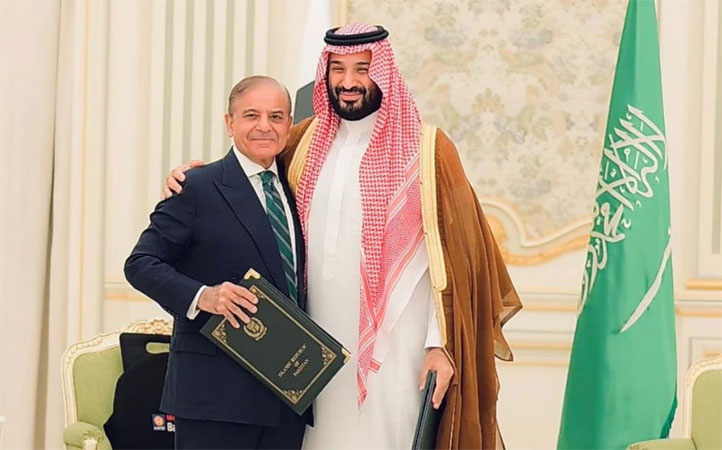
 The digital era is reshaping the very meaning of strategic partnerships, with states moving beyond traditional trade and defence pacts toward broader frameworks that encompass technology, innovation, and security. Yet, in the volatile politics of the Middle East, defence remains the defining pillar of power. Against this backdrop, Pakistan and Saudi Arabia have unveiled a landmark defence and security agreement that could alter the strategic balance of the region.
The deal, signed during Prime Minister Shehbaz Sharif’s recent visit to Riyadh, is widely regarded as the most significant transformation of Pakistan-Saudi defence ties in decades. While both nations describe the pact as a natural evolution of a long-standing relationship, its timing and language point to wider geopolitical undercurrents. The agreement enshrines a principle of collective security: any aggression against one country will be treated as aggression against both – placing it among the strongest commitments either state has made to another in recent years.
Foreign Office officials stress that the accord is not a reaction to a single event but the ‘institutionalisation of longstanding and deep-rooted cooperation’. Still, the timing cannot be divorced from context. It follows Israel’s strike on Qatar and comes at a time when Gulf states are recalibrating alliances amid declining confidence in US security guarantees. In this shifting landscape, Pakistan’s renewed role as a strategic partner to Riyadh is being interpreted as both a deterrent against external threats and a signal of growing autonomy within the Muslim world.
Pakistan and Saudi Arabia share more than defence ties. Their relationship has long been anchored in a blend of military cooperation, economic interdependence, and Islamic identity. Riyadh has often provided crucial financial support to Islamabad, while Pakistan has consistently supplied training and personnel to Saudi defence forces. By formalising these ties under a new strategic umbrella, the agreement transforms a historically pragmatic relationship into a structured security pact.
Former ambassador Maleeha Lodhi termed the development “a significant milestone” with “far-reaching implications” for both nations. “Pakistan and Saudi Arabia have been engaged in defence cooperation for a long time, and their diplomatic relations have always remained strong,” she said. “However, with this agreement, the relationship has shifted to a qualitatively different place altogether.”
The pact has also drawn enthusiastic political support. MNA Sehar Kamran (TI) called it a “historic Strategic Mutual Defence Agreement” that reaffirms the “deep-rooted ties of faith, friendship, and fraternity” between the two nations. While talking to APP, she noted, “For nearly eight decades, Pakistan and Saudi Arabia have stood shoulder-to-shoulder in times of need. Today, this pact elevates our strategic partnership to a new height by ensuring that the security of one is the security of both.”
Sehar Kamran highlighted that the pact comes at a critical time for the Muslim world. “At a time when the global and regional security environment faces unprecedented challenges, this agreement provides not only a shield of deterrence but also a clear message that Pakistan and Saudi Arabia remain committed to safeguarding peace, stability, and sovereignty,” she said. She praised Saudi leadership, describing the Kingdom as “a prominent voice of the Muslim world, leading the Ummah toward prosperity under King Salman and Crown Prince Mohammed bin Salman.”
For analysts, the pact also sends signals well beyond the Muslim world. Former federal minister and Chairman of the Pak-China Institute Mushahid Hussain Syed called it a “surprise for India” and a blow to the “Indo-Israeli nexus”. He argued that Arab trust in Washington’s guarantees has eroded, making Pakistan a more attractive and credible partner. Hussain noted that the first defence pact between Islamabad and Riyadh was signed in 1982, and this new framework builds on that legacy. He described it as “a plus for Muslim Ummah solidarity and pivotal for peace, security, and stability in our region”.
The significance of this agreement lies not only in its immediate security provisions but also in its broader geopolitical symbolism. As Gulf states diversify their alliances – balancing relations with Washington, Beijing, and Moscow – the Pakistan-Saudi accord signals a shift toward more regionalised security architectures. It may serve as a template for future partnerships built on identity, strategic convergence, and shared deterrence, rather than dependence on outside powers.
Whether the pact leads to deeper operational cooperation – joint exercises, arms development, or integrated command structures – remains to be seen. But what is clear is that Pakistan and Saudi Arabia have reinforced their status as steadfast partners at a time of unprecedented regional flux.
Their agreement is both a shield for themselves and a message to allies and adversaries alike: that in a turbulent Middle East, security is increasingly being defined and defended by the region’s own powers.