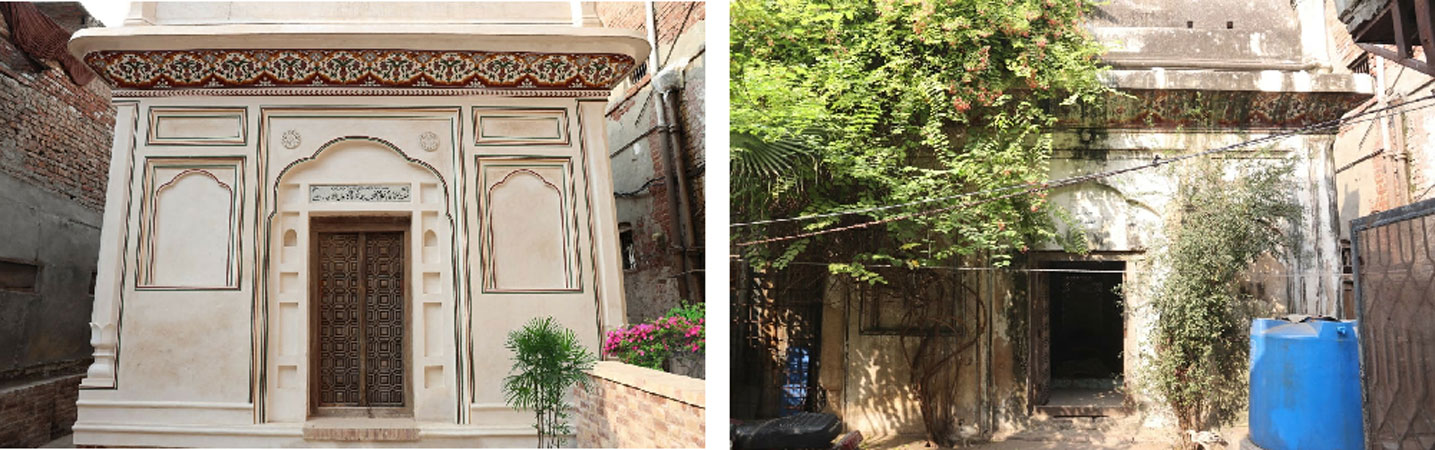
 A joint effort by WCLA and the Aga Khan Cultural Service has transformed a derelict monument into a vibrant cultural landmark.
Walking through the giant arches of Delhi Gate Lahore and stepping on to the Royal Trail one comes across several colorful shops and ancient havelis, which take one into the past, rather the Mughal Era. Most of you must have traveled this trail many a times for tours, shopping or other purposes, but today I will take you to another track, rather an unexplored track of the Royal Trail.
As you cross Chitta Gate, you come across the jewel of Lahore, Masjid Wazir Khan. Stop right there, next to the Shrine of Hazrat Said Soaf and take a left, go a little straight and crossing the blue houses take another left into a small narrow alley. In front of you will be beautiful vista a Koocha by the name of Koocha Hussain Shah, and now move a little ahead and you will be exactly behind the Wazir Khan Masjid.
Tucked away behind the majestic Wazir Khan Mosque you will see one of Old Lahore’s most overlooked treasures – the Tomb of Imam Gammo. For decades, this once-revered site had faded from public memory, crumbling quietly amidst the labyrinthine lanes of the Walled City. Today, because of an ambitious conservation effort by the Walled City of Lahore Authority and Aga Khan Cultural Service, it has re-emerged as a gleaming testament to Lahore’s layered spiritual and cultural heritage.
The Legacy of Imam Gammo
Imam Gammo was far more than a revered cleric. A Hafiz of the Holy Quran, he was also an accomplished scholar of the sciences and arts of his time. In 1779 AD, he was appointed as the Imam of the Wazir Khan Mosque – a role that won him immense respect, even from Maharaja Ranjit Singh, the Sikh ruler of Punjab.
Saving Wazir Khan Masjid from re-use during the Sikh era, is a credit that goes to Imam Gammo. At a time when many mosques were being repurposed under Sikh rule – the Badshahi Mosque, Moti Masjid, and the Begum Shahi Mosque were used as stables, treasuries and ammunition depots – Wazir Khan Mosque was spared such a fate. This was largely due to Imam Gammo’s influence and the esteem he commanded.
Known for his compassion, piety and generosity, Imam Gammo gave away much of his income to support scholars and dervishes. His sermons stirred hearts, and his unwavering commitment to community welfare earned him a lasting place in Lahore’s history.
A Forgotten Legacy in Ruins
Over the years, as the Walled City suffered neglect and decay, the Tomb of Imam Gammo too fell into ruin. Hidden deep in the narrow alleys behind Wazir Khan Mosque, the site slowly slipped from public consciousness. Moreover, with the passage of time, the people had forgotten where the tomb was and even to the extent that it existed or not. To my surprise, it was a wonder for the tourists and many others who visited the walled city.
The once-grand structure was in a pitiful state. Its walls were cracked, the ceiling on the verge of collapse, and its delicate frescoes faded almost beyond recognition. Wild vegetation had engulfed its courtyard, while heaps of debris lay scattered about.
This sacred site, which had once echoed with reverence and learning, had become a silent, forsaken relic of the past.
A New Beginning
Recognizing its historical and cultural importance, the Walled City of Lahore Authority (WCLA), in partnership with the Aga Khan Cultural Service Pakistan (AKCSP), launched a comprehensive project to restore the tomb alongside the Wazir Khan Mosque.
The initiative was supported by the US Ambassador’s Fund for Cultural Preservation and the Government of Punjab, marking a rare moment of collaborative heritage conservation in the city.
The Restoration Journey
Under the stewardship of the Walled City of Lahore Authority (WCLA) and the Aga Khan Cultural Service Pakistan (AKCSP), the Tomb of Imam Gammo underwent a meticulous and multi-layered conservation process. Guided by archaeological research and rooted in traditional craftsmanship, the project sought to preserve both the physical structure and its historic character.
Archaeologists first carried out careful excavations to uncover the original flooring within the tomb and its courtyard, revealing the layout as it once stood. The delicate Mughal-era frescoes that had long faded were painstakingly revived, while traditional lime plaster was reapplied to both the interior and exterior surfaces to restore the building’s original texture.
Structural stability was ensured by consolidating the central dome, and the crumbling parapet and exterior fresco panels were skillfully repaired. Alongside these heritage techniques, discreet modern upgrades were also introduced, including safer electrical systems and improved rainwater drainage to protect the monument from future damage.
A Jewel Reclaimed
Today, the Tomb of Imam Gammo stands restored to its former dignity, now part of the heritage trail that draws thousands of visitors to Wazir Khan Mosque.
The project has not only rescued a forgotten monument from the brink of ruin but also rekindled public interest in the overlooked layers of Lahore’s history. What was once hidden and neglected now thrives as a vibrant cultural landmark – a serene reminder of the city’s enduring spirit.
The Walled City of Lahore Authority is now taking guided tours to this site, and even if you wish to go alone, you can get all the information from the people of the area and the staff office in Chowk Wazir Khan. Trust me, it’s a must visit site!